AC repair in Escondido is priced after a diagnostic, and the cost depends on which part failed and how the system is built. The matched company runs Escondido every day and carries the parts that fail most often. The majority of Escondido calls are fixed in one visit.
Escondido sits in a valley in inland North County, and it gets hot. Summer peaks reliably run 87 to 89 degrees through July and August, with low humidity and very little marine layer to take the edge off after dark. The 92027 east-side neighborhoods routinely log five to seven more degrees than the 92024 coastal stretch on the same afternoon. That heat works air conditioners harder than almost anywhere in the county, which is why homeowners call for failures every July and August when a weak system finally meets a week it cannot handle.
Climate Pros SD matches homeowners with licensed HVAC companies across the city, and matched companies that cover the city know the neighborhoods. That includes the historic homes in Old Escondido, the rural hillside lots in Hidden Meadows, the established streets around Felicita and Kit Carson Park, the larger properties in San Pasqual Valley, the older mid-century housing stock along North Broadway, the newer hillside builds in Eureka Springs, and the tract neighborhoods toward East Valley and Westfield. The matched company quotes that address. This brand does not set a county-wide price. Coverage includes Escondido, including hillside or rural addresses.
AC repair cost in Escondido
The matched company quotes after a diagnostic, so you approve the number before work starts. These are the cost factors that drive the price for Escondido homeowners in 2026. The exact figure depends on the part, the brand, and how the system is built.
| Repair | Typical range | Notes |
| Diagnostic visit | Quoted by the matched company | Ask whether it applies toward the repair |
| Run capacitor replacement | Priced after diagnostic | A common single-visit fix in Escondido |
| Contactor replacement | Priced after diagnostic | Often paired with a capacitor on older units |
| Refrigerant recharge (R-410A) | Priced after diagnostic | Price depends on how much charge the system lost |
| Refrigerant leak repair | Priced after diagnostic | Varies widely by leak location and access |
| Condenser fan motor | Priced after diagnostic | Common on older systems |
| Indoor blower motor | Priced after diagnostic | ECM motors cost more than older PSC motors |
| Control board | Priced after diagnostic | Brand-dependent, some boards are hard to source |
| Hard-start kit (compressor assist) | Priced after diagnostic | Buys time on older compressors in valley heat |
| Condenser coil cleaning (heavy ag dust) | Priced after diagnostic | San Pasqual and Hidden Meadows addresses see this most |
| Evaporator coil | Priced after diagnostic | At this cost, weigh repair against replacement |
| Compressor replacement | Priced after diagnostic | Usually the point to consider a new system |
| After-hours dispatch, if offered | Quoted by the matched company | Ask whether they offer it and how they bill it |
Should you repair or replace your AC?
Repair makes sense when the fix costs less than half the price of a new system. Replace when the unit is older, uses R-22 refrigerant, or needs a compressor or coil. Two simple rules help you decide.
The 50% rule
If a repair costs more than 50% of the price of a new system, replacement is the better money. An expensive coil repair on a 14-year-old unit is a clear replace. A cheap capacitor swap on a 7-year-old unit is a clear repair.
The 5,000 rule
Multiply the age of the system, in years, by the repair cost, in dollars. If the result is over 5,000, replace it. On an older unit, even a moderate repair bill can push the total past that threshold, favoring replacement. The same repair cost on a much newer unit stays well under the threshold, favoring repair. See the 5,000 rule guide, with the math worked out on real San Diego repair scenarios.
Neither rule replaces an honest look at the equipment. The pro you're matched with gives you the repair number, the replacement number, and a read on how much life the system has left. The choice stays yours.
Local angle AC repair built for Escondido homes
Why Escondido is hard on air conditioners
Escondido is one of the warmest cities in the county, and the valley makes it worse. Heat settles into the basin and lingers, so 87 to 89-degree afternoons in July and August often hold into the evening with low humidity. Air conditioners here run long, punishing cycles for weeks at a time, and that load is what surfaces a weak capacitor or a compressor near the end of its life.
The other Escondido pattern is undersized condensers. A system that was specified too small, or that has lost a little capacity over the years, will keep up in June and then fall behind on the first real heat wave. That is the call that shows up every July and August. The dry inland air also pushes attic temperatures far above the outdoor air, so any leak in attic ductwork hits comfort and the power bill hard.
How much hotter is Escondido than the coast?
On a typical July afternoon, the east-side ZIP codes (92027, 92029) run five to seven degrees hotter than the coastal 92024 line in Encinitas. During the worst inland heat waves the gap widens to 12 to 15 degrees. A coastal AC sized for 80-degree peak design temperatures can be 20 to 30 percent undersized when that same equipment is installed in Escondido, which is why matched companies often find homes here cooling fine in May and falling behind by mid-July.
The cost story tracks the heat. Escondido AC repair costs run roughly the same per part as coastal repairs, but Escondido homes typically need repairs more often because the equipment runs more hours. A coastal condenser logs far fewer compressor hours a summer than an Escondido one. Capacitors, contactors, and fan motors live by hour counts more than calendar years, which is why these wear-parts fail sooner here.
Ag dust, dry-grass season, and the Escondido coil
San Pasqual Valley is still working agricultural land. Hidden Meadows sits at the edge of dry chaparral. Old Escondido and the older North Broadway neighborhoods catch wind that has crossed miles of dry-grass slopes. All of that pulls fine, dry dust through a condenser coil all summer. By August, an Escondido coil often looks more like a felt mat than aluminum fins.
A dust-clogged coil chokes heat rejection and forces the compressor to run hotter for longer, which kills capacitors and shortens compressor life. Escondido coils that have not been rinsed in five years turn up regularly, and the head pressure readings reflect it. A coil cleaning is usually the cheapest reliability move you can make on an Escondido system, and it is part of every diagnostic visit if the coil needs it.
The local housing stock
Escondido covers a wide span of eras, and the neighborhood usually tells a lot about what a technician will find. Old Escondido has genuinely old homes, many from the early 1900s through the 1940s, often retrofitted with AC long after they were built. Those retrofits can have tight attics, small returns, and ductwork that was never sized for the house.
The streets around Felicita and Kit Carson Park are largely postwar and 1960s-70s housing on their second or third system. North Broadway and the central tracts are mid-century housing stock where original AC was added in the 1970s and 1980s and the ductwork still reflects that era. Hidden Meadows is rural hillside property with larger homes and longer duct runs, where right-sizing really matters. San Pasqual Valley has spread-out lots and agricultural land. The newer Eureka Springs hillside builds carry late-1990s and 2000s equipment now reaching the age where replacement comes up, and the East Valley and Westfield tract neighborhoods sit in the same window. The matched company checks the install and the ductwork as part of every diagnostic, because in Escondido the original system is often the wrong size for how the house gets used today.
Permits and rebates in Escondido
A straight AC repair does not need a permit. Replacing the system does. Escondido requires a mechanical permit through the city Building Division for an AC changeout, and that permit gets pulled as part of the job so the work is inspected and on record.
If you do replace, and where an SDG&E offer is open it is typically strongest for heat pump systems. For an undersized or aging Escondido unit, a right-sized heat pump plus the rebate often makes a new system competitive with a large repair. The pro walks you through what your home actually qualifies for. Ask for the actual rebate amount, not a rounded sales figure.
What the diagnostic covers
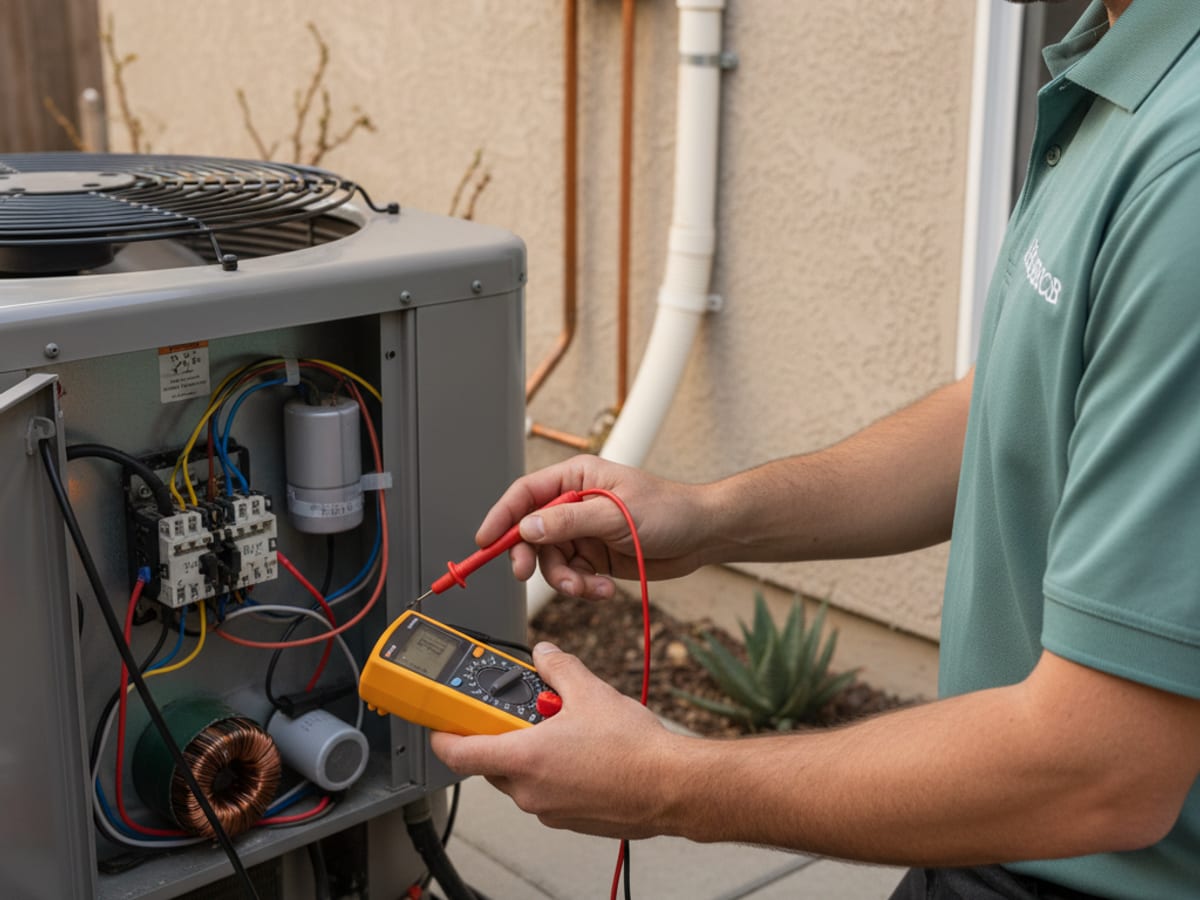
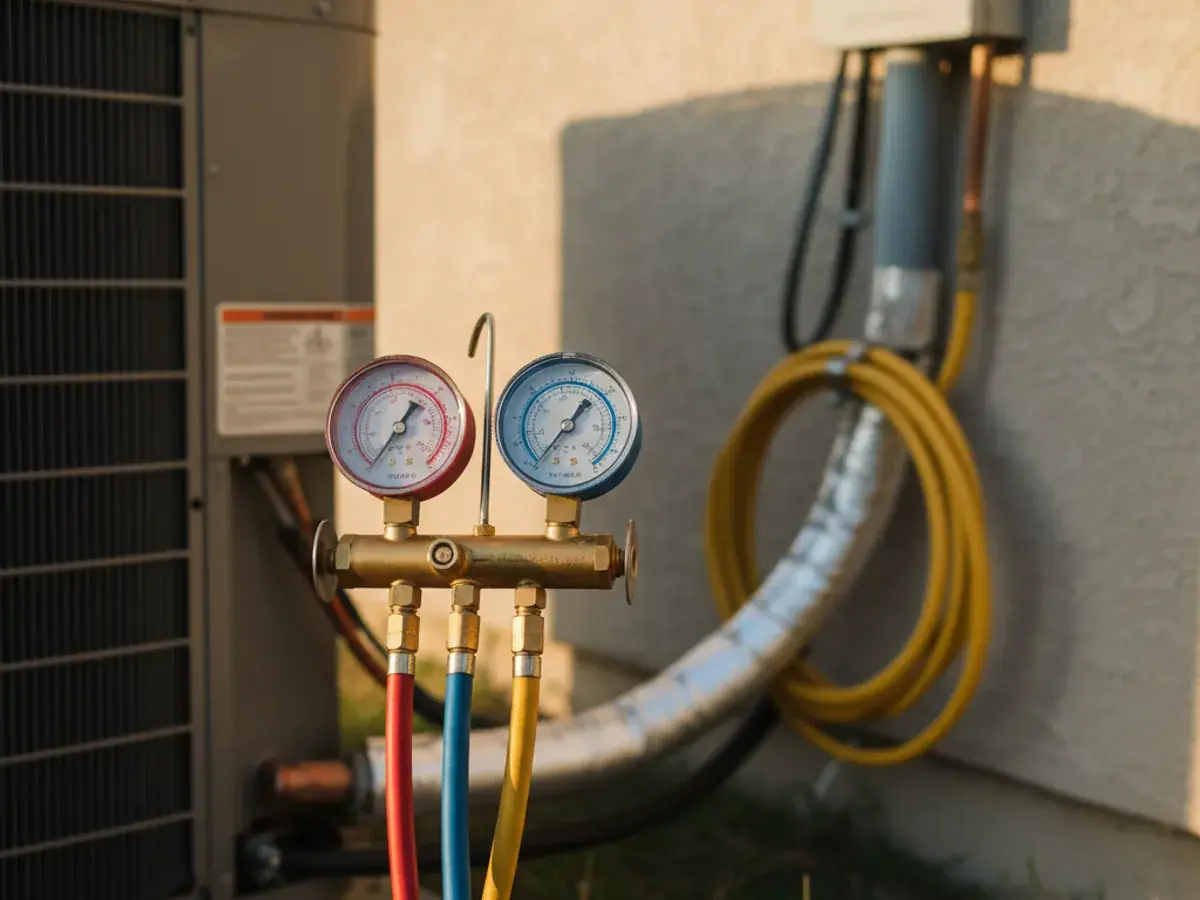
The diagnostic is a real inspection, not a quick look. It checks the refrigerant charge with gauges, tests the capacitor and contactor with a meter, reads the temperature split across the coil, and measures static pressure on the duct system. In Escondido the condenser also gets sized up against the house, because so many failures here trace back to a unit that was never big enough for valley heat.
You get the full picture before any work starts. If the fix is a cheap capacitor swap, you'll hear that. If the system is undersized and aging, you'll hear that too, along with what a right-sized replacement would cost against patching the old one.
How quickly the matched company can arrive
The matched company quotes an ETA when you call. Call volume spikes during a heat wave. Ask whether they offer after-hours dispatch, timing, and any extra fee.
Old Escondido, Felicita, the East Valley tracts, Hidden Meadows, and San Pasqual Valley are all in the same inland market. The matched company quotes timing for that address.