AC repair in Escondido usually starts the same way: the system runs nonstop on a peak-summer afternoon, then quits cooling. Most calls are a failed capacitor, low refrigerant, or a burned-out fan motor. Climate Pros SD matches you with licensed HVAC companies. We do not publish a county price table. The matched pro gives you a written quote first.
When the coast is sitting at a comfortable 75°F, Escondido can already be far hotter. That gap is not just uncomfortable. It is why AC systems in inland North County wear out faster, break down more often, and run longer than units in Carlsbad or Encinitas.
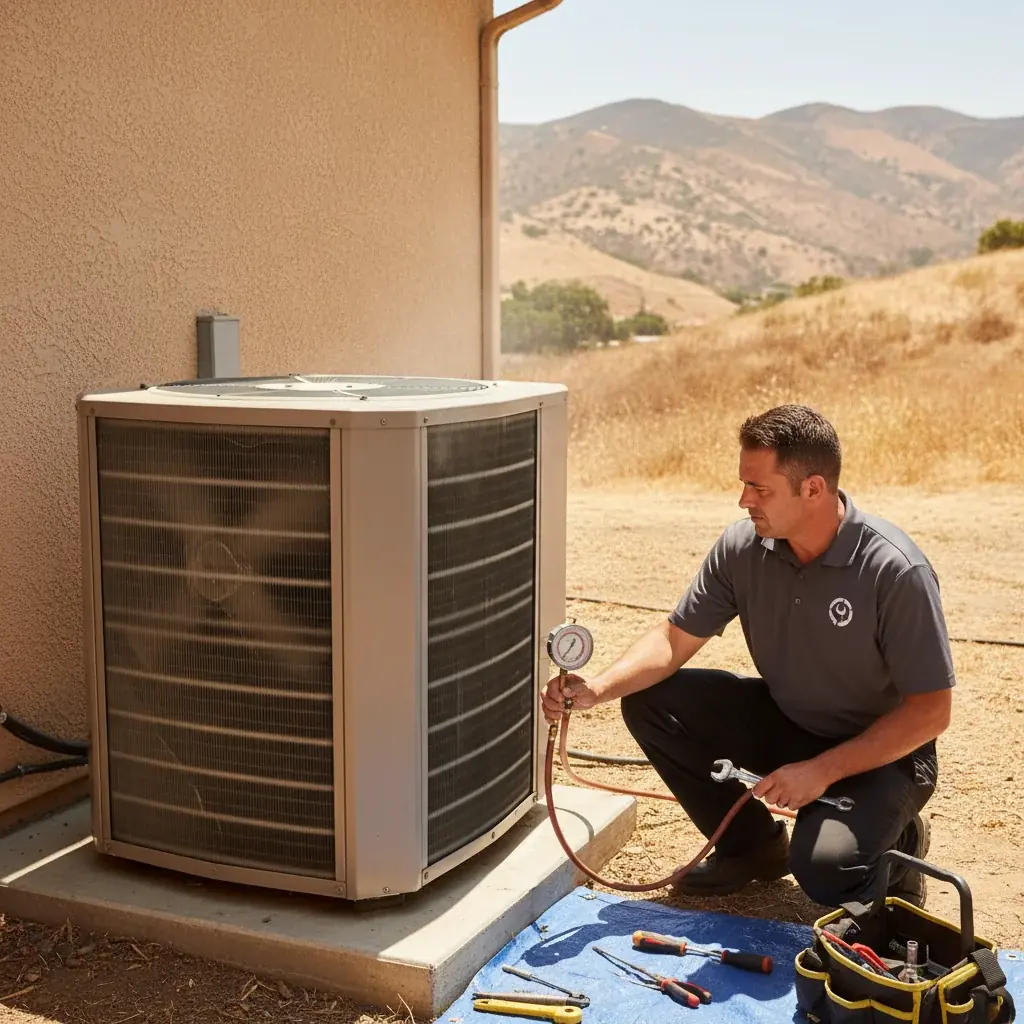
Why Escondido AC systems work harder than coastal homes
San Diego’s marine layer keeps coastal neighborhoods cooler through most of the summer. That natural air conditioning disappears once you get inland past the coastal hills. Escondido sits in a valley that traps heat and blocks the cooling breeze. On a typical July afternoon, it is not unusual to see far hotter readings in Hidden Meadows or Felicita while Del Mar is 72°F with fog.
What that means for your AC: the compressor runs longer every cycle. A unit designed to cool a home to 72°F when it is 85°F outside has to work harder to do the same job when it is far hotter outside. Manufacturers rate equipment efficiency (SEER) on standardized test conditions, not Escondido summer afternoons. In practice, your system is likely running far more hours per season than a comparable unit in a coastal zip code.
More run hours mean more wear on every moving part: the compressor, the fan motors, the capacitors. Refrigerant lines cycle through more pressure swings, electrical contacts open and close more times, and belts and bearings accumulate mileage faster. A 10-year-old system in Old Escondido has often logged the equivalent hours of a much older coastal system.
Add the heat island effect in older neighborhoods like Old Escondido (dark roofs, minimal tree coverage, dense pavement) and units there can run nearly continuously on peak-summer days.
Signs your Escondido AC needs repair now
Inland heat gives you a thin margin. Catch these early and a small part may be the whole job. Wait, and the compressor can take the hit.
- Warm air from the vents while the system is clearly running. Usually low refrigerant or a failing compressor.
- Ice on the indoor unit or the copper line. A frozen coil means airflow or refrigerant trouble. Shut it off and let it thaw before you run it again.
- The unit runs but will not reach the thermostat setting on a hot afternoon. Common on undersized or aging systems in San Pasqual and Hidden Meadows.
- Short cycling, where it turns on and off every few minutes. Often a contactor, capacitor, or refrigerant-charge issue.
- New grinding, buzzing, or rattling from the outdoor unit. A fan motor or bearing is going.
- A breaker that keeps tripping. Stop resetting it. That is an electrical fault, and repeated resets can damage the compressor.
- A spike in your SDG&E bill with no change in how you use the system. A dirty coil or low charge forces longer run times.
If the system already quit on a peak-summer day, treat it as urgent. See our emergency HVAC page for how matching works.
Common failures we see in 92025, 92026, 92027, 92029
Across Escondido’s four main zip codes, HVAC technicians see a predictable list of failures. Capacitor failure is the single most common call. Capacitors help start and run the compressor and fan motors. They degrade faster at high operating temperatures, and Escondido’s heat accelerates that process. A failed run capacitor is often a same-visit job if the part is on the truck.
Refrigerant leaks are the second most frequent issue. When refrigerant is low, the system struggles to cool and the evaporator coil often freezes. You will notice ice on the indoor unit and warm air from the vents. If you are seeing those symptoms, our post on AC freezing up: causes and fixes walks through what is happening.
Condenser fan motor failures show up more in inland systems than coastal ones, again because of heat exposure. When the fan motor fails, the refrigerant cannot reject heat fast enough, and the compressor overheats and shuts down on a high-pressure fault. Left unaddressed, repeated overheating can kill compressors, which is a much larger conversation than a motor swap.
In Hidden Meadows and Felicita, techs also see a higher rate of contactor failure and clogged drain lines. The contactor is the high-voltage switch that turns the compressor on and off. It pits and burns from heavy cycling. Drain clogs are partly a dust issue.
Our AC repair service page has a full list of what a diagnostic visit covers.
What belongs on an Escondido repair quote
Climate Pros SD does not publish 2026 labor rates, diagnostic fees, or after-hours premiums. Ask for line items:
| Line to insist on | Why it matters |
|---|---|
| Diagnostic or trip fee, in dollars | Each company sets it. Ask if it applies toward repair if you approve the work. |
| Failed part, with rating | Capacitor microfarads, contactor size, motor model |
| Refrigerant type if a leak is in play | R-22, R-410A, and A2L blends are not interchangeable stock |
| Labor scope | Attic access and a second visit change hours |
| After-hours | Nights and weekends are a separate line if you need them |
| Warranty, in writing | Part versus labor |
Common failures are not the same job. A dual-run capacitor that will not start the outdoor fan is a different visit than a leak inside an evaporator coil.
Hard-water and dust impacts on condenser life
Escondido’s water supply runs through the San Diego County Water Authority system and carries relatively high mineral content, calcium and magnesium that leave deposits on everything they touch. The San Diego County Water Authority reports average hardness in the 200–300 mg/L range depending on the season and supply blend. That is considered “hard” to “very hard” by most water quality standards.
For HVAC systems, hard water affects the evaporator drain pan and condensate line most directly. Mineral scale builds up inside the drain line and pan, restricting flow and eventually causing overflow. Water intrusion near an air handler can damage drywall, encourage mold growth, and corrode electrical components. Annual condensate line flushing is a legitimate maintenance item in Escondido, not just a sales pitch.
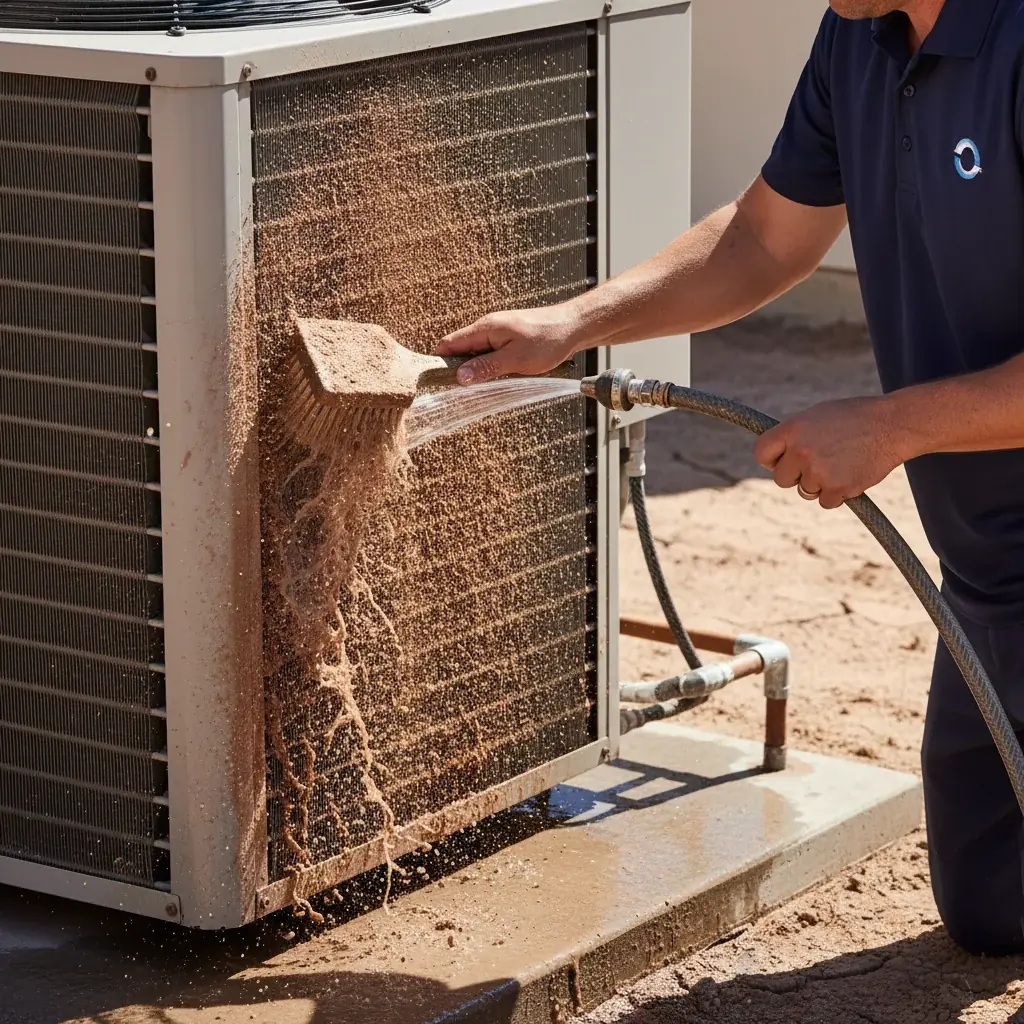
Dust is the other culprit. Escondido sits downwind of drier inland areas, and the air carries a consistent load of fine particulate, especially from late summer through fall when Santa Ana winds blow. That dust coats condenser coils, reducing the surface area available for heat transfer. A coil that is partly blocked makes the compressor work harder and run hotter to achieve the same output.
The fix is straightforward: annual coil cleaning and a condenser fin inspection. What’s less obvious is that this maintenance can extend compressor life, which is the most expensive component in any central AC system.
What inland heat does to the SDG&E bill
Escondido does not just break AC systems faster. It runs up your power bill while the system limps along. SDG&E’s time-of-use plans charge the most from 4 to 9 p.m., which is exactly when inland temperatures peak and your AC works hardest. A unit that’s low on refrigerant or running a clogged coil pulls more amps for the same cooling, and it does it during the priciest window of the day. Check current TOU prices on sdge.com. This page does not publish a monthly bill estimate.
If your bill jumped without a change in how you use the system, that is a diagnostic worth booking. The fix is often a cleaning or a recharge, not a replacement.
Permits and Title 24 for Escondido AC work
Most repairs don’t need a permit. Swapping a capacitor, a contactor, a fan motor, or recharging refrigerant is straightforward service work. Where it changes is when a repair turns into a replacement.
Replacing a condenser, an air handler, or a full system in Escondido triggers a permit from the city, and California’s Title 24 energy code applies. Title 24 sets minimum efficiency for the new equipment and, in many cases, requires duct-leakage testing and a refrigerant-charge verification before the job passes inspection. Some contractors skip the permit to move faster. That’s a problem when you sell the home and the work shows up as unpermitted.
Ask up front whether a job needs a permit and who pulls it. A written quote should spell that out before anyone touches the equipment. The California Energy Commission publishes the current Title 24 standards if you want to read the source.
When to repair vs replace given inland run hours
Do not use a blog “$5,000 rule” as the decision. Multiply a guessed repair by calendar years and you still do not have a quote.
A 10-year-old system that’s spent every summer running long days in peak inland heat may have already crossed the reliability threshold that the same rule would assign to a much older coastal system. Ask your technician how many times the unit has been repaired in the last three years, not just how old it is.
That said, not every older system needs replacement. If the compressor is still healthy, the refrigerant type isn’t obsolete (R-22 systems are a different calculation), and the ductwork is in good shape, a targeted repair often buys you several more useful years. Our post on the repair vs replace decision goes deeper on the calculus, including how to factor in current energy costs.
When replacement does make sense, newer systems rated at 18–20 SEER2 run more efficiently under Escondido’s high-load conditions. The California Energy Commission requires minimum efficiency standards on new equipment. Our AC installation service covers what a full replacement involves from permit to startup.
For comparison, our post on AC repair in Chula Vista covers a similar inland-adjacent heat profile for South Bay homeowners.
FAQs
How much does AC repair cost in Escondido?
Ask the matched licensed contractor. Climate Pros SD does not publish capacitor, contactor, recharge, fan-motor, or compressor bands. Get a written quote before any work starts.
Why does my AC break down more often in Escondido than on the coast?
Heat. When the coast sits at 75°F, Escondido can run far hotter, so your compressor runs far longer every cycle. More run hours mean more wear on the compressor, fan motors, and capacitors. A 10-year-old system inland often has the wear of a much older coastal one.
Do you prioritize urgent no-cool calls?
Matched companies often pull urgent no-cool ahead of routine work. Nights and weekends are a separate line if you need them. Ask for that fee in dollars.
Is it worth repairing an older AC, or should I replace it?
If the compressor is healthy, the refrigerant isn’t an obsolete type like R-22, and the ductwork is sound, a targeted repair often buys several more years. If you have paid for multiple repairs in the last three years, replacement usually wins on inland run hours. Our repair vs replace guide walks through the comparison using the quotes in your hand.
Do I need a permit to fix my AC in Escondido?
Most repairs don’t. Capacitors, contactors, fan motors, and recharges are standard service work. Replacing a condenser, air handler, or full system does need a city permit and has to meet California’s Title 24 energy code, which can include duct-leakage and charge testing before inspection.
When to call us
If your system isn’t keeping up on a hot day, is making new sounds, or has tripped the breaker, don’t wait to see if it fixes itself. Escondido heat gives you very little margin before a small problem becomes a full-system shutdown. Anything involving refrigerant, high-voltage components, or the compressor is service work for a trained technician, not a DIY fix.
Call us at (442) 777-6440. Or read the AC repair in Escondido service page, which covers the neighborhoods from Old Escondido out to Hidden Meadows and San Pasqual.