Last updated: May 26, 2026

HVAC Maintenance · Escondido, CA

HVAC maintenance in Escondido, CA

Escondido summers run hard: 100-plus degrees for weeks at a stretch with no marine layer to help. A pre-season tune-up is the difference between an AC that holds all summer and one that quits on the first July heat wave.

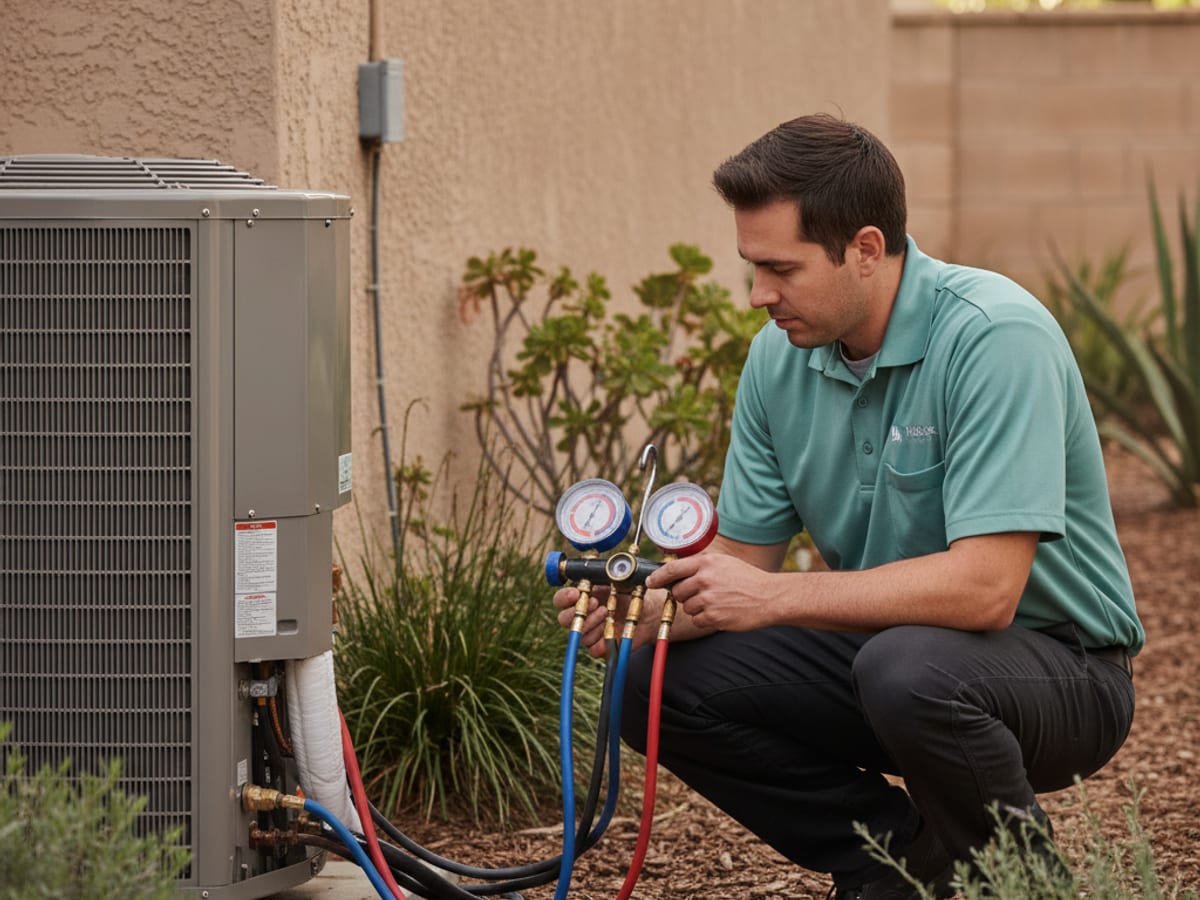
HVAC technician performing maintenance in Escondido, CA

HVAC maintenance in Escondido is available as a single tune-up visit or as an annual plan covering two visits: one before summer, one before winter, and the pros you're matched with quote the price up front before any work starts. The 21-point inspection includes refrigerant level check, capacitor microfarad test, amp draw on the compressor and motors, condenser coil cleaning, and temperature split measurement. Most appointments run about 90 minutes.

Escondido is the hottest non-desert city in San Diego County. Summer peaks hit 100 to 110 degrees, and the cooling season runs nine to ten months. That is a lot of hours on a compressor. Agricultural dust from the San Pasqual Valley and dry inland grit pack condenser coils faster here than in any coastal city, and wildfire smoke from late summer through October loads filters in days rather than months. Equipment that gets a yearly tune-up survives Escondido's climate. Equipment that doesn't tends to fail in July, when the heat is worst and repair slots fill fast.

We match homeowners with pros across every Escondido neighborhood: Old Escondido historic district, South Escondido, Felicita, Hidden Meadows, Eureka Springs, and properties bordering the San Pasqual Valley. No surcharge for the hills or the rural eastern addresses.

What our Escondido tune-up covers

A maintenance visit is not a filter swap and a signature. The pros we send run a 21-point inspection that catches the things that cause summer no-cooling calls before they happen.

  • Refrigerant level check with gauges: slow leaks found here, not in July
  • Capacitor microfarad test: the single most common Escondido summer failure caught in advance
  • Compressor and fan motor amp draw: high amps signal a unit working too hard
  • Condenser coil cleaning: removes ag dust and grit from San Pasqual that packs coils tight
  • Evaporator coil inspection for buildup or early freeze indicators
  • Static pressure check to catch duct leaks pushing the system into high-load conditions
  • Condensate drain flush and float switch test
  • Contactor and electrical connection inspection
  • Thermostat calibration and cycle timing check
  • Temperature split measurement: should read 16-22°F across the air handler
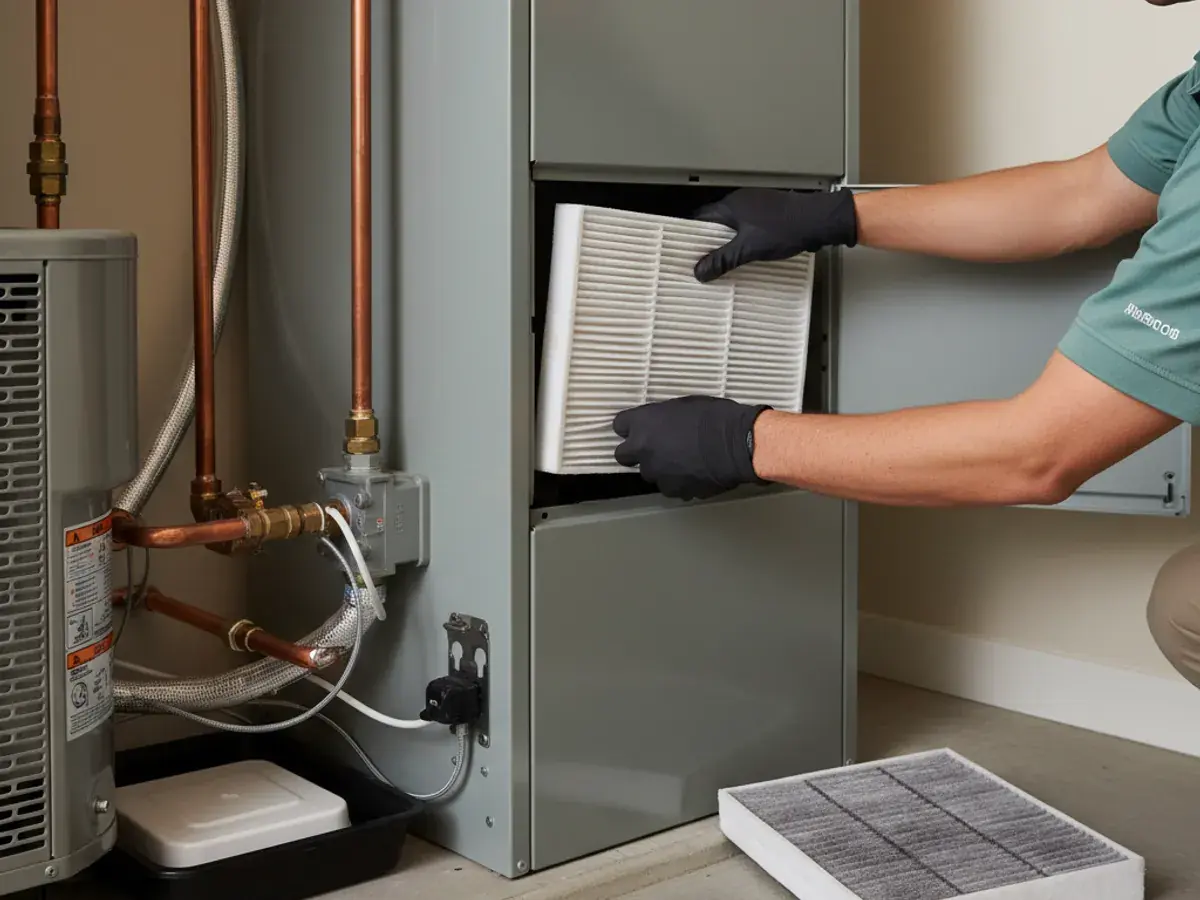
  • Filter condition check and replacement if needed (filter priced separately)
  • Blower wheel inspection for dirt buildup
  • Belt and bearing check on older direct-drive systems
  • R-22 refrigerant assessment on pre-2010 systems: document levels, flag slow leaks early
  • Full written summary with any findings and recommended action items
Maintenance detail work by an HVAC technician in Escondido, CA

HVAC maintenance cost in Escondido

The pro you're matched with quotes every visit before starting, and there's no upsell pressure at the end of the appointment.

Repair Typical range Notes
Single tune-up visit Priced by the company you sign up with Full 21-point inspection, coil cleaning included
Annual maintenance plan (2 visits) Priced by the company you sign up with; typically less per visit than a single tune-up Spring pre-summer + fall pre-winter, same 21-point process each
Filter replacement Priced by filter type and MERV rating Depends on filter type and MERV rating
Heavy ag-dust coil cleaning surcharge Quoted after inspection For San Pasqual Valley and rural eastern Escondido properties
Refrigerant top-off (R-410A) Priced by how much charge is needed If low charge is found during inspection; quoted separately before adding
Refrigerant top-off (R-22) Priced by supply availability and charge needed R-22 supply is limited; persistent leaks on older systems point toward replacement
Capacitor replacement Priced by part and labor If the microfarad test fails during the tune-up
Condensate drain line clear (severe blockage) Priced by severity of the blockage If the drain is fully blocked and requires more than a basic flush

Pricing is set by the company you are matched with, not by neighborhood. If the inspection turns up something that warrants a repair, that gets quoted separately and you decide whether to proceed.

What maintenance prevents in Escondido

A yearly tune-up is mostly about catching small problems before they become expensive ones. Escondido's climate accelerates wear faster than most of San Diego County, which means the gap between a small finding and a large failure is shorter here. These are the failures a regular tune-up is most likely to prevent.

Capacitor failure in the first heat wave

Run capacitors degrade with heat cycles. Escondido systems log more triple-digit hours per year than almost any coastal city in the county. A capacitor that measures within spec in April may fail by July, but one that's already drifting low in April will almost certainly fail in June. Measuring microfarads on every tune-up catches that. A failing capacitor replaced in May is a scheduled part-and-labor cost. The same failure in July, on a Friday afternoon, comes with an emergency call premium and a wait.

Condenser coil overload from agricultural dust

The San Pasqual Valley sits east of Escondido and generates fine agricultural dust that the inland winds carry right into condenser coils. Combined with the dry grit that comes off the hills in summer, coils here clog faster than anywhere on the coast. A packed coil forces the compressor to work harder to reject heat, which pushes amp draw up and compressor life down. The coil gets cleaned on every visit. Left uncleaned for two or three seasons, a condenser coil can turn a working system into a failing one.

For properties closest to agricultural land in the San Pasqual area, a heavy-cleaning surcharge applies when the buildup requires more than the standard rinse. It is worth it: that surcharge beats an expensive compressor replacement.

Refrigerant leaks becoming no-cooling events

Slow refrigerant leaks are invisible until they are not. A system can lose charge gradually over one to three years and cool well enough through mild weather, then fail to hold temperature the first week of triple digits. Refrigerant levels get checked on every visit. A slow leak caught in spring is a repair conversation. The same leak missed until July is an emergency call.

For pre-2010 systems still running R-22, the charge level gets documented every visit. R-22 is no longer manufactured in the US and supply is shrinking. A system that needs frequent top-offs is telling you it has a leak, and a leak on an R-22 system is often the conversation that ends with a replacement decision.

Filter neglect during smoke season

Wildfire smoke from late summer through October loads an air filter in days instead of the usual two to three months. A loaded filter chokes airflow, causes the evaporator coil to freeze, and drives the compressor into high-amp operation trying to move air through the restriction. The fall tune-up includes filter condition check and a conversation about how often to change it during smoke season. The answer in Escondido is: more often than you think.

Compressor failure on older 1970s-90s systems

Escondido has a lot of housing built between 1970 and 1995: South Escondido, Felicita, parts of Old Escondido: and the original HVAC systems in many of those homes are well into their second or third decade. Systems in this age range are entering the replacement window, but a well-maintained unit often has more life than the calendar suggests. The inspection gives an honest read: if the findings show sound mechanicals, that gets reported. If there's a compressor running hot, electrical connections showing heat damage, and a refrigerant charge that keeps needing attention, that gets reported too. The goal is never to push a sale: it's to make sure you're not surprised by an expensive repair bill in August.

Local angle

HVAC maintenance built for Escondido homes

Why Escondido is hard on HVAC equipment

Escondido sits about 15 miles inland from the coast and well above sea level at the base of the Palomar Mountain foothills. It gets almost none of the marine layer that keeps coastal cities like Carlsbad or Encinitas tolerable in summer. When the coast is 72 degrees in July, Escondido is 100. That inland heat differential is why the cooling season here runs nine to ten months: and why AC equipment logs significantly more run hours per year than comparable systems in coastal zip codes.

The dry conditions also mean less humidity to help equipment run efficiently, more static electricity in ductwork, and that persistent layer of fine dust from the San Pasqual Valley and the chaparral hills that coats condenser coils. Add wildfire smoke season and you have a climate that genuinely demands more from HVAC equipment than most other parts of the county.

Housing stock by neighborhood

Old Escondido historic district runs through the core of the city with a lot of Victorian and Craftsman-era homes from the 1920s and 1940s. These were retrofitted with central HVAC at various points, often with ductwork running through tight crawl spaces or finished attics. The systems themselves tend to be 15 to 30 years old. Refrigerant leaks, aging ductwork, and original furnace heat exchangers on this stock are common finds. A tune-up here often includes a closer look at the duct connections and any signs of heat exchanger stress.

South Escondido and Felicita are largely 1970s and 1980s tract homes: the kind of floor plans where the original builder-grade system is now approaching or past its natural end of life. These are the homes where the tune-up conversation frequently turns into a replacement conversation, and where giving homeowners the clearest possible picture before the decision is forced by a summer failure matters most.

Hidden Meadows and Eureka Springs sit higher in the hills to the northeast of the city: newer construction from the 1980s through 2000s, estate-style lots, some homes on well water and private roads. The elevation helps slightly with summer temperatures, but Hidden Meadows sits in SDG&E PSPS territory, meaning power shutoffs during high fire risk events. A well-maintained HVAC system recovers faster after power restoration than one that is already stressed.

PSPS outages and HVAC recovery

SDG&E's Public Safety Power Shutoffs affect the eastern hills of Escondido: primarily the Hidden Meadows and upper Eureka Springs areas: several times a year during high fire risk conditions. When power comes back on, an air conditioner compressor experiences a hard start: full voltage applied to a hot, pressurized system that has been sitting idle. Hard starts stress capacitors and compressors. A system with a weak capacitor is most likely to fail immediately after a PSPS restoration.

The tune-up includes capacitor testing specifically because of this. A hard-start kit added during maintenance reduces the amp surge at startup and extends compressor life for homes in PSPS-affected areas. This gets noted in the written summary after every Hidden Meadows or eastern hills appointment.

The two-visit-per-year standard for Escondido

Most of San Diego can get away with one HVAC tune-up per year. Escondido really benefits from two. The pre-summer visit in March or April catches capacitors, refrigerant levels, and dirty coils before the first heat wave. The fall visit in October or November checks the furnace heat exchanger and controls before the winter freeze nights that do hit Escondido: temperatures drop below 32 degrees in the hills on cold nights, which is not as rare as coastal residents think.

The annual plan covers both visits and typically works out to less per appointment than paying for two single visits. It's the right call for any Escondido home running a system older than eight years.

SDG&E rebates and maintenance documentation

SDG&E's Comfort Connect and TECH Clean California programs offer rebates primarily tied to equipment replacement, not maintenance. But proper maintenance documentation matters in two ways: first, most manufacturer extended warranties require annual professional service records to stay valid. Second, if you're heading toward a heat pump replacement in the next one to three years, having a service history shows the equipment was maintained and helps set a clear baseline for the replacement conversation.

A written inspection report follows every visit. Keep it. It is your record if a warranty question ever comes up, and it helps the next technician understand exactly what your system has had done.

Agricultural dust and coil cleaning in San Pasqual

Properties near the San Pasqual Valley: east of the city toward the Wild Animal Park: sit in the direct path of seasonal winds that carry fine agricultural dust from the valley floor. Condenser coils on these properties build up a dense, compacted layer of dust and organic material that is different from what shows up on city lots. Standard city coil cleaning is a thorough rinse. The heavy agricultural cleaning done on San Pasqual-area properties requires more time and higher pressure to get the fins back to full airflow.

That's why a surcharge applies on properties in this area. It's not a markup: it's an accurate reflection of what it takes to actually clean the coil. A half-cleaned coil on a San Pasqual property is barely better than a dirty one.

Escondido maintenance questions

How much does HVAC maintenance cost in Escondido?

It depends on the company you're matched with and what the inspection finds. A single tune-up and the two-visit annual plan are both priced up front before anything starts, and the annual plan typically works out to less per appointment than paying for two single visits. Filter replacement is priced separately by filter type, and that is separate from the tune-up cost. Coil cleaning is included in every visit; properties near San Pasqual Valley may have an additional heavy-cleaning charge quoted after inspection when agricultural buildup requires more than the standard rinse.

How often should I service my HVAC in Escondido's climate?

Twice a year. Most of San Diego can get by with one tune-up annually, but Escondido runs a nine-to-ten-month cooling season with 100-plus-degree peaks, agricultural dust from San Pasqual, and wildfire smoke in fall. That combination is hard on equipment. A pre-summer visit in March or April and a fall visit in October or November is the right schedule for this climate.

What does a 21-point tune-up include?

Refrigerant level check with gauges, capacitor microfarad test, compressor and motor amp draw, condenser coil cleaning, evaporator coil inspection, static pressure measurement, condensate drain flush and float switch test, contactor and electrical connection check, thermostat calibration and cycle timing, temperature split measurement, filter condition check, and blower wheel inspection. Every visit ends with a written summary of everything found.

Should I get my HVAC serviced before summer in Escondido?

Yes, and sooner than you think. March or April is the right window. By May the schedule starts filling. By June it is full. A tune-up that catches a failing capacitor or a low refrigerant charge in April is a scheduled repair. The same issue found on the first triple-digit day in July is an emergency repair with a wait. Escondido's summer heat arrives fast and stays long.

How does wildfire smoke affect my HVAC system?

Smoke loads the air filter fast: days instead of months during a smoke event. A clogged filter chokes airflow, which causes the evaporator coil to ice over and forces the compressor to run at high amp draw trying to move air through the restriction. Over a prolonged smoke event, that stress accelerates wear on the compressor. Change the filter every one to two weeks during smoke season. Rinse the outdoor condenser fins with a garden hose after the air clears. Both of those habits matter in Escondido's fall fire season.

Do I need to change my filter more often in Escondido?

Yes. The standard recommendation of every two to three months assumes normal air quality. Escondido has agricultural dust from San Pasqual Valley and wildfire smoke from late summer through October. During smoke events, check the filter every two weeks. During the rest of the year, monthly checks make sense for homes close to agricultural land or the eastern hills. A loaded filter is the most common avoidable cause of HVAC failure seen in Escondido.

What is a run capacitor and why does it fail?

A run capacitor is an electrical component that stores charge and helps the compressor and fan motors start and maintain speed. Over time, and especially under repeated heat stress, capacitors lose their ability to hold their rated microfarads. When they drift low enough, the motor they support can't start under load, which produces a humming outdoor unit with a fan that won't spin. Escondido's long, hot summers accelerate this degradation faster than in coastal cities. Testing every capacitor on every tune-up catches a weak one early, when replacing it is a scheduled cost. Missing it until July means an emergency call premium and a wait.

Does HVAC maintenance help me qualify for SDG&E rebates?

Not directly: SDG&E rebates are tied to equipment replacement, not maintenance. But maintenance documentation keeps manufacturer extended warranties valid (most require annual professional service records), and it gives you a clear baseline if you're planning a heat pump replacement in the next few years. When you do replace, the rebate conversation is cleaner when there's a service history showing the old system was maintained, not neglected.

I have a 1985 system: is maintenance still worth it?

That depends on what the inspection shows. A 40-year-old system that has been maintained, has tight electrical connections, a compressor running within amp spec, and no refrigerant leaks has more life than the calendar suggests. The inspection gives an honest assessment of what's found. If the system looks sound, that gets reported and you keep running it. If there's a compressor running hot, connections showing heat damage, and a refrigerant charge that keeps needing attention, that gets reported too. There's no push toward a replacement sale. A modest inspection that tells you the system is done is worth it compared to a surprise compressor failure in August.

What is the PSPS risk and how does it affect my HVAC?

SDG&E uses Public Safety Power Shutoffs in high fire risk conditions. The eastern hills of Escondido: Hidden Meadows, upper Eureka Springs: are affected several times per year. When power is restored after a shutoff, the AC compressor does a hard start: full voltage applied to a hot, pressurized system. Hard starts stress both the capacitor and the compressor. A weak capacitor is most likely to fail right at restoration. The tune-up includes capacitor testing, and a hard-start kit can be installed during the visit that reduces the startup amp surge. That kit is worth it for any home in PSPS territory.

Why does my Escondido AC coil get dirty so fast?

Two reasons. First, the San Pasqual Valley sits to the east and generates fine agricultural dust that the inland winds carry west across the city. Second, the dry inland conditions mean there is less humidity to keep dust particles airborne: they settle into the condenser coil fins instead. On a coastal property the coils might need cleaning every year or two. On an Escondido property near agricultural land, they may need it every six to twelve months. That is why coil cleaning is included in every tune-up rather than charged separately.

Can maintenance extend the life of an older system?

Yes, meaningfully. A system that gets annual coil cleaning, capacitor checks, and refrigerant monitoring runs cooler, starts easier, and operates within its design amp draw. All of that reduces wear on the compressor, which is the most expensive part to replace. Escondido systems regularly hit 18 to 22 years with consistent maintenance. Systems that never get serviced rarely make it past 12 to 15 years in this climate. The math is straightforward.

What happens if I skip the annual tune-up in Escondido's climate?

The condenser coil packs with agricultural dust and grit, which forces the compressor to work harder. Refrigerant levels drift low without anyone catching it until the system can't cool the house. A capacitor that should have been caught at 60% capacity drifts to zero and fails on a 105-degree afternoon. Filters load with smoke in September and nobody changes them, causing an evaporator freeze. Any one of these is a repair call. All of them together is a system that dies five years earlier than it should have.

Do you service Hidden Meadows and San Pasqual Valley properties?

Yes. Pros in our network cover all of Escondido including Hidden Meadows, Eureka Springs, and properties bordering the San Pasqual Valley. The quote reflects the hills or the eastern addresses the same as anywhere else in the county. San Pasqual-area properties with heavy agricultural dust buildup on the condenser coil may have a cleaning surcharge quoted after inspection, based on the actual condition of the coil, not the address.

How long does an HVAC tune-up take?

Most appointments run 60 to 90 minutes. A straightforward tune-up on a single-system home takes about an hour. Larger homes with two systems, or older units that need more attention on the coil cleaning or electrical connections, run closer to 90 minutes. The inspection does not get rushed to make the next appointment.

Is there a difference between HVAC maintenance and an AC tune-up?

The terms are used interchangeably. What gets called a tune-up or maintenance visit covers the full HVAC system: the air conditioner, the furnace or air handler, and the ductwork connections. Both the cooling and heating sides get checked in one visit. In Escondido the cooling system gets most of the attention because it runs almost year-round, but the furnace heat exchanger and heating controls are part of the fall visit on the annual plan.

Service area

Where we serve Escondido

We cover Escondido and the surrounding North County Inland communities, and we match you with a licensed local pro for maintenance.

Serving Escondido

Need maintenance in Escondido?

We match you with a licensed local HVAC pro for your repair or replacement.

Call now · (442) 777-6440 Our operators answer Quote