Portable air conditioners get bought by a lot of San Diego renters who don’t have central air and can’t install anything permanent. They work, but the honest version of how well they work is more limited than the marketing suggests, and knowing that upfront saves you from a unit that runs constantly and still barely cools the room.
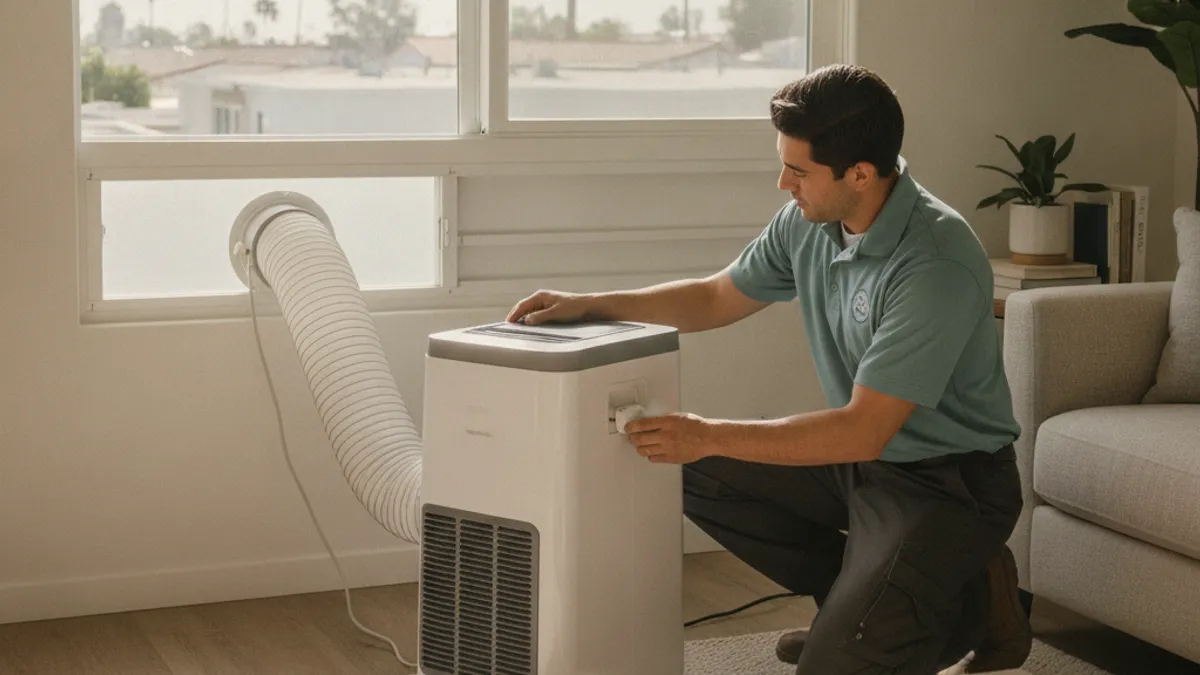
A portable AC only works if the hose vents outside and the room is closed
Single-hose units pull warm air back in through gaps. Dual-hose holds temperature better. North Park and older beach apartments without ducts are the usual use case, not whole-house cooling. Coastal humidity makes the same BTU rating feel weaker than inland dry heat.
Checklist
- Confirm an operable window for the kit.
- Measure the room with doors closed.
- Compare window AC if the window can hold a chassis.
- See mini split vs central if you own the place.
- Do not run a portable unit unvented.
Related: AC installation and window AC for rentals.
Single-hose versus dual-hose: the difference that actually matters
Most budget portable ACs use a single hose that vents hot exhaust air out a window. The problem is physics, not manufacturing quality. As that hot air gets pushed outside, it creates slightly negative pressure inside the room, which pulls warm, humid air in from outside through every gap, under doors, around windows, through outlets, to replace it. You’re cooling the room with one hand while pulling warm air back in with the other, which is why single-hose units often struggle to hold a room below the mid-70s on a genuinely warm day.
Dual-hose units pull outside air in through one hose specifically to cool the condenser, and vent exhaust out the second hose, without depressurizing the room. That design is meaningfully more efficient and holds temperature better, especially in a larger room or on a hot inland day. The tradeoff is a higher price and a slightly bulkier unit with two hoses to manage instead of one.
What actually determines whether a portable AC works for your space
Room size and how well it’s sealed. A portable AC rated for a 400-square-foot room needs that room to actually be reasonably sealed, no wide-open doorway to the rest of the house, no drafty single-pane window frame typical of a lot of San Diego’s older apartment stock. Open floor plans and older buildings both work against a portable unit’s rated capacity.
Coastal humidity versus inland dry heat. Coastal San Diego’s marine layer brings more ambient humidity than inland areas, and a portable AC has to work harder pulling moisture out of the air on top of cooling it, which reduces the effective cooling capacity you actually feel. Inland, where the heat is drier, the same unit generally performs closer to its rated BTU output.
Where the exhaust hose vents. These units need a window, sliding door, or similar opening to vent through, using the included kit that seals around the hose. A room with no operable window that vents outside isn’t a candidate for a portable AC regardless of BTU rating.
Noise. Portable units run louder than a mini-split or central system, since the compressor sits inside the room with you rather than outside. If the unit will run in a bedroom overnight, that’s worth testing or researching before buying, since noise complaints are one of the most common regrets.
Why renters lean on these units in San Diego
Central air isn’t standard in a lot of San Diego’s older apartment stock, particularly in neighborhoods like North Park, South Park, and older beach communities where converted units and pre-1980s buildings never had ducting installed. A portable AC needs no permit, no electrical work, and no landlord approval beyond confirming the lease allows one, which makes it the practical option for a renter who can’t modify the unit.
That said, a portable AC is a stopgap, not a permanent cooling solution. If you’re a homeowner weighing a longer-term fix instead of a plug-in unit, a ductless mini-split delivers real central-air-level performance without ductwork, and it’s worth comparing against a portable unit’s real-world limitations. See our ductless mini-split cost guide for that comparison. If your unit already has a window that’s underused, a fixed window AC unit is also worth considering over portable, since it doesn’t take up floor space and generally cools more efficiently for a comparable price; see our window AC unit guide for that option.
Sizing guidance
BTU needs scale with room size and sun exposure, and manufacturer charts are a reasonable starting point, but San Diego specifics push the number up. A west-facing room with a lot of afternoon sun, or a room adjacent to an unconditioned attic space, needs more capacity than the same square footage would suggest on a generic sizing chart. When in doubt, sizing up one tier is usually the safer call for anything but a small, shaded room.
Frequently asked questions
Are dual-hose portable ACs worth the extra cost?
For anything beyond a small, well-sealed room, generally yes. The efficiency gain from not depressurizing the room is real and noticeable on warmer days, and it usually holds temperature more consistently than a single-hose unit of the same rated capacity.
Why doesn’t my portable AC cool the room like it’s supposed to?
The most common causes are an unsealed or oversized room for the unit’s rating, a single-hose design pulling warm air back in from elsewhere in the house, or coastal humidity reducing the effective cooling capacity beyond what the BTU rating implies.
Can I use a portable AC without venting it outside?
No. These units need to exhaust heat somewhere, and running one without a proper window vent kit means the heat has nowhere to go, which defeats the purpose of the unit entirely.
Is a portable AC cheaper to run than central air?
For cooling a single room you’re actually occupying, often yes, since you’re not conditioning the whole house. For cooling an entire home, a portable unit is far less efficient per square foot than central air or a mini-split system.
Related service: AC repair. Local coverage: all 67 cities we cover in San Diego County.
When to call us
If you’re outgrowing what a portable unit can realistically deliver, or you’re ready to look at a permanent cooling solution like a mini-split or central AC, call (442) 777-6440 for an honest assessment of what fits your space and budget.