A 5 ton AC unit shows up on quotes for large San Diego houses, and on replacements that copy the old outdoor data plate. That number is a cooling rate, not a stamp that your floor plan needs five tons. In this county a 5-ton system is often more machine than the house can use, and the only way to know is a load calculation on the actual home.
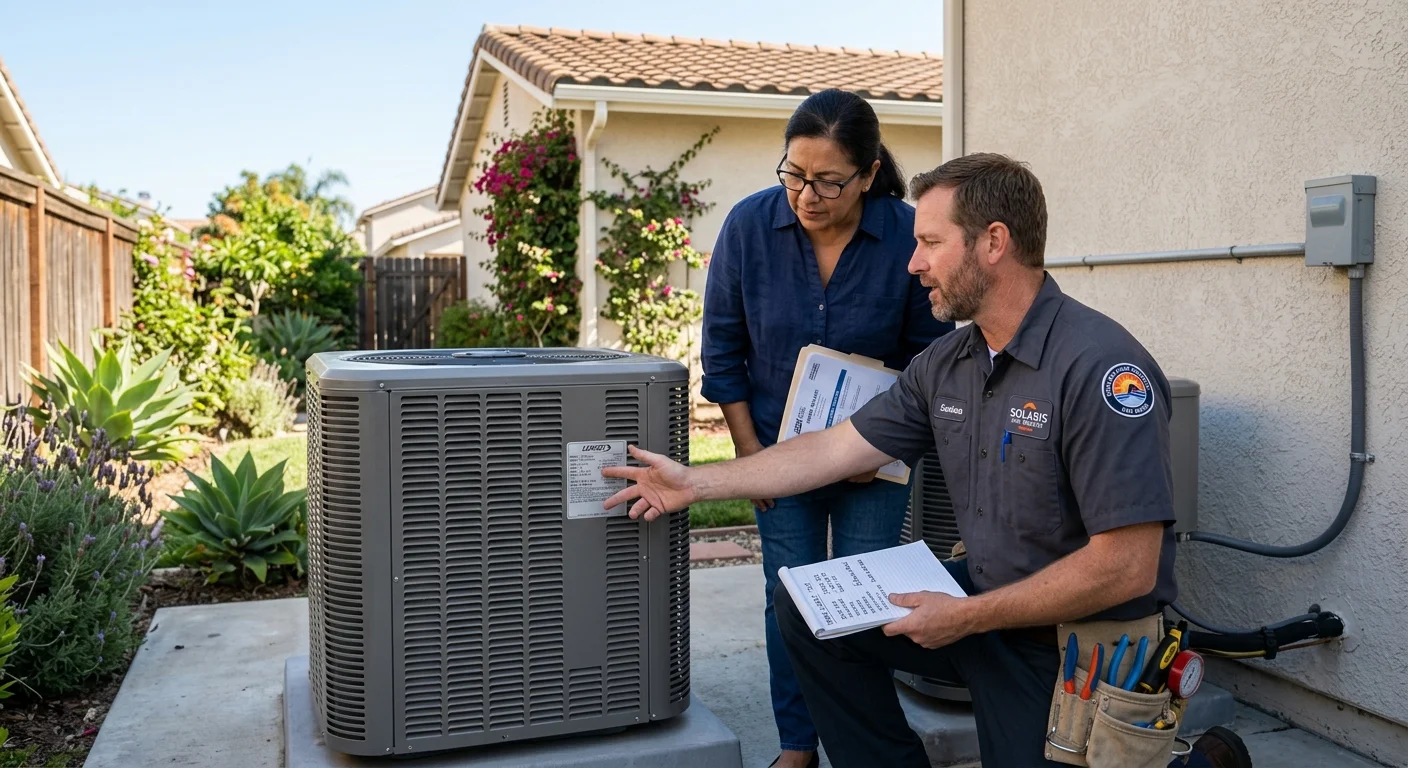
What does a 5-ton AC rating mean?
A ton of air conditioning is a rate of heat removal, not the weight of the outdoor box. One ton equals 12,000 British thermal units per hour. A 5 ton AC unit is rated to move about 60,000 BTU of heat out of the house every hour under the manufacturer’s test conditions.
That figure lives on the outdoor data plate. It does not mean the house is a 5-ton house. It means the compressor and coil pairing is built to that capacity when airflow, refrigerant charge, and outdoor temperature match the test. A Mission Hills bungalow and a Ramona two-story will not match a lab the same way.
SEER2 is a seasonal cooling-efficiency rating expressed in Btu per watt-hour. The U.S. Department of Energy notes that energy-use examples rely on a specified test method and assumed annual operating hours, and that actual savings vary with usage. Bigger tonnage is not a higher SEER2. Capacity and efficiency are different ratings. DOE’s home heating and cooling pages explain the efficiency side without turning tonnage into a shopping chart.
How much electricity a 5-ton machine uses is not one number for San Diego County. One kilowatt equals 1,000 watts. Electricity used over time is measured in watt-hours, and one kWh is one kilowatt used for one hour. Your kWh depends on runtime, the matched system’s SEER2, duct leakage, and your rate plan. SDG&E residential plans can price electricity by time of use. Current listed time-of-use plans place on-peak from 4 p.m. to 9 p.m. Confirm the plan and the current rates with SDG&E. Climate Pros SD does not publish a run-cost for a 5-ton unit because usage is home-specific.
The nameplate also does not decide whether one outdoor unit or two smaller systems is the better layout. That is a design choice after the load is known. 5-ton AC sizing starts with the house, then the equipment.
Why can’t square footage confirm the right size?
Retail pages love a square-foot range for a 5-ton system. Those ranges are rules of thumb from other climates, and they fail in San Diego County. Encinitas and El Cajon can share a floor area and still need different cooling.
The National Weather Service describes ocean moderation near San Diego and warmer summer days in nearby valleys. Hot easterly winds can bring heat to coastal areas. NOAA 1991-2020 normals make that split concrete. San Diego International Airport’s August normal high is 77.3°F. Carlsbad Palomar Airport is 75.8°F. Escondido is 89.0°F. El Cajon is 88.6°F. Campo is 95.1°F. Borrego Desert Park is 106.8°F. A 2,400-square-foot ranch in Pacific Beach is not the same cooling problem as a 2,400-square-foot two-story in Escondido, or a desert house in Borrego Springs.
Windows, glass orientation, attic insulation, and ceiling height change the load more than a floor-plan number. Two 2,000-square-foot houses can sit a few miles apart, one with deep eaves in La Jolla and the other with unshaded west glass in Santee, and they will not share a tonnage.
That is why “how many sq ft will a 5 ton AC unit cool?” is the wrong question. Floor area is an input, not an answer. The same is true for “is a 4-ton AC unit suitable for a 2,000 sq ft house?” Neither 4 tons nor 5 tons is confirmed by square footage. If you are lining up a 3-ton quote next to a 5-ton quote, start with our note on whether a 3-ton AC is the right size for a San Diego home. The method is the same. The answer is not a chart.
Which home conditions change the cooling load?
A licensed C-20 contractor sizes from the house as it stands, not from the last unit’s label. Several local conditions move the load before anyone talks tons.
Coast versus valley. Marine air and lower August highs along the beaches cut heat gain. Inland North County, East County, and the backcountry see higher normal highs and more hours when the outdoor unit works harder. A Chula Vista bungalow near the bay is not an El Cajon tract house, even when the floor plans look similar. Santa Ana days and heat waves run well above those NOAA normals. Design still starts from the house, not from a viral temperature screenshot.
Housing era. Census ACS table B25034 shows which decades dominate each city’s housing stock, and which neighborhoods carry that era’s construction. A 1950s Clairemont house with original ducts is a different envelope than a newer Scripps Ranch two-story. Age is not a size by itself. It flags insulation, window type, and duct condition the pro has to inspect.
Ducts. ENERGY STAR says a typical forced-air house can lose about 20% to 30% of the air moving through ducts because of leaks, holes, and poorly connected ducts. That is a national typical-house statement, not a measured result for a particular home or city. Leaky ducts in a hot attic raise the load the equipment has to fight. Sealing addresses leakage. It is not a promise of a smaller tonnage or a lower bill.
Glass, volume, and internals. West and east glass on inland lots picks up afternoon sun. Vaulted living rooms add volume the floor-area number hides. People, cooking, and all-day home-office gear add heat that a square-foot rule never sees.
SDG&E suggests precooling earlier in the day, then setting the thermostat to 78°F or higher from 4 p.m. to 9 p.m., health permitting. That is conservation guidance, not a sizing formula. An oversized unit that short-cycles will not follow that pattern well.
How can oversizing affect comfort?
Too much capacity does not mean extra comfort. A 5-ton AC for a San Diego home that is larger than the load often hits the thermostat setpoint fast, then shuts off. Those short runs are short cycling. The house can feel cool at the hallway sensor and still sticky in bedrooms, especially near the coast where marine air already holds moisture.
Short cycles also mean the air does not mix as long. Upstairs rooms in two-story Mira Mesa or Rancho Bernardo houses can stay warm while the downstairs thermostat is satisfied. That is runtime and distribution, not a request for still more tons.
Ducts and the indoor coil have to move the air the outdoor unit is built for. A 5-ton blower on undersized returns is a mismatch. The pro checks static pressure and layout, not only the condenser nameplate. Copying the old 5-ton label because it cooled last summer skips that check. Our explainer on whether you can replace an AC with the same size covers why the old tonnage is a clue, not a verdict.
Oversizing is not a guaranteed high bill, and we will not invent a savings percentage for a smaller unit. Watch comfort instead: short runs, humidity that never drops, rooms that never even out, and a system that never settles into a long cycle on a hot Escondido afternoon.
If a quote jumps from 3 tons to 5 tons with no load sheet, ask why. Additions, new west glass, or a converted garage can be the reason. Sometimes the number is just the next size available. Climate Pros SD matches you with licensed, insured independent pros. Those pros should show the load, not only a brochure.
What should a Manual J calculation document?
A Manual J load calculation is the residential cooling and heating worksheet used to size equipment. It is house-specific. It is not a square-foot multiplier.
Ask the contractor you are matched with to document, in writing:
- Conditioned floor area and ceiling heights, including vaults
- Wall, roof, and floor construction, and insulation as found
- Window area, type, and orientation
- Infiltration and where the ducts run (attic, crawl, garage)
- The indoor and outdoor design assumptions used for this climate
- Sensible and latent load, so humidity is not ignored on the coast
- Recommended equipment capacity, and whether that is one system or two
California Title 24 requires field verification testing when HVAC systems are altered or replaced. A CEC-certified rater performs that testing. Current detailed thresholds live with the Energy Code Compliance program at the California Energy Commission. The load calc and the Title 24 tests are related. They are not the same sheet.
In the City of San Diego, no part of a heating, ventilating, air conditioning, or refrigeration system shall be installed, altered, replaced, or repaired unless a mechanical permit has been obtained. Simple no-plan permits can cover air conditioner unit installations on non-historic properties. Plan-required permits apply to more complex work and historically designated properties. County of San Diego and unincorporated rules were not confirmed from our primary sources, so ask which jurisdiction your address sits in. The matched licensed contractor pulls the permit. Climate Pros SD does not.
Check C-20 status on the CSLB license lookup. California requires that classification for HVAC work when the contract exceeds $1,000, when a permit is required, or when the person advertises as a contractor. The $1,000 casual-work exemption does not apply if the job is part of a larger operation or is split to evade the chapter.
People also ask what it costs to replace a 5 ton AC unit. Climate Pros SD does not set prices. No verified 5-ton installed figure is in our claims ledger, so we will not invent one. Ask the pro for a written bid that separates equipment, ducts, electrical, and permit line items.
The $5,000 rule is a trade heuristic that weighs repair cost against system age. It is not a sizing tool and not a brand promise. If you are weighing repair against replacement, see our page on the $5,000 HVAC rule in San Diego. Capacity still comes from Manual J.
When the load is known, AC installation is the service path for a changeout. A typical residential install is often a one- to two-day job. The pro you are matched with confirms the actual duration. That is work time, not an arrival window.
When to call us
If a quote specifies a 5 ton AC unit and you have no Manual J in hand, get the house measured before you buy. Call us at (442) 777-6440 and we will match you with a licensed local pro.