Ductless mini splits usually use less electricity than central AC in San Diego. They hit 20 to 30 SEER2 versus 14 to 20 for central air, and they skip the duct loss ENERGY STAR describes as about 20% to 30% of the air moving through a typical house’s ducts. Climate Pros SD does not publish a $25 to $50 summer-bill cut. Look at your SDG&E TOU bill. Central AC still wins when your home already has healthy ductwork. Here’s the full breakdown.
When the San Diego sun gets serious, you need a reliable way to cool your home. If you’re starting from scratch or replacing an ancient system, you’ll face a fundamental choice: install traditional central air conditioning or opt for a modern ductless mini split system. This isn’t just a technical decision. It’s about cost, comfort, and the unique character of your home.
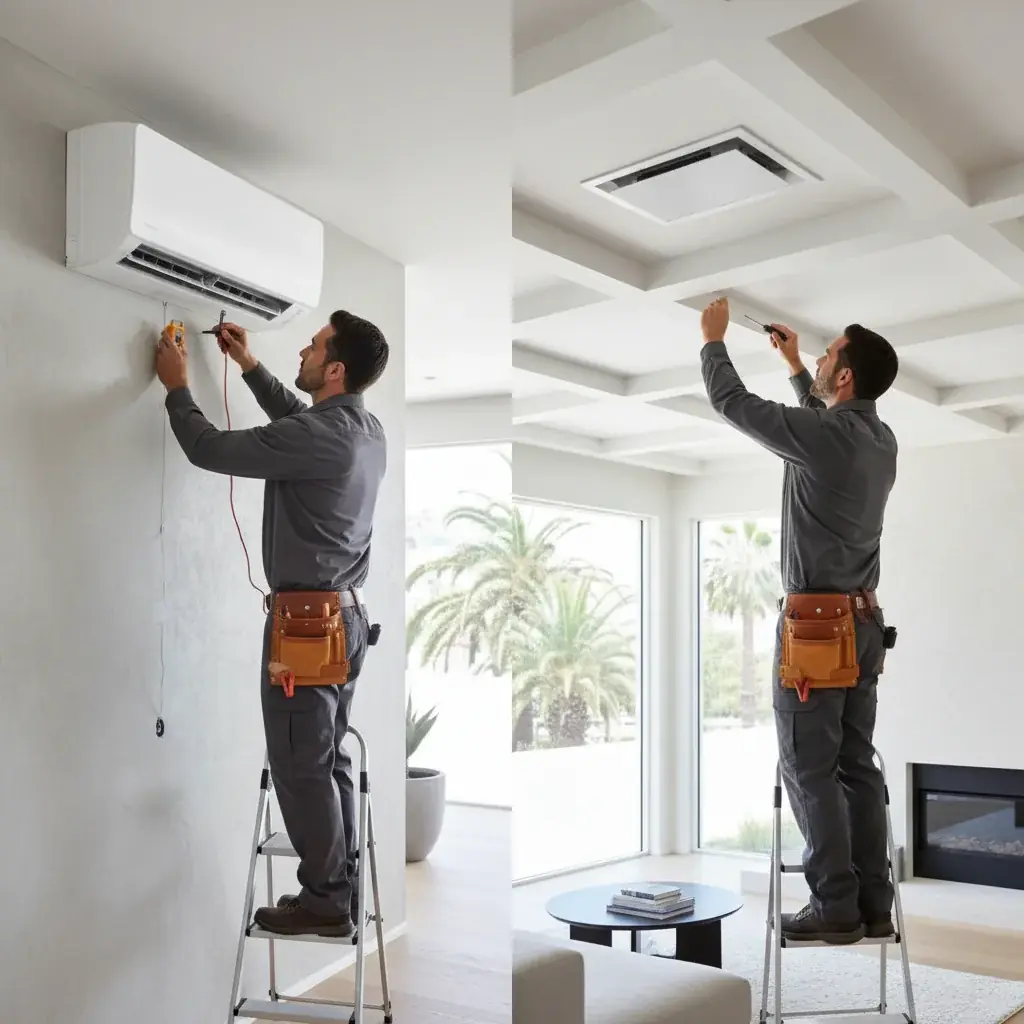
There’s no single “best” answer. The right choice depends entirely on your house, your budget, and how you live in it. Let’s break down the ductless vs central air debate so you can make a confident decision. And if you want a system that heats and cools from one unit, both options come in heat pump form; our heater and AC in one unit guide compares every combo format.
How each system actually cools a home
While both systems use the same refrigeration cycle to move heat from inside your home to the outside, they deliver that cool air in fundamentally different ways. Understanding this difference is the key to choosing the right one.
Central air conditioning: The broadcast approach
Central AC is what most people picture when they think of air conditioning. It’s a split system with two main parts: an outdoor condenser unit and an indoor air handler, which is often paired with your furnace.
The process is straightforward:
- The indoor unit pulls warm air from your home through a large return vent.
- It cools this air by passing it over a refrigerated evaporator coil.
- A powerful blower fan then pushes the newly chilled air through a network of ducts hidden in your walls, attic, or crawlspace.
- The cool air enters each room through supply vents in the ceiling, floor, or walls.
A single thermostat controls the entire system. When the temperature rises above your setpoint, the system turns on and cools the whole house at once. It’s an all-or-nothing approach.
Ductless mini splits: The targeted approach
Ductless mini splits also have an outdoor condenser. But instead of one large indoor unit, they connect to one or more compact indoor air handlers, often called “heads.” These heads are typically mounted high on a wall or in the ceiling of individual rooms.
The process is more direct:
- A thin conduit containing a power cable, refrigerant tubing, and a condensate drain line connects the outdoor unit to each indoor head.
- Each head pulls warm air directly from the room it’s in.
- It cools the air and quietly distributes it back into that same room.
Each indoor head has its own thermostat and remote control. This means you can create independent temperature “zones,” cooling only the rooms you’re using to the exact temperature you want. It’s a point-of-use system that cools spaces, not entire houses.
Where mini splits beat central AC in San Diego
Ductless technology has become incredibly popular in San Diego County for good reason. For many homes and situations, it offers clear advantages over traditional ducted systems.
Unmatched energy efficiency
This is the biggest win for mini splits. Central AC systems can lose up to 30% of their cooling power through leaks, poor insulation, and long runs in the ductwork. Since mini splits have no ducts, that energy loss is completely eliminated. Add in inverter-driven compressors that run at variable speeds instead of just “on” or “off,” and you have a system that uses significantly less electricity. With San Diego’s high utility rates, those savings add up quickly every summer. The efficiency of these systems often exceeds standards set by the California Energy Commission.
Operating cost and electric bill compared
San Diego has some of the highest electricity rates in the country. Check current TOU prices on sdge.com. That makes efficiency the single biggest lever on your cooling bill. Climate Pros SD does not publish a monthly bill table for a “typical” 1,800 to 2,200 square foot home.
| Factor | Central AC | Ductless mini split |
|---|---|---|
| Efficiency rating | 14 to 20 SEER2 | 20 to 30 SEER2 |
| Duct energy loss | Up to 30% | None |
| Summer cooling bill | Your kWh times your TOU rate | Usually lower kWh at the same setpoint |
| Zoning | One thermostat, whole house | Per-room thermostats |
These ranges assume a coastal-to-inland mix. Coastal homes in La Jolla, Encinitas, or Point Loma run far fewer cooling hours, so the dollar gap between the two systems shrinks. Inland homes in El Cajon, Santee, or Escondido run their systems hard from June through October, which is where a mini split’s efficiency pays off fastest. Ask the matched company to model operating cost against your actual SDG&E or CCA plan.
San Diego homeowners can also stack incentives. SDG&E offers rebates on high-efficiency heat pump and mini split systems. The statewide TECH Clean California program is fully reserved with a waitlist and is not accepting new single-family applications. The federal 25C tax credit ended for systems installed after December 31, 2025. Those incentives narrow the upfront price gap that often makes central AC look cheaper.
10-year cost of ownership
Upfront price tells only part of the story. Over a decade, lower running kWh can close an install gap, especially in homes with no existing ductwork. Climate Pros SD does not publish a 10-year total.
| Cost category | Central AC (with ducts) | Multi-zone mini split |
|---|---|---|
| Installation | Matched-company quote | Matched-company quote |
| Operating cost | Your kWh times your TOU rate | Usually fewer kWh at the same setpoint |
| Maintenance | Filter and coil work on the central unit | Per-head coil cleaning plus outdoor unit |
If you already have healthy ducts, central AC is usually the smaller project. If you have no ducts, adding them is its own construction job and often tips the layout toward a mini split. Climate Pros SD does not publish a duct-add band.
Perfect for homes without existing ductwork
Many of San Diego’s charming older homes in neighborhoods like North Park, South Park, and Golden Hill were built long before central air was common. They have no ductwork. Retrofitting a full duct system into these homes is a massive, messy, and expensive project that can compromise the home’s original architecture. A ductless mini split installation is far less invasive, requiring only a small, three-inch hole behind each indoor unit.
Ideal for additions, ADUs, and problem rooms
Do you have a new home office in a converted garage? A casita for family or renters? Or just one upstairs bedroom that’s always 10 degrees hotter than the rest of the house? Mini splits are the perfect solution. Extending existing ductwork to these spaces can be inefficient or impossible. A single-zone mini split provides powerful, efficient cooling and heating right where you need it, without affecting the rest of your home’s HVAC system.
Where central AC still wins
Despite the rise of ductless tech, traditional central air conditioning remains the go-to choice in many scenarios. It’s a proven technology that excels in the right environment.
For homes with existing, healthy ductwork
If your home was built in the last 30 years, it likely has a network of ducts already in place. As long as that ductwork is in good condition, properly sealed, insulated, and sized for your home, sticking with a central system is usually the most practical and cost-effective option. A new, high-efficiency central AC installation can be integrated directly with your existing infrastructure, saving thousands on the project cost.
Whole-home temperature uniformity
Some people prefer a single, consistent temperature throughout their entire home. Central AC delivers this beautifully. You set one thermostat, and the system works to maintain that temperature in every room with a vent. There are no separate zones or remotes to manage. It’s a simple, set-it-and-forget-it approach to whole-home comfort that works especially well in open-concept floor plans.
Invisible aesthetics and advanced filtration
One of the main aesthetic complaints about mini splits is the look of the indoor heads on the wall. Central AC is virtually invisible. All you see are discreet, paintable vents in the ceiling or floor. Furthermore, central systems can accommodate much more advanced air filtration. You can install high-MERV filters or whole-home air purification systems within the central air handler to capture dust, allergens, and even wildfire smoke particles, improving the indoor air quality for your entire house.

Install cost and disruption compared honestly
The price tag and the installation experience are often the deciding factors for homeowners. The comparison isn’t always apples-to-apples.
A brand new central AC system, including all new ductwork, is a major construction project. It’s the most expensive and disruptive option, often taking a week or more and requiring significant drywall cutting and repair. If you’re only replacing an existing central unit and using the old ducts, the cost and disruption are much lower.
A single-zone mini split for one room is typically the least expensive option. It’s a simple installation that can be done in a few hours with minimal mess.
A multi-zone mini split system designed to cool an entire house can be comparable in price to a new central AC system with ductwork. However, the installation is far quicker and cleaner, usually taking just one to three days. The final cost depends heavily on the number of indoor units you need. For a detailed breakdown, see our guide to ductless mini split costs in San Diego.
The final verdict on cost often comes down to this:
- Ducts already in place? Replacing your central AC unit is likely your cheapest path.
- No ducts? A multi-zone mini split system is often more cost-effective than installing central air from scratch.
Hybrid approach: when to use both
You don’t always have to choose one or the other. A hybrid strategy can offer the best of both worlds.
Imagine you have a decent central AC system that keeps most of your house comfortable. But you recently enclosed a patio to create a sunroom, or your teenager moved into the bonus room over the garage. These spaces are notoriously hard to cool.
Instead of trying to extend your existing ductwork, which can unbalance the whole system and may not even work well, you can install a single-zone ductless mini split just for that problem area. This gives you powerful, dedicated cooling and heating in the new space without the expense of replacing your entire central system. It’s a smart, targeted upgrade that solves a specific comfort problem efficiently.
Frequently asked questions
Which is cheaper to run, a mini split or central AC? A mini split is usually cheaper to run. It hits 20 to 30 SEER2 against 14 to 20 for central air, and it skips duct loss. Climate Pros SD does not publish a $25 to $50 monthly figure. Use your SDG&E TOU rate.
Does a mini split really lower my SDG&E bill? Yes, in most cases. Mini splits cool only the rooms you’re using and run on variable-speed compressors, so they pull less power. Check current TOU prices on sdge.com. Climate Pros SD does not publish a cents-per-kWh table.
Is central AC or a mini split better for an older San Diego home? A mini split is usually better for older homes in areas like North Park, South Park, or Golden Hill that have no ductwork. Retrofitting ducts is invasive. A mini split needs only a small hole behind each indoor head. Climate Pros SD does not publish an $8,000 to $18,000 duct retrofit.
What’s the total cost difference over 10 years? Ask for two written quotes covering the same years of ownership. Climate Pros SD does not publish a $12,500 to $24,500 10-year total. If you already have healthy ducts, central AC usually wins on disruption. If you don’t, adding ducts often tips the layout toward a mini split.
Are there rebates for mini splits in San Diego? Yes. SDG&E offers rebates on high-efficiency heat pump and mini split systems, when funded. TECH Clean California is fully reserved with a waitlist. The federal 25C tax credit ended for systems installed after December 31, 2025.
Can I use both systems in one home? Yes. Many San Diego homeowners keep working central AC for the main house and add a single-zone mini split for a converted garage, sunroom, or hot upstairs bedroom. It’s a targeted fix that avoids unbalancing the existing system.
When to call us
Choosing between a mini split and central AC involves a lot of variables: your home’s age and layout, insulation levels, window quality, and your family’s comfort habits. Making the right choice requires a professional assessment and a proper load calculation to ensure whatever system you choose is sized correctly for your home. An undersized system won’t keep up, and an oversized one will waste energy and wear out prematurely.
Call us at (442) 777-6440 to get matched with a vetted pro for an estimate.