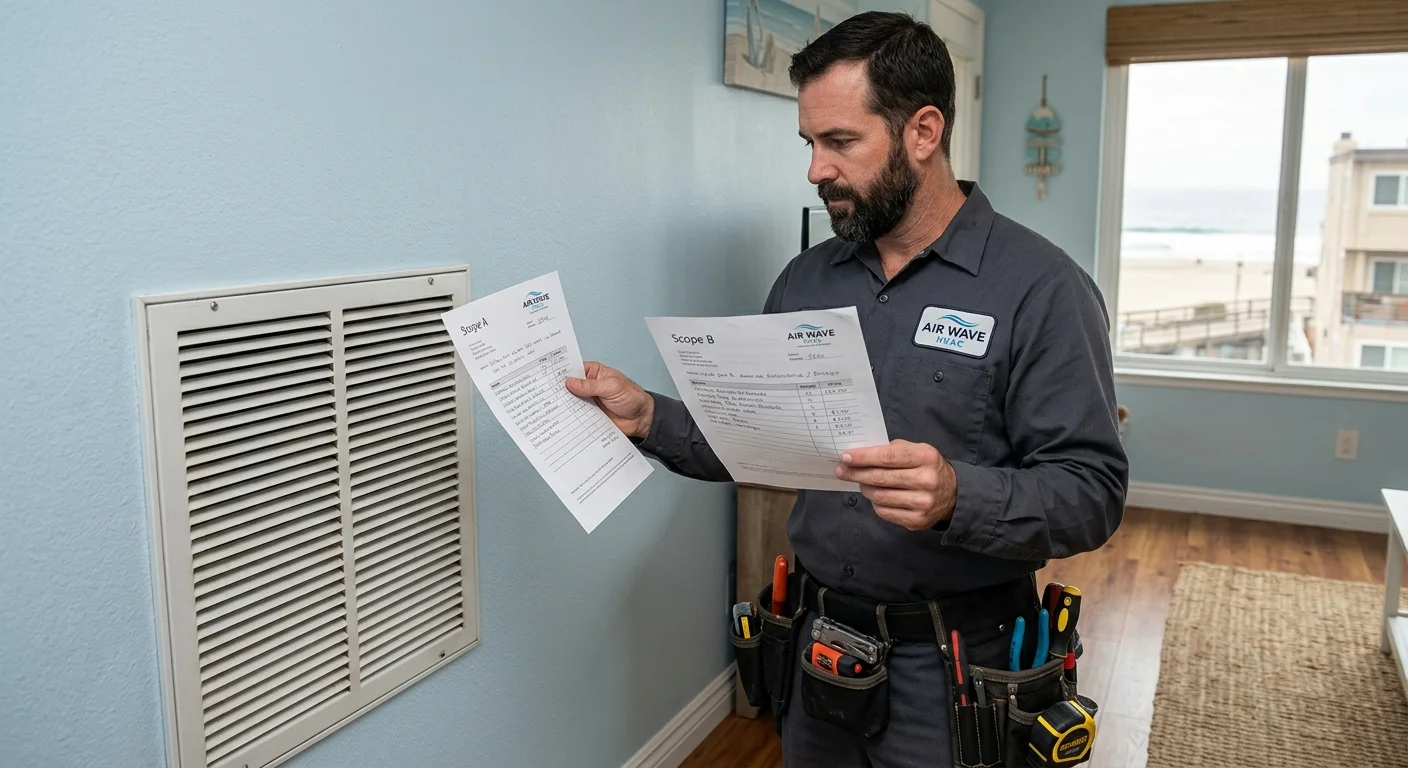
Two Pacific Beach quotes can look the same until you read what each one actually cleans. One may cover every supply and return run in a Crown Point condo. The other may wipe registers and leave the trunks alone. Line the scopes up against access, salt air, and whether the system even needs the work.
Climate Pros SD matches you with licensed, independent HVAC pros. The brand does not clean ducts, own trucks, or set prices. You contract with the pro directly. That is why a written Pacific Beach duct cleaning quote has to name rooms, runs, and access, not just a neighborhood.
What should a written cleaning scope identify?
Ask for the job on paper before anyone opens a register on Garnet, Grand, or Mission Boulevard. A useful scope names the building, the unit, and the system it will touch. It should say whether the work is HVAC supply and return ducts, the air handler, the plenum, the registers and grilles, or something else.
Dryer vents are a different path. Many search results mix lint exhaust with heating and cooling ducts. A clothes-dryer vent runs from the appliance to the outside. HVAC ducts move conditioned air through the home. If both appear on one page, they still need separate line items, separate access, and separate outcomes. Do not let a dryer-only visit stand in for air-duct work, or the reverse.
The scope should list every opening the crew will use. That includes supply registers, return grilles, and any access panel at the air handler. It should say whether covers come off, get cleaned, and go back on. It should say whether the trunk lines get mechanical agitation and vacuum, or only the first few feet. “Whole system” is not a scope. Room count, register count, and which side of the system (supply, return, or both) is.
Ask what the pro will look at before cleaning starts. The U.S. EPA does not recommend duct cleaning on a fixed calendar. It points to conditions such as substantial visible mold, vermin, excessive dust or debris, or particles coming from supply registers. A Pacific Beach proposal that skips that look and jumps to a package clean is incomplete.
The paper should also say what is out of bounds. Flexible runs above a dropped ceiling, ducts inside a concrete slab, or a shared shaft the association will not open all change the job. If the air handler is on a condo roof above Ocean Front Walk, the scope needs roof access in writing. If the return is a stud bay with no real duct, cleaning talk may not match the hardware.
Photos or a simple room map help. So does a note on chemicals. If a sanitizer or sealant is on the quote, ask what it is for and what it will not do. The EPA says duct cleaning has never been shown to prevent health problems, and studies do not conclusively show that particles in ducts raise indoor particle levels. Unexplained symptoms should not be blamed on ducts without evidence. Keep the scope on contamination you can see or document, not on a promised health result.
Finally, ask who moves furniture, how dust is contained, and how the filter is handled. A written Pacific Beach job that names those details is easier to compare with other air-duct cleaning offers than a one-line “duct cleaning” price.
How can condo and rental access affect the proposal?
Pacific Beach housing is mixed: stacked oceanfront condos, bay-side flats in Crown Point, cottages east of Ingraham, and short-term rentals near the boardwalk. Do not assume your building matches the last job on the block. Access is what makes two units in 92109 different on paper.
In a condo, the air handler may sit on a roof, in a closet, or in a shared mechanical space. Registers may serve only your unit, or a hallway the association controls. The matched pro cannot guess which is which from the street. The proposal should name who opens the roof hatch, who has the mechanical-room key, and whether work stops at the unit’s takeoffs.
Parking and staging matter on this peninsula. Summer traffic on Mission Boulevard, permit streets off Fanuel and Lamont, and gated alleys all change how equipment gets to the door. Ask where the vacuum sits, how hoses reach a third-floor stack, and whether the association limits work in common corridors. Climate Pros SD cannot publish one HOA rule for Pacific Beach. Those rules differ by building. Ask your board or manager what they require, then put the answer on the proposal.
Rentals add a second calendar. A tenant on Hornblend, a property manager in Mission Beach, and an owner who lives inland may all need notice. The scope should say whether someone must be home, whether registers in occupied bedrooms are included, and what happens if a locked room is skipped. For a short-term rental, turnover dust and sand at the door are common. That still does not, by itself, prove the ducts need cleaning. Inspection comes first.
Shared laundry rooms complicate dryer vents, not always the HVAC. An in-unit dryer in a stacked condo may exhaust through a long, tight chase. That is still a dryer job. Do not fold it into HVAC duct cleaning unless the paper says so.
If you rent, ask who pays and who authorizes entry. California rental and association documents were not verified here as a single Pacific Beach rule. Get the written okay from the person who controls the unit and the common equipment. Then have the licensed pro walk the access path before the quote is final. A cheap number that assumes open roof hatches and empty rooms will not match a packed August weekend on Sail Bay.
Put access in the same document as the cleaning list. “Need parking, roof key, and unit entry” is part of the job, not a footnote. Without it, you are not comparing equal Pacific Beach duct cleaning quotes.
Which coastal conditions require inspection first?
Pacific Beach sits on the ocean and Mission Bay, with marine air, sand, and a milder coastal pattern than inland valleys. The National Weather Service describes ocean moderation near San Diego and notes that hot easterly winds can still push heat to the coast. That mix is why inspection belongs ahead of a package clean.
Start at the outdoor unit and the nearest registers. Salt crust, sand at floor returns, and damp dust on a supply grille are reasons to look closer. They are not, on their own, a diagnosis. The EPA’s “as needed” list is the filter: substantial visible mold, vermin, excessive dust or debris, or particles blowing from supplies. If those are not there, a coastal address alone does not justify cleaning.
Moisture is the local watch item. Morning marine layer, closed windows on a still night, and beach-level units can leave registers feeling clammy. Visible mold on a grille or in an accessible run is a reason to inspect and to fix the cause, not a reason to promise cleaner lungs. The EPA says unexplained symptoms should not be attributed to ducts without evidence. If you care about indoor air quality, ask the pro to separate filter condition, moisture at the coil, and debris in the ducts. Those are different problems.
Sand is another Pacific Beach specific. Beach-level returns pull grit if they sit low and the door is open to the walk. That can show up as heavy dust at the first few feet of a return. A scope that only brushes bedroom supplies may miss it. A scope that claims a health win from removing beach sand overstates the EPA record.
Do not skip the rest of the system while staring at ducts. A neglected filter, a wet drain pan, or a failing fan can throw dust that looks like a duct problem. Coastal outdoor coils also collect salt and grit. That is equipment maintenance, not duct cleaning. If the unit is weak, read our note on finding an AC repair company in Pacific Beach and treat comfort and airflow as their own visit.
Inspection first also protects you from a calendar pitch. Competitors often sell a 2- or 3-year clean. The EPA does not recommend that schedule. Coastal living does not create a published interval in the sources we can cite. Ask for what the pro sees in this unit, on this day, with photos if they have a camera. Then decide.
If the inspection finds little debris and no listed EPA conditions, you can wait. If it finds a mess at the registers, vermin, or visible mold, you have a reason to clean and a reason to ask what caused it.
How do you separate cleaning from duct repair?
Cleaning removes debris from inside the runs when conditions justify it. Repair and sealing deal with holes, tears, crushed flex, and poor connections. They are not the same bid.
ENERGY STAR says a typical forced-air house can lose about 20% to 30% of the air moving through ducts because of leaks, holes, and poorly connected ducts. That is a national typical-house statement. It is not a measured result for a Pacific Beach condo or cottage. It also describes leakage, not dirt. Vacuuming a leaky trunk does not close the leak.
The EPA says there is little evidence that cleaning ducts alone improves system efficiency. Cleaning addresses contamination when conditions justify it. Sealing addresses air leakage. Neither supports a guaranteed bill, energy, health, or comfort outcome. If a quote promises lower SDG&E charges from cleaning only, treat that as marketing. Current listed SDG&E residential time-of-use plans have a 4-9 p.m. on-peak period, but that does not turn a duct vacuum into a rate cut. Confirm your plan and rates with SDG&E.
On the job, keep the line items apart. Cleaning: agitation and collection in named ducts, register service, air-handler cabinet if accessible. Repair: taping or mastic at joints, replacing a crushed flex run to a Crown Point bedroom, reconnecting a boot that dumped air into a ceiling, or sealing a return that pulls from a garage. If the matched contractor will alter or repair ductwork in the City of San Diego, that work can trigger a mechanical permit. City rules say heating, ventilating, air conditioning, or refrigeration systems shall not be installed, altered, replaced, or repaired unless a mechanical permit has been obtained. The licensed contractor pulls that permit. Climate Pros SD does not.
California Title 24 also requires field verification testing when HVAC systems are altered or replaced. A clean-only visit is not the same as an alteration. If repair turns into new ducts or a system change, ask the pro whether a CEC-certified rater is part of the plan. Specific leakage percentages were not confirmed in our ledger, so do not accept a made-up test number as a city rule.
Flex duct in tight condo chases can hide kinks that look like “dirty air.” A camera shot of a pinched run is a repair conversation. A pile of lint at a return is a cleaning conversation. Get both in writing if both are real. Then you can decide whether you are buying duct cleaning, a repair, or both.
Do not let a cleaner “seal” with a product that is only a spray inside the pipe unless the paper explains the product and the limit. Sealing that matters is at joints and connections a C-20 contractor can reach and document.
When should an independent HVAC pro inspect the system?
Call for an inspection when you see the EPA’s conditions, when airflow is weak in one room, or when two quotes disagree about what exists behind the registers. Pacific Beach units hide a lot: roof packs, closet air handlers, and short runs over a single story. An independent, licensed HVAC pro can tell cleaning from mechanical trouble.
Check the license. C-20 (warm-air heating, ventilating, and air-conditioning) covers ducts, registers, and air filters in connection with those systems. Verify the number on the CSLB license check before anyone works. Every HVAC pro in the Climate Pros SD network is licensed and insured. The brand itself is a referral service, not the contractor of record.
Inspect before you buy a package. If supply registers puff debris, if you can see substantial mold or vermin in accessible duct, or if dust is excessive at returns, cleaning may be justified. If the complaint is a hot west bedroom, a noisy unit, or a system that short-cycles, start with equipment diagnosis. Cleaning will not resize a system or fix a failing capacitor.
People also ask whether duct cleaning is worthwhile. The honest answer is: sometimes, when those conditions are present, and not as a routine. We walk through that decision in whether duct cleaning is worth it in San Diego. There is no published average price in our verified ledger for this page, and Climate Pros SD does not set fees. Ask each pro for a written number tied to the scope you compared.
Inspect after remodeling or a heavy sand week only if debris actually reached the system. A covered return during work is prevention. An uncovered return in a unit off the Tourmaline surf park is a reason to look, not a reason to skip the look.
Bring the written scopes to that visit. Ask the pro to confirm register count, air-handler access, and whether repair is mixed into a cleaning price. Ask how long the work itself should take for this unit. Job length is a work estimate the pro confirms. It is not an arrival promise, and Climate Pros SD does not publish one.
If the inspection says wait, keep the filter on a real change-out rhythm and keep moisture off the coil. If it says clean, use the scope rules above. If it says repair, treat permit and testing as the contractor’s licensed work, not as extras you invent later.
When to call us
Call when you have two unmatched Pacific Beach quotes, a condo or rental access problem, or visible debris, vermin, or mold in accessible ducts that needs a licensed look. Climate Pros SD will connect you with an independent C-20 pro who can inspect first, separate cleaning from repair, and put the job in writing. Call us at (442) 777-6440 and we will match you with a licensed local pro.