Window AC units are simple machines, which is part of their appeal, but simple doesn’t mean failure-proof. Most of the problems we hear about trace back to one of five causes, and a few of them are fixable in minutes without a service call.
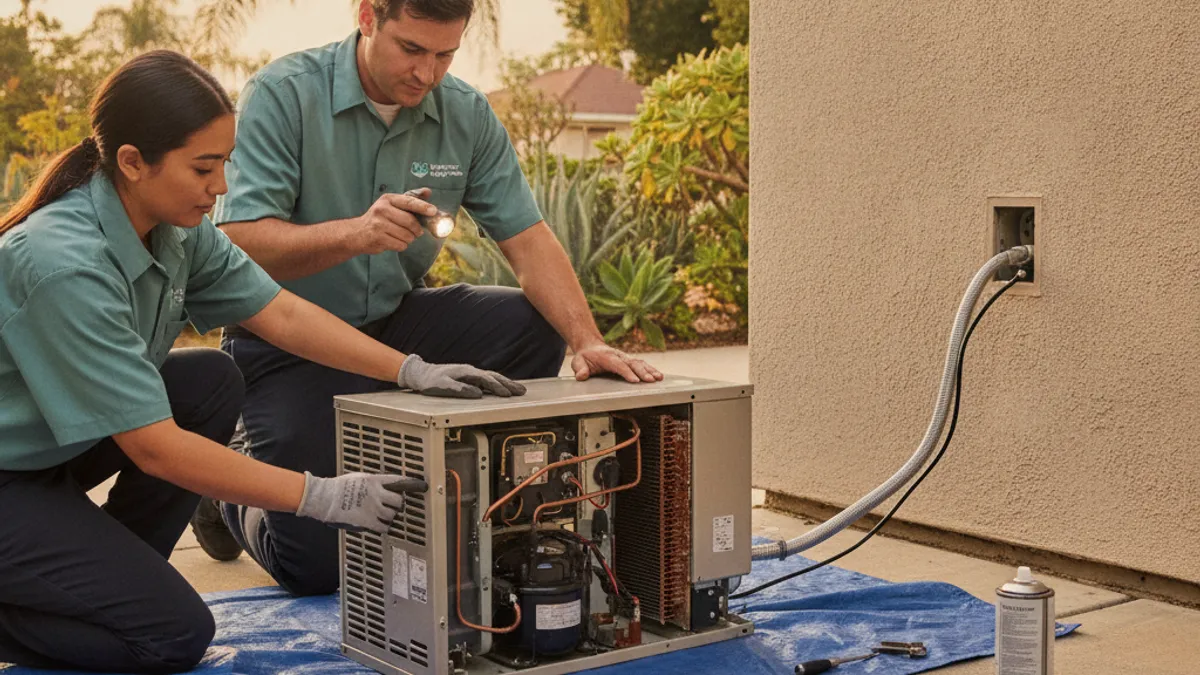
Window AC not cooling: filter, ice, then tilt
Rinse the slide-out filter. If the coil is iced, run fan-only until it melts. Check that the chassis tilts slightly outdoors so condensate leaves the room. Refrigerant leaks on window units often mean replacement, not a field recharge. Coastal PB and OB units corrode faster. Inland units die from capacitors after long heat-wave runtime.
Checklist
- Confirm the outlet and GFCI have power.
- See portable AC.
- See window AC rentals.
- See heat wave while you wait.
- Use AC repair for a licensed look if you are weighing a mini split instead.
Related: Pacific Beach HVAC and AC installation.
Not cooling, or barely cooling
This is the most common complaint, and the most common cause is the simplest one: a dirty air filter restricting airflow across the coil. Most window units have a slide-out filter behind the front grille that’s easy to pull, rinse, and dry. If cleaning the filter doesn’t help, check whether the coil itself, visible once the filter is out, has visible ice or frost on it. Ice on the coil usually means restricted airflow (a dirty filter, blocked intake, or a failing fan) or the thermostat set too aggressively for the ambient conditions, causing the coil to run colder than it should and freeze over. Run the unit on fan-only for an hour to let the ice melt fully before diagnosing further, since ice on the coil blocks the airflow you’re trying to test.
If the coil is clean and frost-free and the unit still isn’t cooling, the sealed refrigerant system itself may have a leak. Unlike central AC, window units aren’t generally designed to be serviced or recharged in the field. A refrigerant issue on a window unit usually means replacement is more practical than repair, given the unit’s overall cost relative to a proper refrigerant system repair.
Water leaking inside instead of draining outside
Window units are designed to tilt very slightly backward, toward the outside, so condensate drains out the back rather than pooling and dripping inside your room. If yours is leaking indoors, check the installation angle first. A level bubble or even a basic carpenter’s level on top of the unit will show you quickly if it’s tilted the wrong way or sitting perfectly flat when it needs a slight backward pitch.
If the tilt is correct and it’s still leaking inside, the condensate drain path inside the unit itself may be blocked with dust or debris, causing water to back up and overflow toward the front instead of draining out the back as designed.
Unusual noise
A rattling or buzzing noise often means a loose panel or a fan blade making contact with its housing, sometimes from a blade that’s warped slightly or slipped on its shaft. A grinding sound points to a failing fan motor bearing. A single loud bang on startup or shutdown is usually a compressor mount issue, the rubber isolation mounts that cushion the compressor have hardened or failed with age, letting it thump against the cabinet during its start or stop cycle.
Won’t turn on at all
Start with the obvious: confirm the outlet has power and the unit isn’t on a dedicated circuit that’s tripped, which is common since many window units draw enough current to warrant their own breaker or a GFCI outlet that can trip independently of the main panel. If power is confirmed, a failed thermostat sensor or control board is the next most likely cause, followed by a failed run capacitor, the same small part responsible for a huge share of AC failures across every type of system, central or window unit alike.
San Diego-specific wear patterns
Coastal units, especially anywhere within a mile or two of the ocean, see faster cabinet and coil corrosion from salt-laden air than inland units do. If your window unit is installed in an older apartment building near the coast, in neighborhoods like Pacific Beach or Ocean Beach, expect a shorter working life than the same model would get further inland, and budget for that when deciding whether a given repair is worth it versus replacement.
Inland units run harder and longer during summer heat waves, which shows up as more frequent capacitor and fan motor wear from the extended runtime, similar to capacitor and fan wear on central systems in the same inland zip codes. See our heat wave prep checklist for broader summer readiness that applies to any cooling system, window units included.
For a comparison against a portable unit if you’re deciding which type of supplemental cooling fits your space, see our portable AC guide.
Frequently asked questions
Why is my window AC leaking water inside my room?
The most common cause is incorrect installation tilt. The unit needs a slight backward pitch toward the outside so condensate drains out rather than pooling inside. Check the tilt with a level before assuming there’s an internal problem.
Is it worth repairing a window AC unit, or should I just replace it?
For simple issues like a dirty filter, a capacitor, or an installation tilt problem, repair is usually worth it and inexpensive. For a refrigerant leak or a compressor failure, replacement is often more practical given the unit’s overall cost.
Why does ice form on my window AC’s coil?
Restricted airflow is the most common cause, from a dirty filter, a blocked intake grille, or a weak fan. Running the thermostat too cold for the ambient conditions can also cause the coil to run below freezing and ice over.
How long do window AC units typically last?
Most run 8-12 years with reasonable care, though coastal units exposed to salt air often see a shorter working life due to faster corrosion of the cabinet and coil.
Related services: AC repair, AC installation and HVAC maintenance.
When to call us
Window units are often more practical to replace than deeply repair once the sealed refrigerant system is involved, but if you’re dealing with a fixable issue, a capacitor, a fan, or an installation problem, or you’re weighing a window unit against a more permanent cooling solution for the space, call (442) 777-6440 for an honest read on which makes sense.