Last updated: May 26, 2026

HVAC Maintenance · Vista, CA

HVAC maintenance in Vista, CA

A Vista summer will stress-test every weak component in your HVAC system. A yearly tune-up finds the parts about to fail before July turns your house into a waiting room. One visit, 21 checkpoints, priced up front.

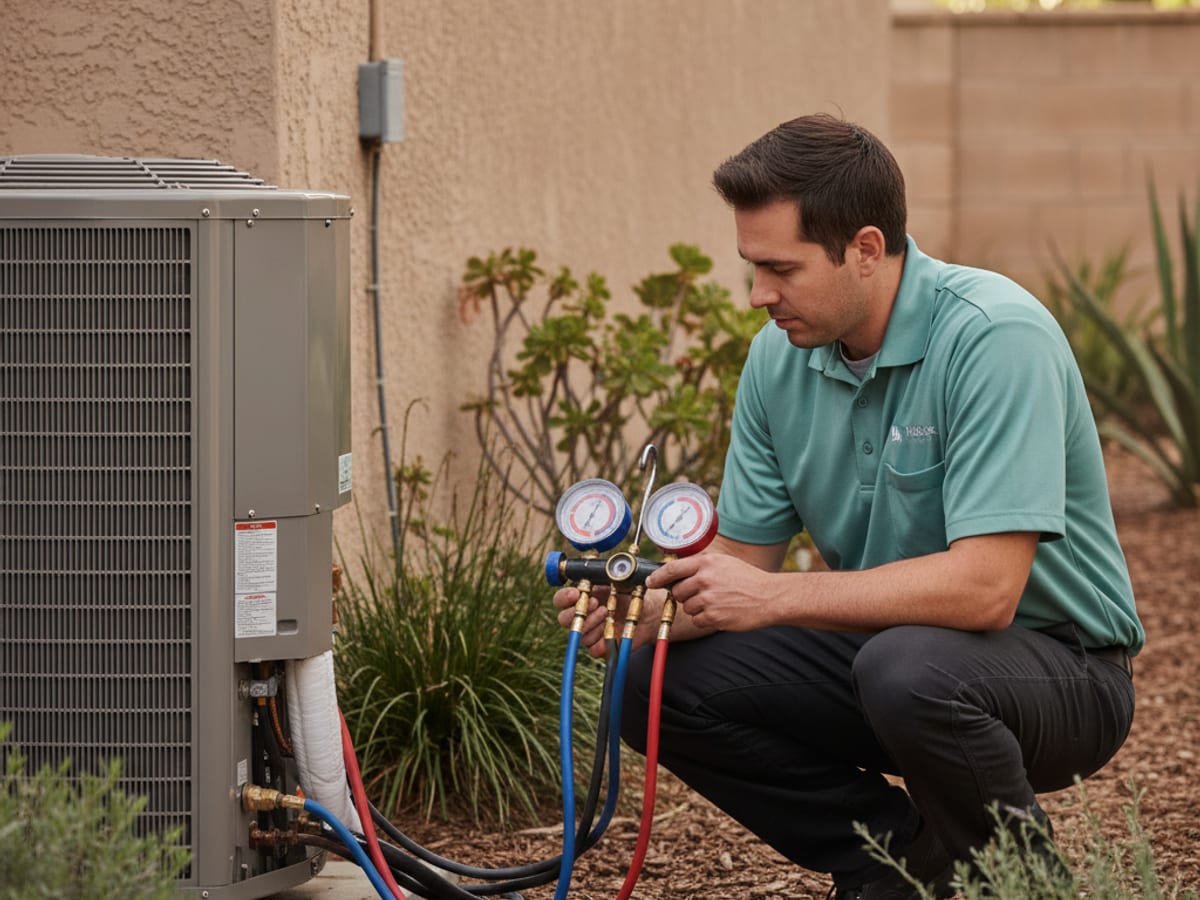
HVAC technician performing maintenance in Vista, CA

HVAC maintenance in Vista is available as a single tune-up visit or as our two-visit annual plan, and the pro you're matched with quotes the price up front before starting. The 21-point inspection covers every component that causes a mid-summer failure: capacitor microfarads, contactor condition, refrigerant subcooling and superheat, static pressure, amp draw on every motor, and a full coil cleaning. You get a written report at the end of every visit.

Vista sits well inland from the coast. The marine layer that keeps Oceanside and Carlsbad comfortable most summer afternoons rarely reaches Shadowridge or Vista Village. That means your system runs longer daily cycles under real heat, often 90 to 105 degrees from June through September. Components that are technically within spec in April become failures by the third week of June. Annual maintenance is the only way to catch them before that window opens.

A large portion of Vista's housing stock was built in the 1970s and 1980s. Those homes are now sitting on systems that are 35 to 45 years old, or on second-generation equipment from the 1990s that is entering its own end-of-life phase. For those homes, a yearly tune-up is not optional, it is the difference between a controlled replacement on your timeline and an emergency call late on a Saturday in August.

What our 21-point inspection covers in Vista

Every maintenance visit runs through the same 21 checkpoints. These are the measurements and tests that catch failures before they happen, not after the system quits.

  • Capacitor microfarad reading: identifies a cap within 10% of failure before it blows
  • Contactor condition and contact gap: burned contacts cause hard starts and compressor stress
  • Refrigerant subcooling and superheat with gauges: finds low-charge or overcharge conditions
  • Amp draw on compressor, condenser fan motor, and indoor blower: catches motors pulling high before they fail
  • Static pressure across the air handler: identifies restricted ductwork and clogged coils
  • Temperature split across the evaporator coil: measures actual cooling performance at the coil
  • Evaporator coil cleaning if restricted: dust buildup in Vista's dry inland air packs into coils fast
  • Condenser coil rinse and inspection: outdoor coil condition affects refrigerant head pressure directly
  • Condensate drain flush and float switch test: clogged drains are one of the most common Vista call causes in summer
  • Thermostat calibration and staging verification: checks that the system stages correctly at setpoint
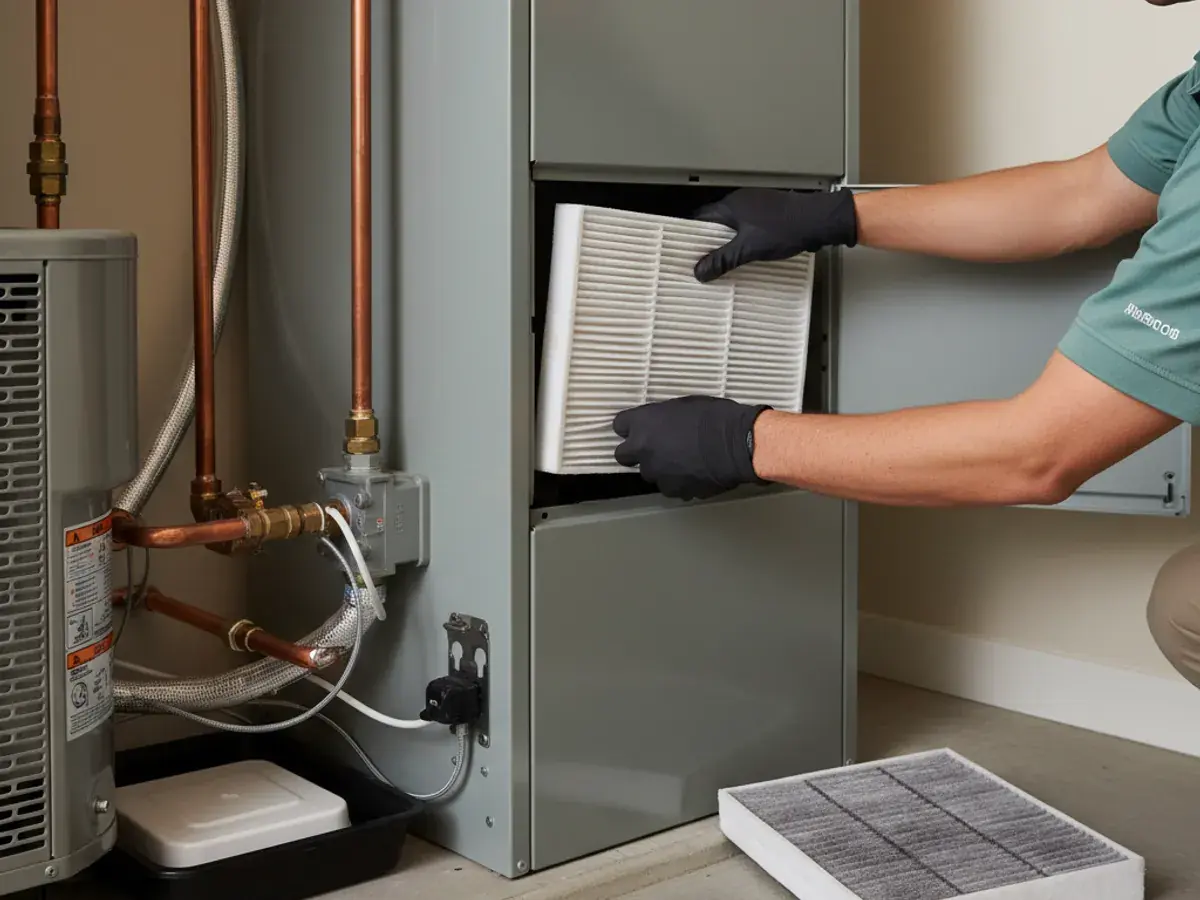
  • Filter inspection and replacement if needed: priced separately by filter type
  • Electrical connections tightened and inspected: loose terminals cause arcing that takes out control boards
  • Refrigerant line insulation condition: degraded insulation in Vista attics is common after 10+ years of heat cycling
Maintenance detail work by an HVAC technician in Vista, CA

HVAC maintenance cost in Vista

Every visit is quoted up front by the pro you're matched with. No diagnostic fee layered on top, no hidden charges for the coil cleaning.

Repair Typical range Notes
Single tune-up visit Priced by the company you sign up with 21-point inspection, coil cleaning, written report
Annual maintenance plan (2 visits) Priced by the company you sign up with; typically less per visit than a single tune-up Pre-summer + pre-winter, best value for Vista homes
Filter replacement (standard 1") Priced by filter type Often included in the visit price if you supply the filter
Filter replacement (4" media or HEPA) Priced by filter brand and size Depends on filter brand and size
Shadowridge multi-zone system (additional zones) Priced by the company you sign up with Per-visit rate for 3+ zone systems common in estate homes, covers all zones in one visit
Condensate drain treatment Included Algae tablet or flush, part of every tune-up
Refrigerant top-off (if needed) Priced by how much charge is needed Quoted separately if the system is low; leak search required
Hard-start kit installation Quoted after inspection Reduces compressor start stress on aging Vista systems

Pricing is set by the company you are matched with, not by ZIP code, across all Vista ZIP codes: 92081, 92083, and 92084. No travel fee for Shadowridge, Vista Village, Buena Creek, or Rancho Buena Vista. If the tune-up turns up something that needs repair, that gets quoted separately and nothing proceeds without your approval.

What annual maintenance prevents

A tune-up does not just clean coils. It finds the components on the edge of failure and gets them on your radar before they take the system down. These are the failures that a yearly inspection catches early, and what they cost if they are caught late.

Capacitor failure: cheap to catch early, expensive to replace on an emergency call

Run capacitors are the most common single point of failure in Vista air conditioners. They weaken over years of heat cycling, and the reading drops gradually until the motor they start cannot pull enough current to run. Capacitor microfarads get measured on every maintenance visit. A cap reading 10% or more below rated value gets flagged and replaced during the tune-up at the standard scheduled part rate, not an emergency rate.

Left unfound, a weak capacitor lets the compressor hard-start on every cycle until it fails. Compressor replacement is a major expense, and at that cost, replacement of the full system usually wins. One maintenance visit catches the cap for a modest scheduled cost before it takes the compressor with it.

Refrigerant loss: catch it early vs. a frozen coil at midnight

Small refrigerant leaks develop slowly. The system runs fine in April with the charge slightly low, then struggles in June when the outdoor temperature hits 98 and demand rises. By late July the evaporator coil freezes, the air handler blows warm, and the emergency call happens on a Friday evening.

Every maintenance visit includes a refrigerant subcooling and superheat check with gauges. A system running borderline low shows that on the gauges even before it causes symptoms. Finding the leak, repairing it, and recharging the system happens on a scheduled visit for a predictable, quoted cost, not an emergency premium.

Coil restriction: airflow loss that compounds every year

Vista's dry inland air carries fine dust and particulate from inland areas, especially during Santa Ana wind events. That dust bypasses the filter gradually and packs into the evaporator coil fins. A coil that is 20% restricted runs the compressor harder to achieve the same cooling, raises amp draw on the blower motor, and raises head pressure on the refrigerant circuit. Left alone for several seasons, this takes years off the compressor and the motors.

Evaporator coil cleaning is included in every maintenance visit. The condenser coil gets rinsed and inspected. Both are reset to baseline so the system runs at rated efficiency, not degraded efficiency.

Condensate blockage: a quick flush vs. water damage to ceilings and walls

The condensate drain carries the moisture the evaporator coil pulls out of the air during cooling. In Vista homes, the drain line runs through walls or ceilings, and a blockage backs up into the air handler drain pan. When the pan overflows, the water goes into the ceiling or wall below it. The drain gets flushed and treated with an algae tab on every visit so the line stays clear all season.

Local angle

Maintenance built for Vista's housing and climate

The 1970s-80s Vista tract stock

South Vista and the Buena Vista area hold a large concentration of tract homes built between 1972 and 1988. That puts most of those original systems at 35 to 45 years old. Even homes that replaced equipment once in the early 2000s are now at 20 to 25 years on that second system.

At that age, the failure mode changes. It is no longer a question of whether components are wearing down, it is a question of which one goes first. A capacitor, a contactor, a motor: each one is fragile. A skipped tune-up in this range is not a missed tune-up, it is a missed chance to find the part that fails in the third week of July, meaning two days of 90-degree indoor heat while parts ship.

For these homes, compressor amp draw and hard-start behavior get particular attention. A compressor pulling high amps is telling you it is working too hard to start. A hard-start kit reduces that strain and can add two to three years to a compressor that is otherwise on borrowed time.

Shadowridge: HOA schedules and multi-zone systems

Shadowridge is a master-planned community with 1980s to 2000s estate homes, many of them larger two-story floor plans with multi-zone HVAC systems. Two-zone and three-zone setups are common, and they add complexity to a maintenance visit because each air handler and each zone damper has to be checked independently.

HOA rules in Shadowridge generally require pre-approval for equipment replacements and visible exterior changes, but routine maintenance, coil cleaning, and filter replacement do not require HOA sign-off. If you are scheduling a visit and your HOA does have specific coordination requirements, service works around those timelines. When equipment replacement jobs in Shadowridge come out of a maintenance visit, documentation for HOA review gets handled.

The per-visit rate for multi-zone Shadowridge systems covers all zones in one visit, not a per-zone charge.

Rancho Buena Vista rental properties

The Rancho Buena Vista corridor near MiraCosta College and CSUSM has a high concentration of rental units, and rental HVAC follows a different wear curve than owner-occupied systems. Filters get changed less often, coils pack with dust faster, and the system runs longer before anyone calls about performance.

Property managers often schedule maintenance during tenant turnover windows, which makes sense. Property managers get worked with directly for portfolio scheduling. If you own multiple units in Vista, visits can be batched to reduce trip time and give you a consistent written report for each unit. Scheduling during turnover is fine, and if the unit is occupied, coordination happens directly with the tenant on access.

The Vista summer: why inland heat changes everything

Coastal cities in San Diego County rely on the marine layer to moderate afternoon temperatures through June, July, and August. Oceanside and Carlsbad routinely sit in the low 70s on summer afternoons when the coast is socked in. Vista does not get that. Most of Vista, especially inland neighborhoods like Shadowridge, South Vista, and Buena Creek, bakes through the full summer heat cycle.

When the outdoor temperature runs 95 to 105 for three to four weeks, an HVAC system runs far longer daily cycles than it does in May or October. Capacitors that are borderline but functional in the shoulder seasons fail under sustained heat load. Refrigerant that is slightly low is fine at 75 degrees but causes a freeze-up at 95. This is why pre-summer tune-ups in March, April, and May matter so much more than waiting for a problem to show itself.

Santa Ana winds and filter load in Vista

Vista's inland position makes it one of the harder-hit areas in San Diego County during Santa Ana wind events. When the wind shifts easterly in late summer and fall, it brings dry, dusty air from inland valleys. During a multi-day Santa Ana event, a standard 1-inch filter can load up to 60 to 70% of its capacity in a matter of days.

A choked filter reduces airflow, raises static pressure across the air handler, drops the temperature split at the coil, and raises amp draw on the blower motor. If the system was already running warm-season hours, a five-day Santa Ana event can take it from functional to struggling. Checking and replacing the filter immediately after any significant wind event is worth doing, and the fall maintenance visit is timed to address exactly this.

Vista Village and the older central neighborhoods

Vista Village and the residential streets near the historic commercial core include some of Vista's oldest housing, with some structures dating to the 1920s and 1930s. HVAC in these homes is often a retrofit: original structures were not designed for central air, so ductwork is sometimes undersized or routed in non-standard ways.

All of it gets serviced. Older duct layouts sometimes run longer from the air handler to the register, which increases static pressure and reduces airflow at the far end of the system. Static pressure gets measured as part of every tune-up, so if duct restrictions are limiting performance, that shows up in the numbers and the options can get walked through.

Vista maintenance questions

How much does HVAC maintenance cost in Vista?

It depends on the company you're matched with and what the inspection finds. Both the single tune-up visit and the two-visit annual plan are priced up front, and the annual plan typically works out to less per appointment than paying for two single visits. That includes the full 21-point inspection, coil cleaning, and a written report. There is no separate diagnostic fee layered on top.

How often should I service my HVAC in Vista?

Once a year minimum. Twice a year is better for Vista homes because the summer and the Santa Ana season are distinct stress events on the system. The pre-summer visit in March to May catches failing components before the heat load hits. The fall visit cleans out the dust and particulate that summer and early Santa Ana winds leave behind.

What does a 21-point tune-up include?

Capacitor microfarads get measured, refrigerant subcooling and superheat get read with gauges, amp draw on the compressor and both motors gets checked, static pressure across the air handler gets measured, temperature split at the coil gets checked, the evaporator and condenser coils get cleaned, the condensate drain gets flushed, electrical connections get inspected, and the thermostat gets calibrated. You get a written report with the readings from every checkpoint.

My Vista home was built in 1979. Is annual maintenance worth it at that age?

Yes, more so than for newer homes. A system in a 1979 Vista home is either original, which puts it at 45+ years and in need of the most careful monitoring available, or it was replaced at some point and is now 20 to 30 years old itself. At either age, components are fragile and failure is not a matter of if but when. Maintenance at this stage is about finding the weak part on a scheduled visit rather than on a July Saturday night. It also helps you plan a replacement on your timeline rather than in response to an emergency.

I own rental property in Vista. How do you handle tenant scheduling?

Direct coordination with your tenant for access is available. If you prefer, service can be scheduled during a turnover window when the unit is vacant. Property managers with multiple Vista units can batch visits to reduce trip time. After each visit, a written report with findings and any recommendations goes to you directly, so you have a record without having to relay information from the tenant.

Why does my Vista AC keep failing every summer if I just had it repaired last year?

A repair fixes the part that failed. It does not tell you which parts are close to failing. If you repair the capacitor in July but the contactor is also worn, the contactor will fail the following summer or the one after it. That pattern, one repair per summer, usually means the system has multiple components at the same age and condition. A maintenance visit after the repair would have shown the contactor was next. Maintenance is the only way to get ahead of that cycle.

Shadowridge HOA: do you handle equipment review documentation?

Routine maintenance visits, coil cleaning, and filter replacement do not require HOA approval in Shadowridge. If a maintenance visit leads to a recommendation for equipment replacement, documentation of the equipment specifications, efficiency ratings, and installation scope that HOA architectural review committees typically require gets provided. Installation timing can also be coordinated to comply with HOA quiet hours or scheduling restrictions.

What is a run capacitor and why do Vista systems fail so often in June?

A run capacitor is a small cylindrical component that stores and releases electrical charge to help motors start and run at the right speed. Capacitors degrade over time, and heat accelerates that degradation. In Vista, a system that has been idle through spring runs its first sustained cycles in June when temperatures hit the mid-90s. A capacitor that measured borderline on a cold April day fails under the thermal stress of the first real heat wave. Capacitor microfarads get measured on every tune-up visit. If the reading is within 10% of the lower tolerance limit, it gets replaced before it causes a no-start in June.

Does HVAC maintenance help me qualify for SDG&E rebates?

Maintenance visits do not directly generate a rebate by themselves, but they matter in two ways. First, a maintained system performs closer to its rated efficiency, which keeps you in compliance with rebate program requirements if you are already enrolled. Second, if a maintenance visit reveals that your system is underperforming to the point that replacement makes financial sense, guidance is available on which equipment upgrades qualify for current SDG&E and TECH Clean California rebates. Replacement recommendations do not get inflated to chase rebate numbers.

Can I schedule maintenance during a tenant turnover?

Yes, and it is often the best time. The unit is accessible without coordinating around a tenant's schedule, allowing a more thorough inspection of the equipment, filters, and ductwork condition without any occupancy concerns. The report goes to the property owner or manager after the visit so you have a written record of system condition at the time of turnover.

What happens if I skip the annual tune-up?

The system runs, until it does not. A capacitor that would have been caught at 92% of failure reading continues degrading. A condensate drain that would have been flushed slowly grows an algae clog. Refrigerant that is slightly low continues losing charge through a small leak. None of these become obvious until they cause a failure, and in Vista, failures happen during the hottest days of the year when HVAC companies are at capacity and parts lead times stretch longer. Skipping a tune-up is not a cost saving, it is a deferred cost with a summer premium attached.

Do you service the older homes in Vista Village?

Yes. All of Vista gets serviced, including the older residential areas near Vista Village where ductwork and equipment are sometimes non-standard. Older retrofitted duct layouts can create static pressure issues that reduce performance at the far end of the system. Static pressure gets measured as part of every tune-up, so those problems show up in the data even if they have been invisible for years.

How does the inland climate affect how often I need maintenance compared to coastal cities?

Coastal cities like Oceanside and Carlsbad run their AC systems fewer hours per day because the marine layer moderates afternoon temperatures through most of the summer. Vista does not have that buffer. Your system runs longer daily cycles under higher peak temperatures, which means capacitors, contactors, and compressors wear faster. Annual maintenance is sufficient for coastal systems. For Vista, twice a year is the right call if your system is over 10 years old.

When is the best time to schedule maintenance in Vista?

March, April, or May for the primary visit. That window is before sustained summer heat, which means the inspection catches problems when they can be repaired on a scheduled basis rather than under emergency pressure, and parts are available without the summer backorder delays that happen in July and August. The secondary visit in September or October catches the post-summer condition and prepares the system for winter heating before the first cold nights hit.
Service area

Where we serve Vista

We cover Vista and the surrounding North County Inland communities, and we match you with a licensed local pro for maintenance.

Serving Vista

Need maintenance in Vista?

We match you with a licensed local HVAC pro for your repair or replacement.

Call now · (442) 777-6440 Our operators answer Quote