Office HVAC in San Diego is almost never a single thermostat on a house-style split. Most multi-tenant buildings here use packaged rooftop units feeding variable air volume (VAV) boxes per suite. Comfort fails when those boxes are out of balance, after-hours use is undefined, or a tenant improvement changes the load without a new air-balance report.
That pattern shows up in Sorrento Valley, UTC, Carmel Mountain Ranch, Mission Valley, Kearny Mesa, and Rancho Bernardo. Climate Pros SD is a referral service. We connect owners and tenants with licensed local HVAC pros. We do not install equipment or hold a C-20 license. Verify the matched contractor at cslb.ca.gov before work starts.
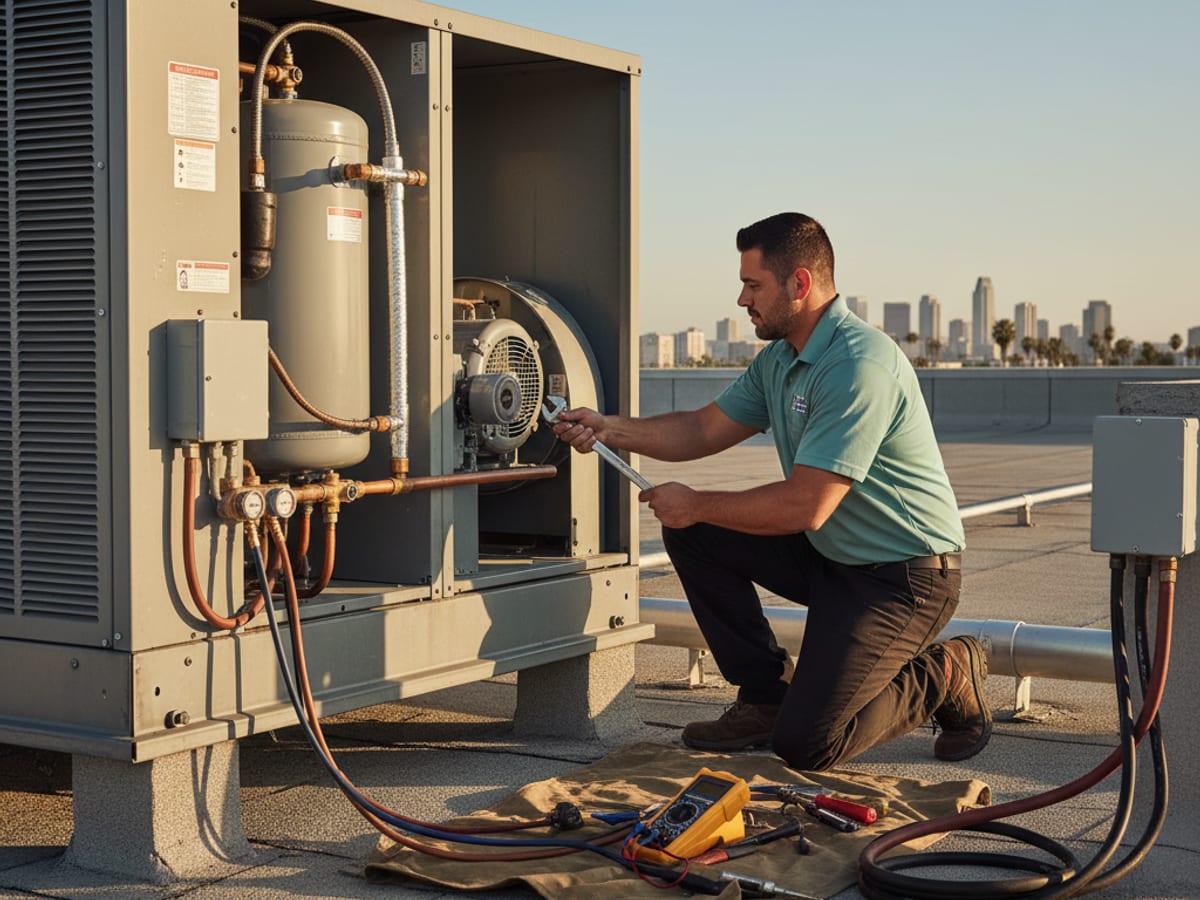
How is HVAC for office buildings in San Diego usually built?
Most San Diego office buildings under 100,000 square feet use one of two layouts.
Per-suite rooftop unit. Each tenant gets a dedicated packaged RTU. Billing is simple. After-hours cooling is easier to isolate. Roof penetrations and curb work multiply. This layout is common in single-story office parks in Carmel Mountain Ranch and Rancho Bernardo.
Central RTU plus VAV boxes. One or two larger rooftop units serve a floor through a duct trunk, with a VAV box and thermostat per suite. Install cost per square foot is often lower. Fair billing is harder. Comfort depends on whether the original commissioning still matches the current floor plan.
Layout 2 is where most retrofit pain lives. VAV boxes get balanced once, then tenants cut into ducts for new rooms. Reheat coils corrode. One suite freezes while the next one sweats. The equipment still runs. The air is just going to the wrong rooms.
What does a tenant improvement HVAC scope actually include?
A tenant improvement HVAC scope is not a square-footage formula. Ask the matched pro to write down whether existing VAV boxes stay, which zones are new, and whether a test-and-balance report is in the price.
Typical scopes in San Diego County look like this:
| Scope | What it usually means |
|---|---|
| Reuse existing VAV, add a zone or two | Lightest change. Still needs a rebalance after drywall. |
| New VAV boxes, full rebalance, new thermostats | Common when a suite is recut. |
| Dedicated RTU for a data room or conference space | Separate load that should not ride the office trunk. |
| Full floor rebuild | New duct, new VAVs, new controls. Longest permit path. |
| Economizer and demand-controlled ventilation | Often required when a permit is pulled on larger packaged units. |
The swing factor is controls. Keeping existing thermostats is one project. Migrating a floor onto a new building management system is another. The landlord usually owns the base-building plant. Your suite still has to meet Title 24 for the work you pull a permit on.
The commercial HVAC page is the right starting point for matching a pro to that scope.
Which Title 24 rules actually change office HVAC work?
California Title 24 Part 6 applies to almost every office HVAC project in San Diego County that pulls a permit. The 2025 Energy Code applies to permit applications filed on or after January 1, 2026. Confirm the code cycle on your permit, because two buildings on the same block can sit on different vintages.
Economizers. Packaged cooling units at or above 4.5 tons generally need an air-side economizer so the system can use outdoor air for free cooling when conditions allow. Many San Diego rooftop economizers are stuck closed. A failed damper is a comfort problem and a compliance problem once plan check opens the unit.
Demand-controlled ventilation. Conference rooms, training rooms, and dense open-plan floors often need outdoor air that tracks occupancy, commonly with CO2 sensors. If the existing controls cannot modulate outdoor air, the suite work includes controls, not just a new box.
Fan power and occupancy interlock. New VAV systems have prescriptive fan-power limits. Lighting occupancy sensors that set back HVAC in empty zones are another common plan-check item on older buildings.
If you are a tenant, the landlord still owns base-building Title 24 for the shared plant. Your suite-level duct and controls still need to pass. Plan time for the City of San Diego Development Services cycle, or the city that actually issued the occupancy (Carlsbad, Chula Vista, and others each run their own mechanical permits).
Rebate programs change and run out. Confirm current SDG&E commercial offers at quote time at sdge.com. Do not treat a brochure number as a locked credit.
How does after-hours HVAC get billed in a multi-tenant building?
After-hours HVAC is where multi-tenant offices either work or fall apart. Many leases say HVAC is provided on weekday business hours. Saturday work then either pays an after-hours fee or needs a dedicated unit.
If you are signing a 3 to 5 year lease, ask three questions in writing:
- What is the after-hours HVAC fee, how is a “zone” defined, and who meters it?
- Is the suite on a dedicated RTU or a shared VAV trunk?
- When was the last air-balance report, and who signed it?
A building with a recent balance report from a test-and-balance contractor is a different risk than one that has not been balanced since the last sale. Climate Pros SD does not set lease fees. Those numbers live in the lease and the landlord’s vendor contracts.
Who pays for lobbies, restrooms, and shared conference rooms?
Lobbies, corridors, restrooms, and shared conference areas typically run on a separate RTU billed through common-area maintenance. When that unit fails, every tenant feels it and no one tenant has authority to fix it.
If you own a small building with one or two tenants, putting common areas on their own dedicated unit and billing them as a fixed line item is cleaner than blending them into a shared trunk. The matched pro can map which rooftop unit serves which rooms. That map should exist before anyone replaces equipment.
How do Sorrento Valley, UTC, and Carmel Mountain offices differ?
Sorrento Valley. Lots of 1980s and 1990s buildings with original Trane or Carrier RTUs. Marine-layer corrosion on rooftop coils is real even a few miles inland. Replacement is often the honest path once coils and economizers are both failing.
UTC. Newer mid-rise and high-rise stock with central plant chilled water and fan-coil or VAV per floor. A tenant improvement here is mostly boxes, ducts, and balance. The central plant stays the landlord’s problem unless your lease says otherwise.
Carmel Mountain Ranch and Rancho Bernardo. Suburban office parks, mostly single-story, mostly per-suite RTUs. Easier to scope and bill. Rooftop access still needs fall protection. Ask how the crew will work the roof, not only what tonnage they propose.
Mission Valley. Mix of mid-century offices with tight chases and newer construction near the trolley. Older stock can hide asbestos in ceiling tile. Plan extra time for unknowns. Do not invent a schedule around a building nobody has opened.
When does an office HVAC retrofit actually make sense?
A commercial retrofit earns its keep in a few situations. Outside them, keep maintaining what you have.
The VAV boxes still work, but nobody has balanced them since the building opened. An air-balance pass with working controls often fixes “one suite freezes, the next one sweats” without new rooftop units.
The rooftop units are old and the roof is due. Equipment replacement and roof work share a crane, a permit cycle, and a shutdown window. Doing them separately usually means paying for access twice.
A tenant change forces zoning to change. Splitting a suite, or turning general office into a lab or a gym, changes load and ventilation. That is the moment to fix zoning instead of patching around the old layout.
Efficiency brochures written for a national climate overstate cooling hours in coastal San Diego. A retrofit sold only on payback math from another state often misses the lease term.
When should an office rooftop unit be repaired instead of replaced?
Age alone is not a verdict. Ask the matched pro for refrigerant type, leak history, and whether major components have already been swapped.
Under about 12 years, with a clean service history and a single failed part, repair is often the first path.
In the middle years, repeated failures plus R-22 (no longer produced) usually tilt toward replacement, because leak repairs on that refrigerant get harder over time.
Very old units with a major component failure are usually replacement candidates. New equipment efficiency and current rebate rules have to be checked at quote time, not copied from last year’s flyer.
The federal 25C credit expired for equipment placed in service after December 31, 2025. Do not budget a 2026 office project as if that credit still applies.
FAQ
How do I budget HVAC for a 5,000 square foot San Diego office?
There is no honest single number. A like-for-like rooftop swap is one price. New VAV boxes, a rebalance, crane time, and curb adapters are another. Get a written scope from the matched pro after they walk the roof and the suite.
Do I need a permit for office HVAC work in San Diego?
Yes for almost everything beyond filter changes. Equipment replacement, duct changes, thermostats tied into building controls, and refrigerant work typically need a mechanical permit from the City of San Diego or the city that issued occupancy. Ask the contractor who pulls it and who is on site for inspection.
Can my landlord force me to pay for HVAC repairs in a leased office?
That depends on the lease. Triple-net leases often pass repair and replacement to the tenant. Modified gross leases often keep major plant work with the landlord. Read the HVAC clause before you sign. Climate Pros SD does not interpret leases.
How long does an office HVAC tenant improvement take?
Design, permit, equipment lead time, install, balance, and final inspection all stack. Lead times on higher-efficiency packaged units can stretch the middle of that sequence. The matched pro owns the schedule. We do not promise a completion date from this page.
What is the difference between VAV and constant volume?
Constant volume blows the same airflow and changes temperature by heating or cooling that fixed flow. VAV modulates airflow per zone. VAV is usually more comfortable in multi-suite buildings and more work to keep in balance. Almost all newer San Diego office construction uses VAV.
Why is one office room freezing and the next one hot?
Three usual causes: VAV boxes out of balance, a thermostat reading a hot or cold spot that is not the room, or a dead reheat coil on an interior zone with no exterior wall. All three need a technician, not a tenant moving the setpoint.
Where to start
If you are signing a new San Diego office lease, get HVAC history before you sign. If you own a building that is collecting complaints, start with a current air-balance report from a test-and-balance contractor, not only a filter change.
For broader commercial context, see commercial HVAC for small businesses. For kitchens, see restaurant HVAC in San Diego. An IT closet that runs after the office system shuts down belongs on server room cooling. A kitchen in the same building needs restaurant HVAC.
Call (442) 777-6440 and we will match you with a local pro. The technician you are matched with walks the suite or roof, reviews existing equipment and any balance reports, and gives you a written scope before work starts.