Restaurant HVAC in San Diego is three systems that have to agree. The dining-room rooftop unit, the kitchen makeup air unit, and the Type I or Type II exhaust hood. Get the balance wrong and you cook the dining room, pull grease through the dining coil, or fail final inspection.
Owners in Gaslamp, Little Italy, Ocean Beach, Pacific Beach, North Park, and Hillcrest run into the same physics on different roofs. Climate Pros SD connects you with licensed local HVAC pros. We do not pull hood permits or install fire suppression. Verify the matched contractor’s license at cslb.ca.gov before work starts.
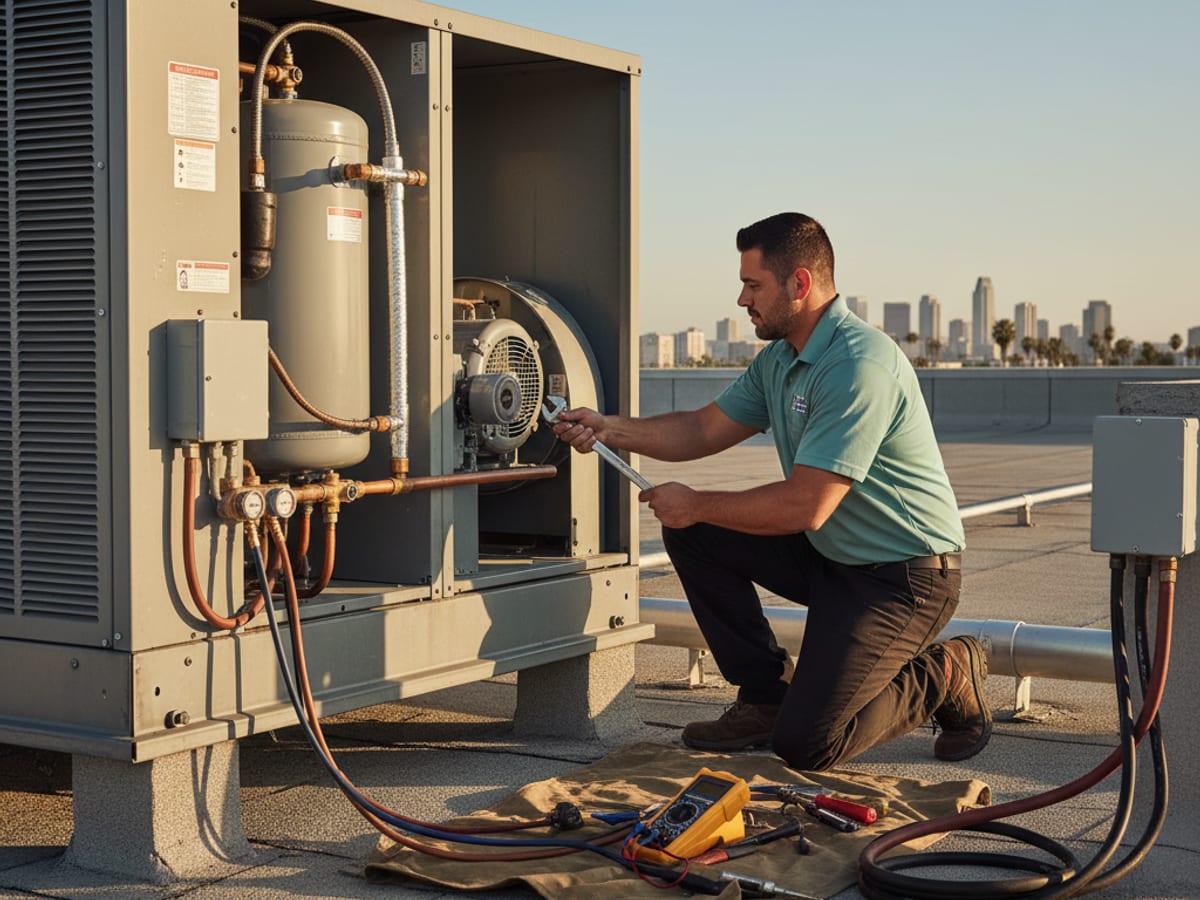
Why do restaurant kitchens and dining rooms have to stay in balance?
A kitchen hood pulls a large volume of air out of the building. That air has to come from somewhere. If it does not come from a sized makeup air unit, it comes from the dining room. Then the dining AC fights the hood for every cubic foot of conditioned air.
Type I hoods cover grease-producing equipment: ranges, fryers, charbroilers, woks, salamanders. They need listed grease duct, fire suppression, and grease-rated exhaust fans. The California Mechanical Code (CMC Chapter 5) and IMC 507 language are the references the plan checker uses.
Type II hoods cover heat and steam only: dishwashers, ovens that do not produce grease, steam tables. Lower fire risk, still code-compliant exhaust.
The restaurant HVAC service page treats hood, makeup air, and dining as one scope, which is how a quote has to be written.
Makeup air should replace most of what the hood exhausts, with a small remainder coming from the dining HVAC. That small deficit keeps the kitchen slightly negative so grease and smells stay on the cook line. If the kitchen goes too negative, dining air, and sometimes neighboring tenants’ air, gets pulled the wrong way.
A practical target many kitchen designers use is a slight negative in the kitchen relative to dining (on the order of a few hundredths of an inch of water column). A host stand that smells like fryer oil is usually a pressure problem, not a bigger AC.
What does a restaurant HVAC project actually include?
The matched pro prices your building after they see the hood length, the menu equipment, roof structure, and whether you sit in a historic overlay. Treat any table of round numbers as a rumor.
| Project type | What usually drives the quote |
|---|---|
| Dining RTU replacement only | Tonnage, curb, crane, and whether ducts stay |
| Type II hood plus small makeup air | Dishrooms and steam-only lines |
| Type I hood, listed makeup air, fire suppression | Grease duct, roof fan, Ansul or equivalent, electrical |
| Full retrofit | RTU, makeup air, hood, and ducting together |
| Ground-up restaurant | Follows the construction schedule and stamped plans |
Historic Gaslamp and other Historical Resources Board sites add rooftop screening and structural review. Coastal sites in Ocean Beach, Pacific Beach, Mission Beach, and Imperial Beach add salt-air corrosion on makeup air casings. Stainless or coated cabinets last longer there. The pro specifies that after they see the roof.
What does kitchen density do to dining HVAC coils?
Gaslamp, Little Italy, and the Convention Center corridor pack restaurants wall to wall. Hood exhaust from one roof can enter a neighbor’s makeup air intake. Dining coils in those districts foul with grease aerosol much faster than a suburban restaurant in Mira Mesa or Carmel Mountain.
A dining RTU evaporator that would last a decade in a strip center can foul in a few years if kitchen pressure is wrong. Coil cleaning is not optional maintenance in those neighborhoods. It is how the dining unit keeps capacity.
Hood cleaning frequency follows NFPA 96 and San Diego Fire-Rescue inspection practice:
- Solid fuel (wood-fired pizza, charcoal): monthly
- High-volume frying and charbroiling: quarterly
- Moderate-volume cooking: semi-annually
- Low-volume or seasonal: annually
Skip a cycle and a grease fire can become an insurance fight. That is a carrier and marshal issue, not a Climate Pros SD policy.
When should you repair, retrofit, or start over?
Repair when the hood and makeup air are still sized for the menu, the dining RTU is not at end of life, pressure is in range, and the last health or fire inspection did not flag the hood.
Full retrofit when you add grease-producing equipment, the hood is undersized for the current cook line, makeup air is missing or open-loop, you failed a fire marshal inspection, or occupancy class is changing.
New build or heavy TI when the shell cannot carry code-compliant rooftop weight, you are converting former retail or office to food service, or the landlord’s tenant-improvement allowance is meant to cover HVAC as a package.
For tenant improvements in the City of San Diego, plan check at Development Services sits on the calendar before anyone cuts a roof. Hood and makeup air work above small Type II thresholds typically needs mechanical plans stamped by a California-licensed engineer. The contractor you are matched with should say who stamps, who pulls, and who stands the inspection.
FAQ
How do I plan a Type I hood and makeup air in San Diego?
Start with the cook line, not a catalog hood length. The matched pro and the engineer size exhaust CFM to the equipment, then size makeup air to that exhaust. Fire suppression, listed duct, and roof fans travel with that package. Historic overlays and tight roof access change access cost, not the code requirement.
Do I need a permit to replace a restaurant rooftop unit in San Diego?
Yes. Commercial RTU replacement on a restaurant needs a mechanical permit through San Diego Development Services or the city that issued occupancy. Like-for-like swaps can be a shorter review. Sizing changes or new ductwork trigger full plan review.
What is the difference between Type I and Type II hoods?
Type I is grease. Type II is heat and steam. The California Mechanical Code lists which appliances require which type. Guessing from the menu is how people fail inspection.
Why does the dining room smell like the kitchen?
Pressure imbalance. The kitchen should sit slightly negative to dining. If either room is too negative, air flows the wrong way. The fix is usually makeup air delivery and damper settings, not a larger dining AC.
How often does restaurant HVAC need maintenance?
Quarterly is a practical minimum for San Diego restaurants. High-volume cooking wants monthly attention to coils and filters. Grease and long run hours are harder on equipment than a typical office RTU.
Can a residential AC company handle a small restaurant?
A coffee shop with no Type I hood is a maybe. Anything with a grease hood needs CMC Chapter 5, NFPA 96, and a pressure-balance check. A residential-only crew often undersizes makeup air.
What rebates apply to restaurant HVAC in San Diego?
SDG&E runs commercial efficiency programs that sometimes include high-efficiency RTUs and demand-controlled kitchen ventilation. Amounts change. Confirm at sdge.com before you buy. The federal 25C credit expired for equipment placed in service after December 31, 2025.
Related service: AC repair.
When to call
If the kitchen is too hot, the dining room smells like the line, or a tenant improvement is on the calendar, call (442) 777-6440. We match you with a local pro. See commercial HVAC for county-wide commercial matching, and commercial HVAC for small businesses for the broader picture.