A Pacific Beach studio and an El Cajon guest room over the garage both need heat and cooling in one room. The usual fork is a mini split heat pump or a window AC unit with heat, and they are not interchangeable. The right pick depends on who owns the walls, where the box can sit, and whether you need that room year-round.
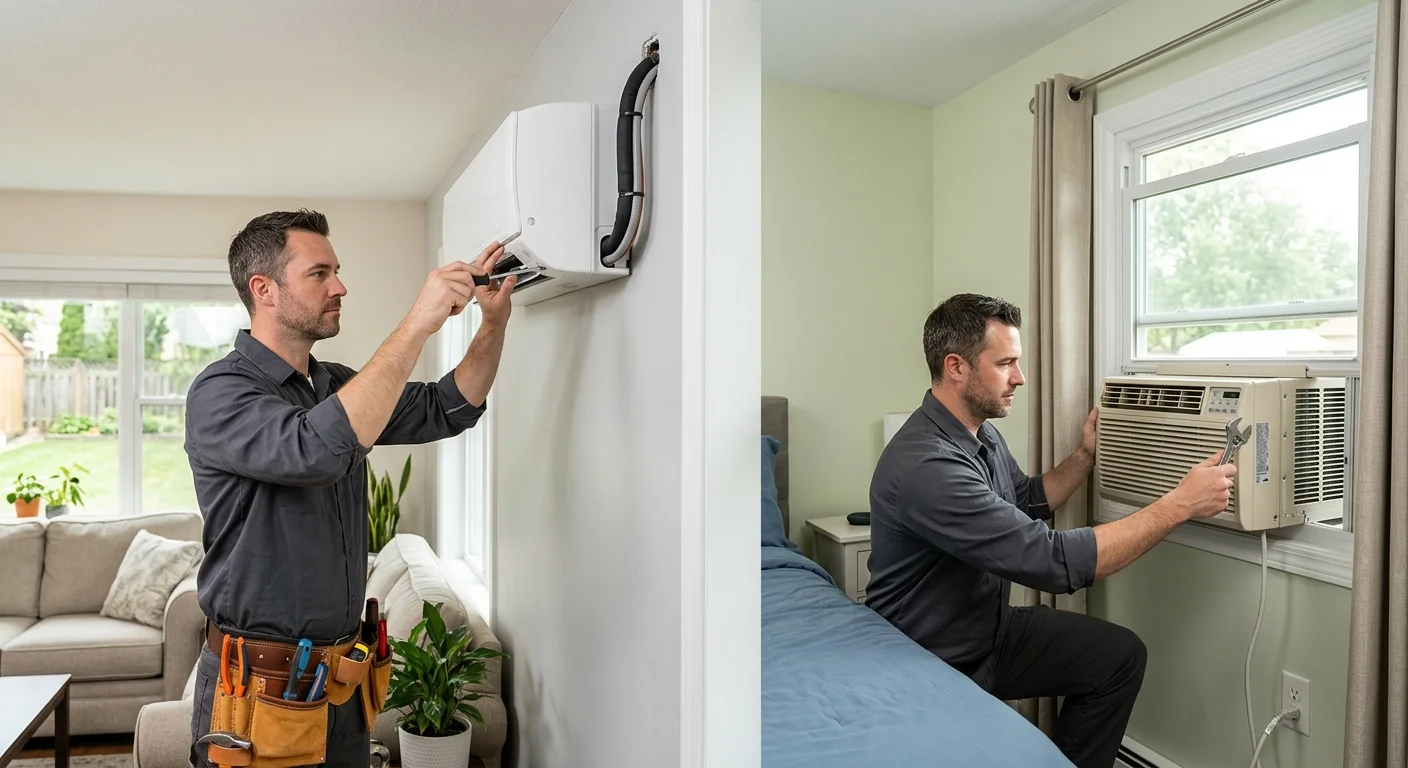
How do these systems heat and cool a room?
A mini split heat pump is a ductless pair: an indoor head on the wall, ceiling, or floor, plus an outdoor unit. Refrigerant lines connect the two. In cooling mode it pulls heat from the room and dumps it outside. In heating mode it runs the other way and brings outdoor heat indoors. The U.S. Department of Energy describes that as moving heat, not making it with a burner.
Not every mini split heats. Cooling-only heads exist. If you searched mini split heat pump, you want a unit that reverses. Confirm heat on the model sheet before anyone drills a wall.
A window AC unit with heat sits in the opening and does both jobs from one chassis. Some window models are small heat pumps. Others add electric-resistance heat. That difference matters on the bill and on a cold inland night, so read the label instead of assuming. For how one box can handle both seasons in this county, see our guide to a heater and air conditioner in one unit.
San Diego County is not one climate. NOAA 1991-2020 normals put the August high near 77°F at San Diego International Airport and about 71°F at Oceanside Marina. Inland, Escondido sits near 89°F in August and El Cajon near 89°F as well. Campo’s August normal is about 95°F. The National Weather Service also notes ocean moderation on the coast, warmer summer days in nearby valleys, and hot easterly winds that can push heat to the beaches. A bedroom that feels fine with a small window unit in Encinitas can struggle in Santee during a heat wave that runs well above those normals.
Neither option is a whole-house system by itself. Each conditions the air it can reach. Open stairs, a kitchen that dumps heat, west glass, and high ceilings all change the load. Square footage charts from retailers are not a load calculation. The matched licensed contractor sizes the room you actually live in.
Ductless delivery also skips leaky ducts. ENERGY STAR says a typical forced-air house can lose about 20% to 30% of the air moving through ducts because of leaks, holes, and poorly connected ducts. That is a national typical-house statement, not a reading from your bungalow in North Park. It still explains why a room-level heat pump can feel tighter than a distant supply register.
Which option fits renters and homeowners?
Renters usually lose the mini split argument on the wall, not on comfort. A window unit uses an opening you already have. You can take it when you move. A landlord may still require written approval, a proper support bracket, and a clear rule on condensate. Our window AC installation notes for San Diego rentals cover that path. Do not cut siding, run a line set, or tap a panel without the owner’s okay.
Homeowners, and owners of ADUs, have more room to choose. A single-zone mini split is a common answer for a garage conversion, a bonus room, or a 1920s cottage that never got ducts. Multi-zone layouts put extra indoor heads on one outdoor unit when several rooms need their own setpoint. That is still not automatic whole-home coverage. Closed doors, long hallways, and two-story stacks can leave pockets the head never treats.
HOAs and condo boards add a third filter. Many coastal complexes limit what may hang in a window or sit on a balcony. A wall-mounted indoor head with the condenser in an approved yard or roof well can pass where a window box fails, or the reverse. Ask the association in writing before you buy equipment.
Tenure matters more than gadget preference. If you will be in the unit one summer, a window AC unit with heat is the reversible move. If you own the house and that room works year-round, a mini split heat pump is the fixture. Climate Pros SD is a referral service. We match you with licensed, independent HVAC pros. We do not install, and we do not own the equipment.
Is a mini split heat pump worth it? Only in that context. It is worth a hard look when you own the wall, you need heat and cooling in the same room, and a window opening is a poor place for a chassis. It is a weak fit when you rent, when the HOA blocks the outdoor unit, or when every bedroom already shares working ducts.
How do noise and placement affect the decision?
A window unit puts the compressor in the opening, so the noise lives in the room and on the street. Neighbors in Mission Beach and Golden Hill hear that buzz through thin walls. The chassis also blocks light, the latch, and often the only window a small bedroom has for getting out in a fire. Security and fire escape are real placement questions, not style notes.
A mini split moves the compressor outside. The indoor head is a fan and a coil. That usually makes the room quieter, but the outdoor unit still hums. Set it away from a neighbor’s bedroom window, a patio table, and the HOA’s sightlines. Leave clearance for airflow and service. Coastal salt air and inland dust both punish a condenser shoved into a dead corner.
Indoor head placement is its own argument. High on an interior wall, the head can throw air across the room. Over a door, it short-circuits. Opposite west glass in an El Cajon family room, it fights afternoon sun all summer. Floor consoles show up in remodels where wall space is gone. Ceiling cassettes hide better in a finished ADU, if the joists allow it.
Line-set routing is the part photos skip. The matched pro has to reach from the indoor head to the outdoor unit without chewing through a historic stucco detail or a neighbor’s view. Condensate has to drain. A head that drips on the sofa is a placement miss, not a mystery.
Window units have a placement limit you cannot design around: you need a window that fits the chassis, that you are allowed to occupy, and that you can support. Slider windows common in South Bay apartments are a poor match for a box built for a hung sash. Through-wall sleeves exist in some mid-century buildings. Confirm the opening before you order.
If several rooms need independent control, stacking window units gets loud and ugly fast. That is the moment to look at mini split installation instead of another chassis in another sash.
What should a licensed pro verify before installation?
Start with license status. HVAC work in California that exceeds the $1,000 contractor threshold, needs a permit, or is advertised as contracting work belongs with a C-20 contractor. Check the person on the CSLB license lookup before anyone opens a wall. Every HVAC pro in the Climate Pros SD network is licensed and insured. The contractor you are matched with, not the brand, pulls permits and sets the equipment.
In the City of San Diego, no part of a heating, ventilating, air conditioning, or refrigeration system may be installed, altered, replaced, or repaired unless a mechanical permit has been obtained. Simple no-plan permits cover some minor work on non-historic properties, including some air conditioner installations. Plan-required permits apply to more complex work and historically designated properties. County and other city rules were not confirmed for this page. Ask the building department that actually governs the address.
California Title 24 requires field verification testing when HVAC systems are altered or replaced. A CEC-certified rater does that work. Specific leakage percentages and charge tests were not verified here. Point questions at the California Energy Commission’s Energy Code Compliance program.
On site, the pro should confirm the room load, sun, insulation, and how the space connects to the rest of the house. They should confirm electrical capacity at the panel without promising a particular breaker size on this page. They should pick indoor and outdoor locations that drain, breathe, and can be serviced. They should tell you whether the equipment is a heat pump or cooling-only, and which refrigerant the new unit uses.
New residential air conditioning and heat pump equipment manufactured or imported after January 1, 2025 must meet EPA’s GWP limit of 700. Older R-410A systems remain legal to run and to service. Do not treat refrigerant work as a casual weekend project.
Ask about incentives in writing, then recheck. The federal Section 25C energy-efficient home improvement credit applied to qualifying property placed in service through December 31, 2025. Do not count on that credit for a 2026 install. TECH Clean California single-family heat pump HVAC incentives stopped taking new reservations on November 14, 2025. HEEHRA single-family rebates were fully reserved statewide as of February 24, 2026. Direct tax questions to a tax professional.
ENERGY STAR publishes heating and cooling ratings, including SEER2. SEER2 is a seasonal cooling-efficiency rating in Btu per watt-hour. DOE says actual savings vary with usage. No page here can promise a bill cut from a model number.
When does a whole-home option make more sense?
One loud bedroom is a room problem. A two-story house that never cools upstairs, a 1960s ranch with tired ducts, or an inland family that lives in every room is a house problem. A mini split heat pump can still be the right tool, as a multi-zone layout or as a supplement. It is the wrong tool when you are trying to fake a central system with one head in the hallway.
Compare ductless against ducted on the bones of the house, not on a slogan. If you already have decent ducts and a furnace or air handler that can take a heat pump, a central changeout may cover more square feet with less wall clutter. If the ducts are a mess, ENERGY STAR’s typical 20% to 30% leakage warning is a reason to fix ducts or to skip them. Our ductless mini split vs central AC comparison walks that fork.
SDG&E residential time-of-use plans price electricity by time of day. Current listed plans put on-peak from 4 p.m. to 9 p.m. Confirm your plan and current rates on SDG&E’s site. A mini split that runs hard through that window can still lift the bill, especially inland when everyone gets home and the house is hot. SDG&E’s heat-wave guidance, health permitting, is to precool earlier, then set the thermostat to 78°F or higher from 4 to 9 p.m. That is utility conservation advice, not a medical rule.
People also ask why the electric bill jumped after a mini split went in. Common causes are a unit running when the house used to go without cooling, a head left on in an empty room, peak-period use, or a system that does not match the room. None of those prove the hardware is defective. They do mean you should walk the usage with the contractor who set it.
Downsides of a mini split heat pump are real. The indoor head stays visible. The outdoor unit needs a legal, serviceable pad or wall bracket. Line sets and condensate have to be routed. Filters need regular cleaning. A single zone will not fix every bedroom. Upfront cost is often higher than a window box, though this site does not publish prices. Ask the matched pro for a written figure for your address. Climate Pros SD sets none.
A window unit with heat stays the better small move when the stay is short, the opening is legal, and you only need that one room. When the house needs even temperatures in several zones, look at heat pump service for a whole-home conversation, not another sash.
When to call us
Call when you own the home, a room needs year-round heat and cooling, and a window chassis is a poor fit for noise, security, or HOA rules. The matched licensed contractor verifies load, placement, electrical capacity, and permits. Call us at (442) 777-6440 and we will match you with a licensed local pro.