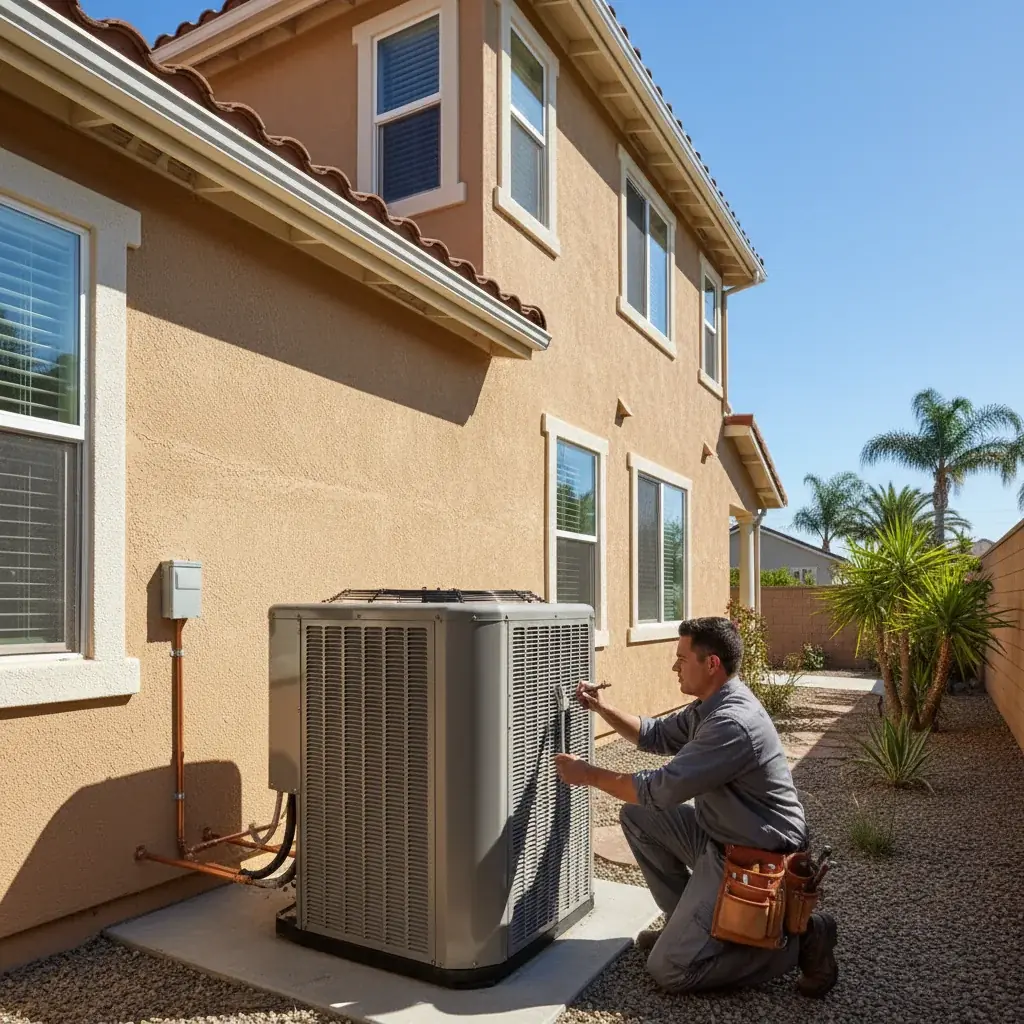
It’s a classic San Diego problem. You have a beautiful two-story home in Carmel Valley, Scripps Ranch, Rancho Bernardo, or one of the East County hillside neighborhoods like Alpine, Jamul, or the higher elevations of El Cajon and La Mesa. In July, the upstairs bedrooms feel like a sauna while the downstairs living room is an icebox. You crank the AC to cool the second floor, only to freeze everyone out on the first floor. This constant battle with the thermostat is why many homeowners consider an HVAC zoning system.
These multi-story neighborhoods share three traits that make zoning especially relevant: 1990s-2010s tract construction with single-stage systems and one downstairs thermostat, vaulted entries that let conditioned air pool downstairs, and roof orientations that bake the second story from late morning through evening. Inland and East County homes also pull heavy late-afternoon cooling loads that line up exactly with SDG&E’s peak-rate window, which is where zoning can cut wasted compressor runtime, not just the comfort problem.
Why upstairs is always hotter in San Diego two-story homes
The frustrating temperature difference in your home isn’t just your imagination. It’s a combination of basic physics and common home construction in Southern California. Three main factors are working against your comfort.
First, heat rises. This is a fundamental principle of thermodynamics called convection. The warmer, less dense air generated by people, cooking, and electronics on your first floor naturally moves upward, accumulating on the second story.
Second, your roof is a massive heat collector. Throughout a sunny San Diego day, your roof absorbs solar radiation. This heat radiates downward through the attic and ceiling materials, directly into your upstairs rooms. Even with good insulation, this “attic heat gain” is a significant load on your AC system, and it primarily affects the top floor.
Finally, most two-story homes are built with a single HVAC system controlled by one thermostat, which is almost always located downstairs. This thermostat can only read the temperature in its immediate vicinity, the hallway or living room. It has no idea that your master bedroom is 10 degrees warmer. So, it satisfies the temperature setpoint for the first floor and shuts the system off, leaving the upstairs to bake. This is a primary driver of two story house ac problems.
How a zoning system actually works
An HVAC zoning system is a control strategy that allows a single HVAC unit to create multiple distinct temperature zones within your home. Instead of one thermostat for the whole house, you get one for each zone. For a two-story home, the most common setup is two zones: one for downstairs and one for upstairs.
The system works using three key components:
Motorized Dampers
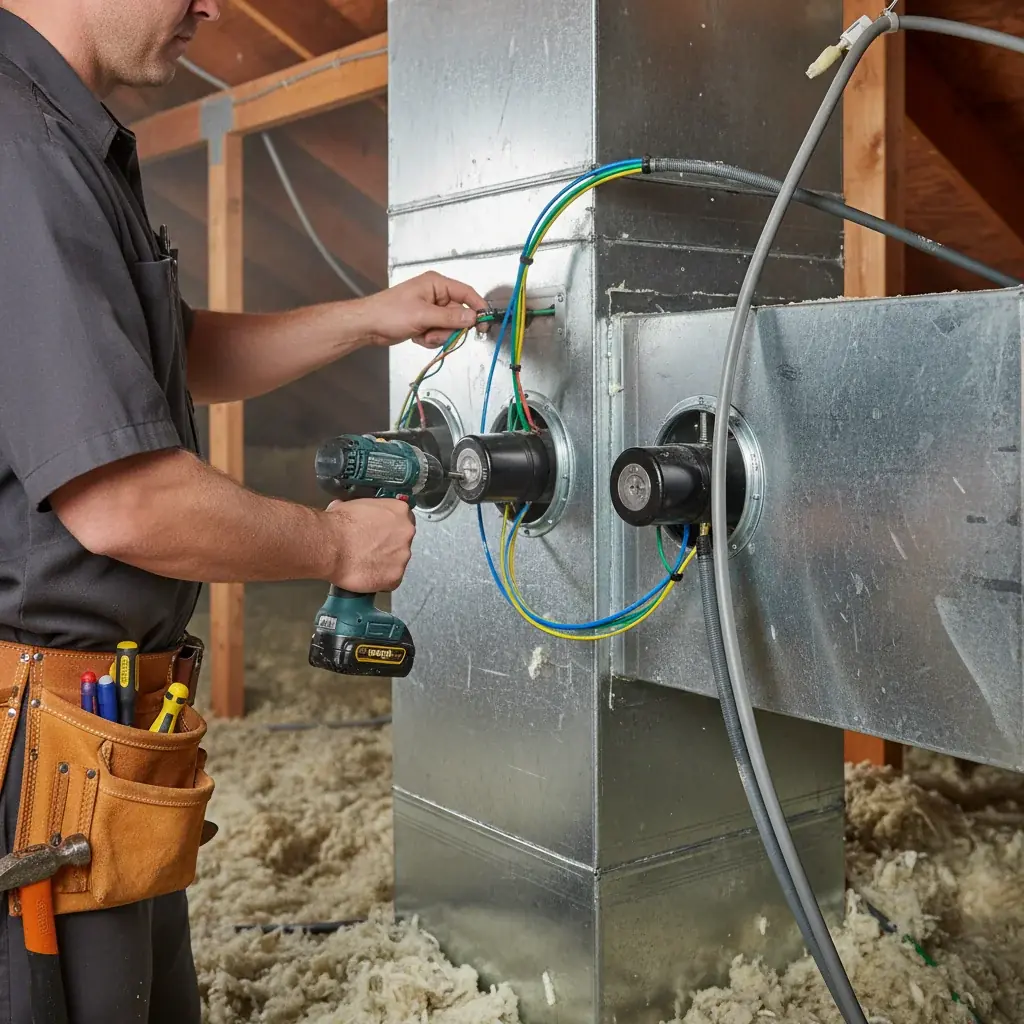
These are the workhorses of the system. The company you are matched with install metal plates, or dampers, inside your existing ductwork. Each damper is controlled by a small motor. When a zone calls for cooling, the dampers leading to that zone open up, while the dampers for other, satisfied zones close. This physically redirects the conditioned air to where it’s needed most.
Zone Control Panel
This is the brain of the operation. The control panel is a small computer, usually installed near your furnace or air handler. It receives signals from all the zone thermostats and controls the dampers accordingly. It also tells your main HVAC system when to turn on and off based on the needs of any single zone.
Multiple Thermostats
With a two-zone system, you’ll have a thermostat for each floor. The upstairs thermostat reads the actual temperature in the upstairs zone, and the downstairs thermostat does the same for its area. They operate independently. If the upstairs is 78°F and the thermostat is set to 72°F, it will call for cooling, even if the downstairs is already a comfortable 71°F.
A properly installed system also includes a bypass damper. This is a safety mechanism that relieves excess air pressure in the ducts. If only a small zone is calling for air, all that airflow from your powerful AC has nowhere to go. The bypass damper routes this excess air back to the return side of the system, preventing damage to your equipment and reducing noise.
Zoning vs adding a second system vs going ductless
When facing an unbearably hot second floor, zoning isn’t your only option. It’s important to compare it to the other two common solutions: adding a second, dedicated HVAC system or installing ductless mini-splits.
HVAC Zoning System
This involves retrofitting your existing central air system.
- Pros: It’s often the most cost-effective solution if your ductwork is in good shape. It uses the equipment you already own and provides true temperature control for different areas of your home, improving both comfort and energy efficiency.
- Cons: Zoning is only as good as the duct system it’s built on. If your ducts are poorly designed or undersized for the second floor, zoning won’t fix the core airflow problem.
Adding a Second HVAC System
This means installing a completely separate air conditioner and furnace (or air handler) just for the second floor.
- Pros: This offers the ultimate in performance and control. Each floor has its own dedicated system, eliminating any compromises. This is the gold standard for very large homes or houses with known ductwork issues. The company you are matched with for AC installation can assess if this is a viable path.
- Cons: The cost is significantly higher. You’re buying a whole new set of equipment. It also requires a lot of space, typically in the attic, for the second air handler, plus a spot outside for another condenser.
Going Ductless with Mini-Splits
This approach bypasses your ductwork entirely for the problem areas. You install one or more indoor air handlers (the “heads”) in the upstairs rooms, connected to a single outdoor condenser.
- Pros: Ductless mini-splits are incredibly efficient and provide room-by-room temperature control. They are a perfect solution when ductwork is inaccessible or fundamentally flawed.
- Cons: The upfront cost can be higher than a simple zoning retrofit. Some homeowners also dislike the aesthetic of the wall-mounted indoor units. If you’re weighing your options, comparing a ductless mini-split vs central AC is a great place to start. A targeted mini-split installation can solve the hot-upstairs problem permanently.
What a retrofit zoning quote should name in 2026
Climate Pros SD is a referral service. It does not install zoning or publish a damper, panel, or re-zone dollar menu. The licensed company you are matched with prices the job after they see the ducts.
Ask the bid to name these scopes, not a blog band:
- Basic two-zone retrofit, accessible attic ducts. The usual upstairs/downstairs split when supply trunks are reachable from an attic walkway. Common on Scripps Ranch and Carmel Valley tract homes.
- Three to four zones with a communicating panel. Extra dampers for a master suite, home office, or a third floor. Common on Rancho Bernardo and Rancho Peñasquitos homes with detached primary suites.
- Full ducted re-zone with duct rework or replacement. Needed when upstairs ducts are undersized, second-floor returns are missing, or vaulted ceilings need new soffit runs. That is the East County hillside case.
What actually moves the quote:
- Number of zones. Each added zone is a damper, a thermostat, and another control wire back to the panel.
- Ductwork accessibility. An open attic walkway is the easier labor case. Drywall ceilings, tight crawlspaces, or upstairs ducts buried in a vaulted soffit take more time.
- Equipment. Communicating zone systems that talk to variable-speed equipment cost more than basic standalone panels. They are also the setup that can follow an SDG&E time-of-use schedule.
- Existing duct condition. Leaky, undersized, or kinked ducts have to be fixed first. Zoning a broken duct system just changes the symptom.
By not over-cooling the downstairs just to make the upstairs tolerable, you cut wasted runtime. How much shows up on the SDG&E bill depends on your TOU plan and how you schedule the zones.
SDG&E peak-rate load shifting with zoning
This is the angle most national zoning articles miss. SDG&E’s residential time-of-use plans (TOU-DR1 and TOU-DR2) charge a sharply higher rate from 4 p.m. to 9 p.m. on weekdays. Summer on-peak kWh runs roughly 2x to 3x the off-peak rate. That window happens to be exactly when your upstairs is hottest and your AC runs hardest.
A zoning system gives you a knob national articles don’t talk about: you can pre-cool the upstairs aggressively from 2 p.m. to 4 p.m. on off-peak rates, then let the upstairs thermostat coast at a higher setpoint from 4 p.m. to 9 p.m. while the downstairs zone, where the family actually is during dinner and screen time, holds a comfortable temperature on much less compressor runtime. A smart zone panel paired with a learning thermostat schedules this automatically.
On a Scripps Ranch or Rancho Bernardo two-story, shifting a share of cooling out of the 4-9 p.m. window is the bill lever. Ask the matched company to look at your actual SDG&E TOU plan, not a blog payback. Comfort is immediate. Bill savings only show if you actually use the schedule.
When zoning fails and a redesign is the real answer
We believe in being honest with our customers. A zoning system is a powerful tool, but it’s not a magic bullet. Sometimes, installing dampers is just putting a band-aid on a much bigger problem. Zoning is a control upgrade; it cannot fix fundamental airflow issues.
Here are scenarios where zoning will fail to deliver the comfort you expect:
Critically Undersized Ducts
The most common issue is ductwork that was never designed properly in the first place. If the duct run to your master bedroom is too long, has too many sharp turns, or is simply too small in diameter, it cannot physically deliver enough cubic feet per minute (CFM) of cold air. Closing dampers elsewhere won’t force more air through a duct that’s already at its maximum capacity. In these cases, the real solution is a ductwork redesign and replacement, not just zoning.
Poor or Non-Existent Return Air
Your HVAC system is a closed loop. For every bit of cold air pushed into a room, an equal amount of warm air must be pulled back out through a return vent. Many tract homes have only one large central return in a downstairs hallway. When bedroom doors are closed upstairs, the air has no easy path back to the system. This pressurizes the rooms, chokes the system, and dramatically reduces airflow. Zoning can’t fix this. The solution is adding dedicated return air ducts to the upstairs rooms.
Incorrectly Sized Equipment
If your air conditioner itself is too small for your home’s total heat load, it will run constantly without ever reaching the setpoint, especially on hot days. Zoning won’t help an undersized unit keep up. Conversely, a massively oversized unit will cool the space too quickly and shut off before it has a chance to dehumidify the air, leading to a cold, clammy feeling. A proper system design starts with a load calculation, not a guess.
Before we recommend any solution, the company you are matched with perform a thorough evaluation of your entire system, the equipment, the duct design, and the return air pathways, to ensure our recommendation will actually solve your problem.
FAQs
How much does an HVAC zoning system cost in San Diego?
Ask the matched company after they see the ducts. Climate Pros SD does not publish two-zone, four-zone, or full re-zone dollar bands. Access, damper count, and whether ducts need rework are the usual swing items.
Is HVAC zoning worth it for a two-story home in San Diego?
For most two-story homes in Carmel Valley, Scripps Ranch, Rancho Bernardo, and the East County hillsides, yes. The comfort difference is immediate, and pairing zoning with an SDG&E time-of-use schedule lets you shift cooling load out of the 4-9 p.m. peak window, which is where the energy savings actually live in San Diego.
Can zoning be added to an existing central AC system?
Usually yes, as long as the ductwork is in good shape and sized correctly for each floor. The retrofit installs motorized dampers in the existing trunk lines, a zone control panel near the air handler, and one thermostat per zone. If the existing ducts are undersized or leaky, those need to be fixed first or zoning won’t deliver the comfort gain.
Will an HVAC zoning system lower my SDG&E bill?
It can, but only if you also use a time-of-use rate plan and a schedule that pre-cools off-peak. The mechanism is load-shifting: cool the upstairs hard from 2 to 4 p.m. on cheaper rates, then let it coast through the 4-9 p.m. peak. Climate Pros SD does not publish a percent-off-the-bill figure.
How many zones do I need for my house?
Two zones (upstairs and downstairs) handle most two-story San Diego homes. Add a third zone for a detached primary suite, a fourth for a home office or finished room above the garage. Beyond four zones the math usually points toward a dedicated second system or ductless mini-splits for the outlier rooms instead.
What’s the difference between zoning and ductless mini-splits?
Zoning controls airflow within your existing central system using dampers. Mini-splits are separate small AC units installed in specific rooms with no shared ductwork. Zoning is usually the smaller retrofit if your ducts are sound. Mini-splits are the better answer when the ductwork is fundamentally broken or doesn’t reach a problem room at all. For the full comparison, see our ductless mini-split vs central AC breakdown.
Related service: AC repair.
When to call us
Evaluating ductwork, calculating airflow, and installing electronic controls are not DIY projects. A mistake can lead to poor performance or even damage your expensive HVAC equipment. If you’re tired of the temperature battle in your two-story home, an expert assessment is the first step. The company you are matched with can determine if your home is a good candidate for an hvac zoning system or if another solution is a better fit.
Call us at (442) 777-6440.