Every piece of heat pump content we’ve published so far has covered air-source systems, the kind that pull heat from or reject heat to the outside air. Geothermal, or ground-source, heat pumps work on a different principle entirely, and they come up often enough in reader questions that they deserve an honest, direct answer instead of a sales pitch.
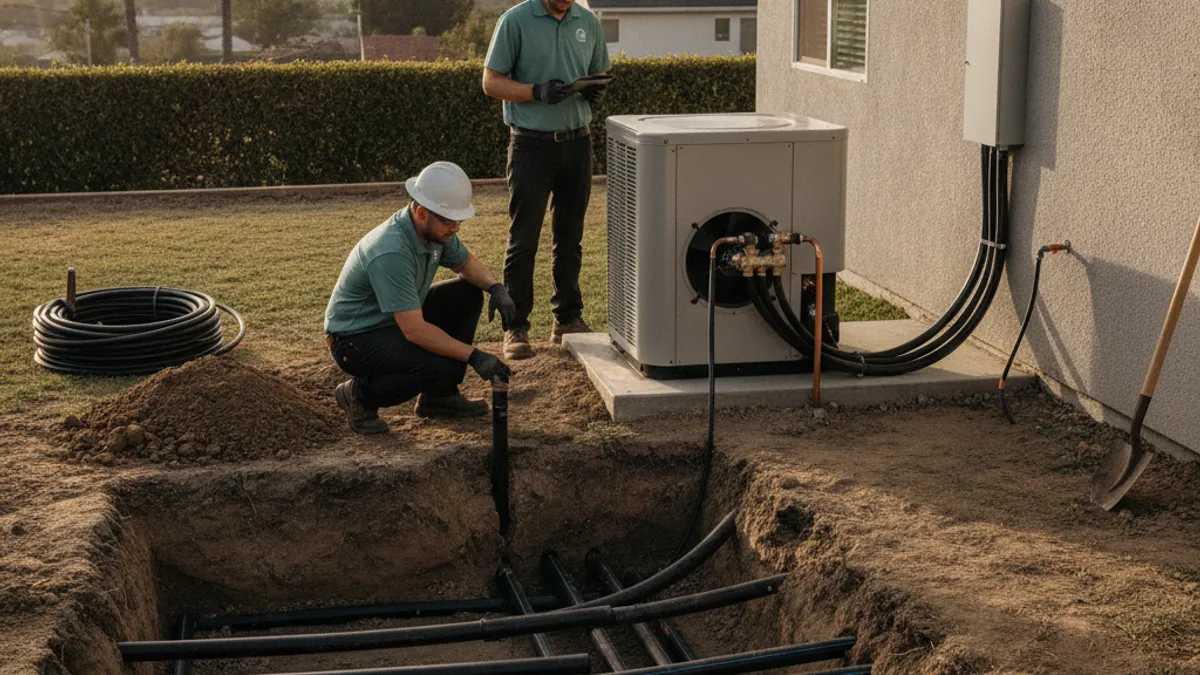
How geothermal systems actually work
A few feet below the surface, ground temperature stays relatively stable year-round, generally somewhere in the 50s Fahrenheit across most of the country, regardless of whether it’s summer or winter above ground. A geothermal system buries a loop of piping, either laid horizontally in trenches across a large area, or run vertically down one or more boreholes where space is limited, and circulates fluid through that loop to exchange heat with the stable ground temperature instead of the more volatile outside air.
In winter, the system pulls heat from that relatively warm ground and delivers it inside. In summer, it rejects heat into the relatively cool ground instead of fighting against a hot afternoon outdoors. Because the ground temperature it’s working against is so much more stable than outside air, a geothermal system can run at very high efficiency, often meaningfully higher than even a good air-source heat pump, especially in regions with brutal winters or scorching summers where an air-source system is straining against extreme outdoor temperatures.
Why the case is weaker in San Diego specifically
That last part is the key. Geothermal’s efficiency advantage comes from avoiding extreme outdoor air temperatures, and San Diego doesn’t really have extreme outdoor air temperatures. Our winters rarely drop into the range where an air-source heat pump starts losing meaningful efficiency, and our summers, outside of inland heat waves, aren’t punishing enough to make ground-source cooling’s advantage decisive either. A technology built to shine in a place with 20-degree winters and 100-degree summers has a much smaller efficiency gap to close here.
Meanwhile, the cost side of geothermal doesn’t change based on climate. Drilling or trenching is expensive everywhere, and it’s often more expensive in San Diego specifically. A lot of the county sits on hard clay, decomposed granite, or rocky hillside soil that makes horizontal trenching impractical on a typical residential lot, pushing installers toward vertical boreholes, which cost more per foot than horizontal loops. Lot sizes in a lot of established San Diego neighborhoods also aren’t large enough for the horizontal loop field these systems ideally want, forcing the more expensive vertical option by default. On top of that, geothermal installers are genuinely rare in Southern California’s residential market compared to regions where the technology is more common, which limits competitive bidding and can extend project timelines.
Put together: a technology with a smaller efficiency advantage in this climate, combined with above-average installation costs for the ground loop, means the payback period on a geothermal system in San Diego tends to run much longer than it would somewhere with harsher weather extremes.
What usually makes more sense here
For a typical San Diego lot, a modern variable-speed air-source heat pump delivers most of the comfort and efficiency people are chasing when they ask about geothermal, with a far larger pool of local installers and parts. See our heat pump versus AC comparison. Climate Pros SD does not publish an installed geothermal or air-source price. Geothermal can still make sense on a large rural lot with easy trenching and a long hold. For a typical tract lot, the drilling cost rarely pays back on climate alone.
On incentives: do not assume a stack. Section 25C does not cover property placed in service after December 31, 2025. The IRS $2,000 figure is the 2025 qualified heat-pump cap for that credit year. TECH single-family HVAC reservations stopped November 14, 2025. HEEHRA $8,000 / $4,000 figures are design caps, not live money after the February 24, 2026 single-family reservation. Confirm geothermal-specific federal or state programs with a tax professional and the program administrator.
Frequently asked questions
Is geothermal more efficient than a regular heat pump?
Yes, generally. Ground-source systems typically achieve higher efficiency than air-source heat pumps because they exchange heat with stable underground temperatures instead of more extreme outdoor air. The size of that advantage depends heavily on climate, and it’s smaller in mild climates like San Diego than in regions with harsh winters or summers.
Why is geothermal so expensive to install in San Diego?
Installation cost is dominated by the ground loop, drilling or trenching to bury the piping. San Diego’s rocky and clay-heavy soil in many areas, combined with lot sizes too small for horizontal loop fields, often forces the more expensive vertical borehole approach, and there are relatively few local installers experienced with the technology.
Does geothermal work in a hot, dry climate like inland San Diego?
Yes, the technology works fine here, it’s not a climate limitation in that sense. The question is whether the extra upfront cost pays back fast enough to be worth it, and in a mild climate, the efficiency gain over a good air-source heat pump is smaller than it would be somewhere with more extreme weather.
Are there tax credits available for geothermal heat pumps?
Federal and state incentive programs for geothermal systems have existed and changed over time. Confirm current eligibility, amounts, and expiration dates with a tax professional or the program administrator. Do not use a blog dollar figure. Section 25C does not apply to a 2026 in-service date.
Related services: AC repair, AC installation and HVAC maintenance. Local coverage: all 67 cities we cover in San Diego County.
When to call us
If you’re weighing geothermal against a modern air-source heat pump, call (442) 777-6440. We will match you with a licensed local pro who can walk the lot. Climate Pros SD does not install ground loops.