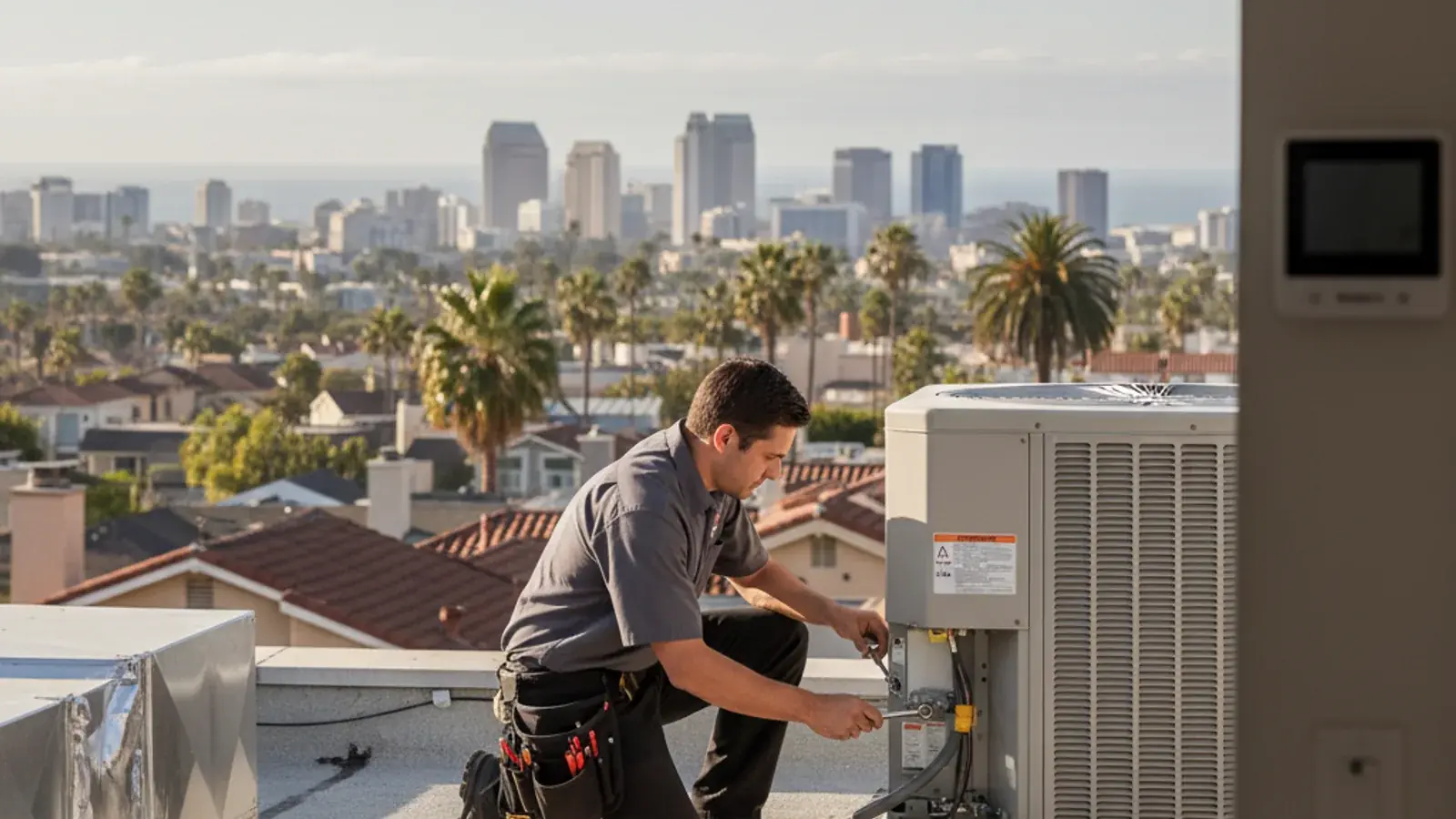
Two licensed visits a year (spring for cooling, fall for heating) plus regular filter checks is the core San Diego maintenance plan. Everything else is a short homeowner walk-around. This page does not claim a percent fewer breakdowns, a guaranteed extra decade of life, or a published plan price.
Climate Pros SD matches you with licensed HVAC companies. We do not sell maintenance contracts or dispatch our own trucks.
San Diego is gentler on equipment than a humid Gulf climate, and inland yards still run long cooling weeks. Coastal salt air works on outdoor coils year-round. Regular care is what keeps those two stresses from stacking.
What does a year-round HVAC maintenance schedule look like?
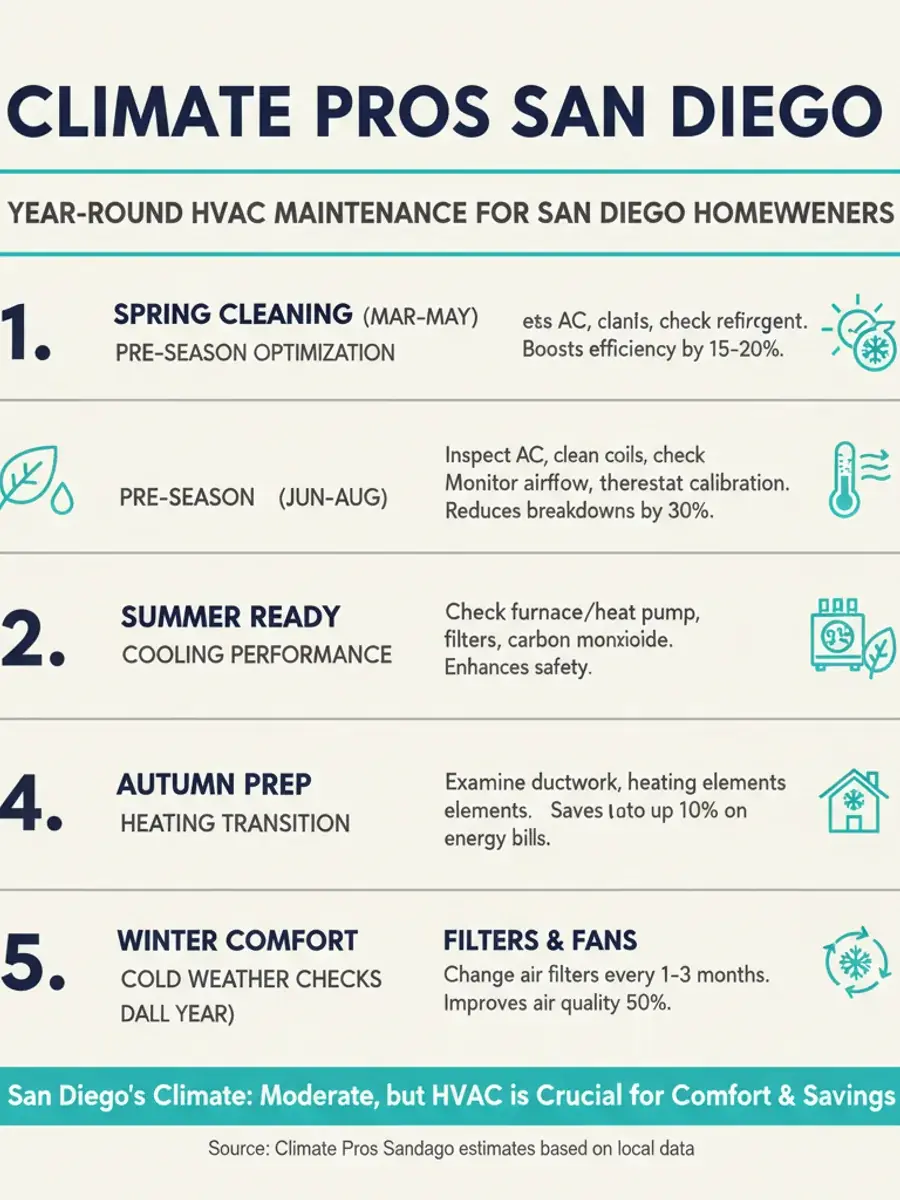
Professional: spring cooling check (often March-April), fall heating check (often October).
Homeowner: filter, outdoor clearance, listen at startup, glance at the bill.
Book the spring visit before the first inland heat stretch. Fall before the first cold inland morning. The matched company sets availability. This brand does not promise a calendar slot.
January
Homeowner: Check the filter. Test CO detectors. Note rooms that run cold in a snap. Skip outdoor coil work in heavy rain.
February
Homeowner: Filter. Listen on startup. Write down new noises for the spring visit.
Book: Spring cooling check.
March
Homeowner: Replace a dirty filter. Clear leaves and palm fronds from the condenser. Look for obviously bent fins. Dust the return grille.
Professional: Spring AC tune-up. Capacitor, charge concerns, airflow. That visit is for cooling, not a full heat-pump defrost test unless you have a heat pump and they include it. Ask. Heat-pump owners: heat pump maintenance.
April
Homeowner: Filter. Test cooling on a warm day. Pour water in the condensate pan and confirm it drains.
Consider: Smart thermostat or filter-cabinet work before peak cooling. Electrical prep is electrician scope.
May
Homeowner: Filter more often if you are entering heavy cooling. Clear the outdoor unit. If you are on an SDG&E time-of-use plan, set schedules around the 4-9 p.m. on-peak window, health permitting (SDG&E pricing, heat-wave guidance). SDG&E suggests precooling earlier, then 78F or higher from 4-9 p.m. if that is safe for your household.
June
Homeowner: Mid-month filter check. Watch the bill. Note runtime and noises on the first hard heat day.
If cooling fails: Call. Ask whether a tech is available today, yes or no. No arrival window from this brand.
July
Homeowner: Filter. Listen for hard starts, hums, or delays. If you leave town, a moderate set point is kinder to the house than a dead-off system in humid stretches. CDC heat guidance for older adults: stay in air-conditioned buildings in hot weather and do not rely on a fan as the main cooling source when it is very hot (CDC). Individual medical limits belong with a clinician.
August
Homeowner: Filter if the system is running hard. Keep lawn growth off the condenser. For wildfire smoke, a higher-MERV filter is a household choice; change it when it loads.
September
Homeowner: Filter. List summer issues for the fall visit. Clear debris after Santa Ana winds.
Book: Fall heating check.
October
Homeowner: Test heat on a cool morning. Filter. Clear returns.
Professional: Fall heating visit. Heat exchanger look, burners, ignitor, flame sensor, flue, limit switches. If you already see furnace warning signs, say so on the booking.
November
Homeowner: Filter. Run heat enough that the first cold week is not the first cycle of the year. Check CO detectors.
December
Homeowner: Filter. Watch bills and smells. Ask the matched company about a two-visit plan for next year if you want reminders. Holiday week availability is the contractor’s, not a brand promise.
What monthly tasks should every homeowner do?
- Filter. Pull it. Replace it if it is loaded.
- Outdoor walk-around. Clearance and obvious damage.
- Listen at startup.
- Watch the bill for a jump that does not match weather.
What does an HVAC maintenance plan include?
Plans are contractor products. Typical written items: two seasonal visits, a report, maybe a parts discount. This site does not publish an annual price, overtime policy, or “priority” guarantee. Ask for the contract in writing. Compare it to booking HVAC maintenance twice a year a la carte.
ENERGY STAR: a typical forced-air house can lose about 20% to 30% of the air moving through ducts to leaks, holes, and poor connections. National typical-house statement, not your measured leakage (ENERGY STAR).
Maintenance plan vs a la carte: which costs less?
Ask the company to price two standalone visits versus their plan for the same checklist. Include whether heat-pump reversing valve and defrost are in the visit. A cheaper AC-only plan is not a heat-pump visit.
What maintenance should you skip?
Annual duct cleaning specials. EPA does not recommend routine duct cleaning on a fixed schedule. Consider it when there is substantial visible mold, vermin, excessive dust or debris, or particles blowing from supplies, and fix the cause. EPA also says duct cleaning has never been shown to prevent health problems, and little evidence that cleaning ducts alone improves efficiency (EPA).
UV bulbs every year if the lamp is specified for a longer interval. Follow the fixture, not a seasonal flyer.
Chemical “refrigerant flush” without a contamination event. A proper coil wash is a different job.
Frequently asked questions
How often should HVAC be serviced in San Diego?
Twice a year for most central systems: spring cooling, fall heating. Monthly filter and outdoor checks in between. Heat pumps: confirm both modes are on the ticket.
Is an HVAC maintenance plan worth the money?
It can be if it includes both visits, the right checklist, and a price you would have paid anyway. This site will not invent a 5-year cost table or an emergency-call reduction percent.
When should I book a spring AC tune-up in San Diego?
Before peak inland cooling. March or early April is a common window. The contractor’s calendar controls, not this brand.
Do I need duct cleaning every year?
No. EPA’s position is as-needed, not a fixed annual schedule.
How often should I replace my HVAC filter in San Diego?
When it is dirty. A 1-inch pleated filter in a dusty inland house during cooling season loads faster than a 4-inch media cabinet. Smoke weeks load faster still. There is no single countywide day count.
What’s the highest-value professional check?
A spring electrical and capacitor check on the outdoor unit, plus a fall heat-exchanger look on a gas furnace. Heat pumps add reversing valve and defrost. Catching a weak capacitor before a heat wave is why you book early, not a published part-versus-emergency dollar comparison.
Want the spring list in more detail? Spring AC tune-up checklist. Contract questions: HVAC maintenance contract. Thermostats: smart thermostat installation. Frequency: how often HVAC should be serviced.
HVAC maintenance across Escondido, Poway, Oceanside, Chula Vista, La Mesa, and San Diego County.
Call (442) 777-6440 to match with a licensed company for a written seasonal visit.