Climate Pros SD matches Valley Center homeowners with licensed HVAC companies. We do not publish a $150 to $600 repair menu. Capacitor, refrigerant, motor, and furnace jobs are separate quotes. The pro sets the diagnostic fee and confirms it with you before the visit. Valley Center’s extreme inland heat and SDG&E PSPS shutoff history make HVAC reliability a different kind of problem here than anywhere on the coast.
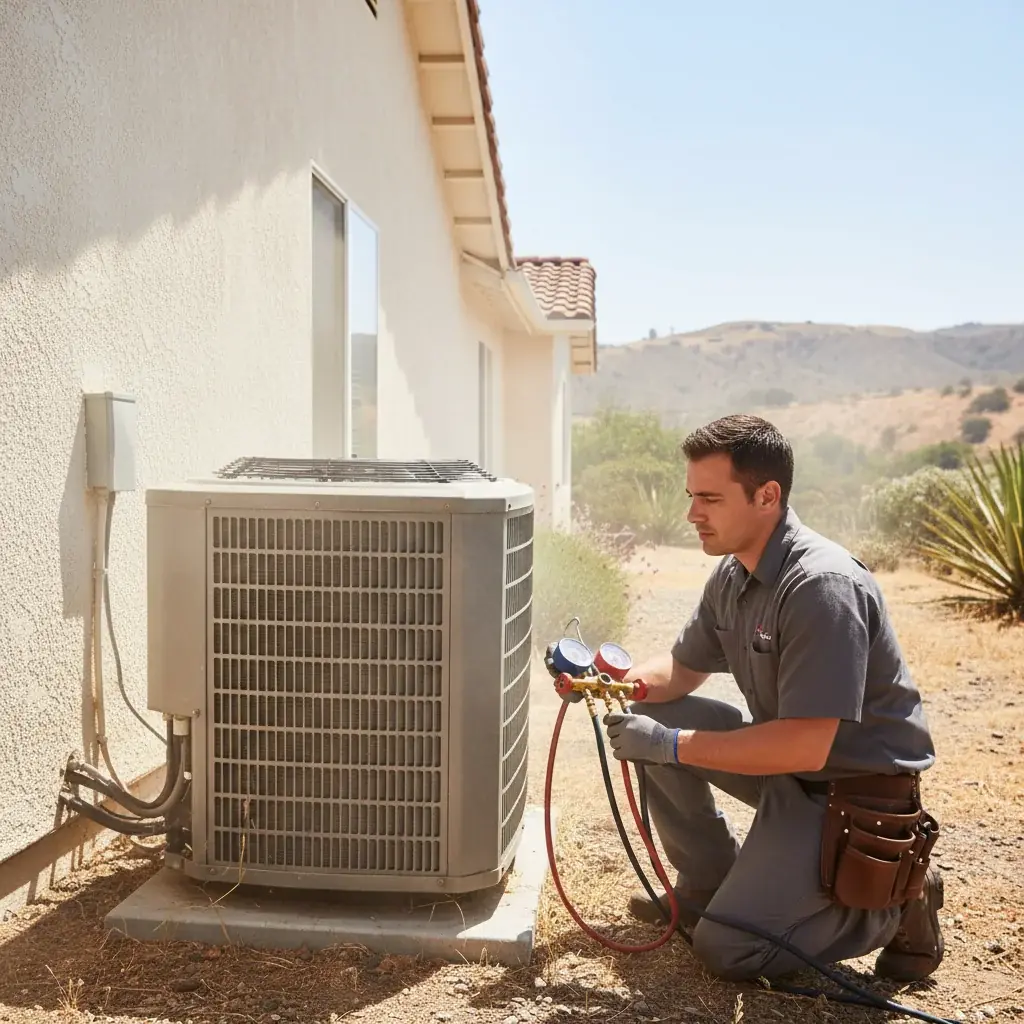
This guide covers what’s different about HVAC service in Valley Center, the failure modes techs see most often, and what estate and ranch property owners should know before calling for repair.
Why Valley Center is unusually hard on HVAC systems
Valley Center sits far enough inland that it operates in a different climate category than coastal San Diego. Summer temperatures of 91 to 93 degrees are common from June through September. Heat waves push past 115. That sustained load means outdoor condenser units are running at or near their design limits for weeks at a stretch, not just a few peak afternoons.
The topography spreads things out further. Avocado grove ranches, Skyline Ranch gated estates, and large residential lots along Cole Grade Road, Lilac Road, Lake Wohlford Road, and Paradise Mountain Road typically have condensers placed 50 to 150 feet from the air handler. Long line-set runs are the norm, not the exception. A system installed without the correct line sizing for that run length loses efficiency from day one and puts extra strain on the compressor year after year.
Matched companies typically route via I-15 and Valley Center Road. During peak heat-wave periods with high call volume, urgent no-cool and no-heat calls get pulled ahead of routine scheduling.
PSPS hard-start failures: the problem most AC companies don’t know to check for
SDG&E’s public safety power shutoffs are a real operating condition in Valley Center, not a background footnote. The area sits in a high-fire-risk zone, and during hot dry stretches, multi-day shutoffs are a documented part of life here.
When grid power comes back after a PSPS event, the voltage restoration can be sudden, and compressors start under full load with no soft-start protection. This hard-start condition kills run capacitors faster than anything else in the climate. A capacitor weakened by a summer of peak inland operating temperatures can fail outright the first time it sees a hard restart after an outage.
This is a failure mode that’s common in Valley Center but almost never mentioned in generic HVAC content written for San Diego as a whole. If your system has been through several PSPS seasons and the capacitor hasn’t been inspected recently, it’s worth having it checked before the next one. A capacitor replacement is usually the smaller ticket. A failed capacitor that takes the compressor down with it is not.
For more on how capacitors fail and what the symptoms look like, see our post on AC capacitor replacement in San Diego.
Common AC repair calls we see in Valley Center
Beyond PSPS-related capacitor failures, these are the AC repair issues techs see most on Valley Center properties.
Refrigerant problems. Low refrigerant is the most common reason an AC runs but doesn’t cool. On older systems, the culprit is usually a slow leak. On systems under five years old, an undercharge from a substandard installation is more common. Either way, the result is the same: the system runs constantly, the house doesn’t cool, and the compressor runs hotter than it should.
Condenser coil fouling. Valley Center’s dry terrain and avocado grove environment puts a lot of fine particulate in the air. Condenser coils accumulate dust and debris faster here than in coastal climates. A dirty condenser raises head pressure, the compressor runs harder, and equipment life shortens. Annual coil cleaning matters more in this environment.
Blower motor and capacitor failures. Both are accelerated by sustained high-temperature operation. If the system is struggling to start, tripping breakers, or making a humming sound before shutting off, a capacitor or motor issue is the likely cause. For the breaker angle, see our post on AC tripping the breaker in San Diego.
Thermostat and sensor calibration. Systems running in peak inland heat can drift on calibration. If the house never reaches the setpoint, or the system short-cycles, a thermostat or temperature sensor check is part of the diagnostic.
For a full overview of what’s covered, see the AC repair in Valley Center service page.
What belongs on a Valley Center repair quote
These jobs are not one price. Estate homes with long line-set runs and variable-speed inverter equipment tend toward more labor. Systems over 12 years old approaching compressor failure often tip the math toward replacement over repair.
| Line to insist on | Why it matters |
|---|---|
| Diagnostic fee, in dollars | Ask if it applies toward repair |
| Named AC part | Capacitor, recharge with leak search, fan motor, blower, compressor, thermostat, coil cleaning |
| Named furnace part | Ignitor, flame sensor, control board, heat exchanger |
| Line-set length | Estate runs change leak search and recharge labor |
| Fuel type | Propane orifice and regulator checks are extra scope |
| Warranty | Part versus labor |
Climate Pros SD does not publish those dollar ranges.
Furnace repair in Valley Center
Valley Center’s heating needs are more real than people expect. Temperatures drop into the low 30s and occasionally below freezing on winter nights at elevation, particularly in the Paradise Mountain and Lake Wohlford areas. A furnace that’s been coasting through San Diego’s mild winters can fail quietly for years before a cold night exposes it.
Common furnace failures include ignitor failures (a common single-point failure on gas furnaces), flame sensor carbon buildup (causes the furnace to light and then shut off within seconds), draft inducer motor failures on high-efficiency units, and heat exchanger wear on older systems. A cracked heat exchanger is a safety issue, not a repair candidate. When a tech finds one, replacement is the responsible call.
Some Valley Center properties, particularly the larger estates and older ranch homes, use propane rather than natural gas. Propane furnaces require correct orifice sizing and regulator pressure settings. A furnace running with incorrect orifice or regulator configuration runs rich, soots the heat exchanger, and fails early. If your property has propane and the system has had any fuel-related issues, an orifice and pressure check is worth doing.
For heating repair context across nearby North County Inland communities, see our post on HVAC repair in Bonsall.
For Valley Center-specific furnace work, go to furnace repair in Valley Center.
Areas we serve in Valley Center
Matched companies service the full Valley Center area including Skyline Ranch estates, Cole Grade Road and Lilac Road corridors, Lake Wohlford Road, Paradise Mountain Road, the casino corridor along SR-76 near Harrah’s and Valley View, and the surrounding rural ranch and avocado grove communities.
For a full service overview, visit the Valley Center HVAC page.
Frequently asked questions
How much does AC repair cost in Valley Center CA?
Ask the matched licensed contractor. Capacitor replacements sit at the smaller end. Refrigerant recharges with leak repair sit in the middle. Compressor-level work often tips older systems toward replacement. Climate Pros SD does not publish those bands. The diagnostic fee often applies toward any repair. Confirm that on the phone.
Why do PSPS events cause AC failures in Valley Center?
When power restores after a shutoff, compressors start under full load with no ramp-up. This hard-start condition stresses run capacitors, which are already worn from operating in peak summer heat. Repeated hard starts over multiple PSPS seasons shorten capacitor life significantly. Adding a hard-start kit or replacing a weakened capacitor before the next outage season is a straightforward preventive step.
How long does it take to get a technician out to Valley Center?
From the North County service area via I-15 and Valley Center Road, response time depends on distance and how busy the schedule is. Urgent no-cool and no-heat calls get pulled ahead of routine scheduling, especially during peak summer heat waves.
Are long line-set runs on estate lots a problem for AC systems?
They’re not a problem when installed correctly. The key is sizing refrigerant lines for the actual run length, using exterior-rated closed-cell insulation, and selecting equipment rated for extended line sets. Problems arise when a system was installed for a standard 15 to 25 foot run and the actual run is 100 feet. That mismatch causes efficiency loss and compressor strain that shows up over years, not days. The matched pro measures actual run length and verifies line sizing as part of any diagnostic on estate properties.
Does Valley Center qualify for SDG&E or TECH Clean California rebates on new equipment?
Rebate programs change year to year. The federal Section 25C tax credit covers qualifying improvements made through December 31, 2025. SDG&E rebate availability shifts with funding. Check current program status at quote time. Don’t rely on rebate amounts you’ve seen in older online guides.
What’s the difference between furnace repair costs for gas versus propane systems?
The work is similar, but propane system work sometimes requires additional checks on orifice sizing and regulator pressure that gas systems don’t need. Incorrect orifice or regulator settings on a propane furnace cause rich combustion, heat exchanger sooting, and early failure. If your Valley Center property runs propane and you haven’t had the orifice and pressure settings verified recently, it’s worth adding to any furnace service call.
Ready to schedule?
If your Valley Center AC or furnace isn’t performing the way it should, call us at (442) 777-6440. Ask the pro what their diagnostic fee is and whether it applies toward the repair. Most San Diego contractors credit it; each one sets its own policy, and confirming it on the phone takes ten seconds.