We’ve written about AC and HVAC service in Solana Beach before, since cooling is what most bluff-top and Cedros corridor homes actually need most of the year here. But furnaces still exist in nearly every one of these houses, and when they’re finally asked to run on a cold, damp December night, that’s exactly when problems that have been building all year show up at once.
Climate Pros SD matches you with licensed HVAC companies. We do not repair equipment, own trucks, or publish repair prices.
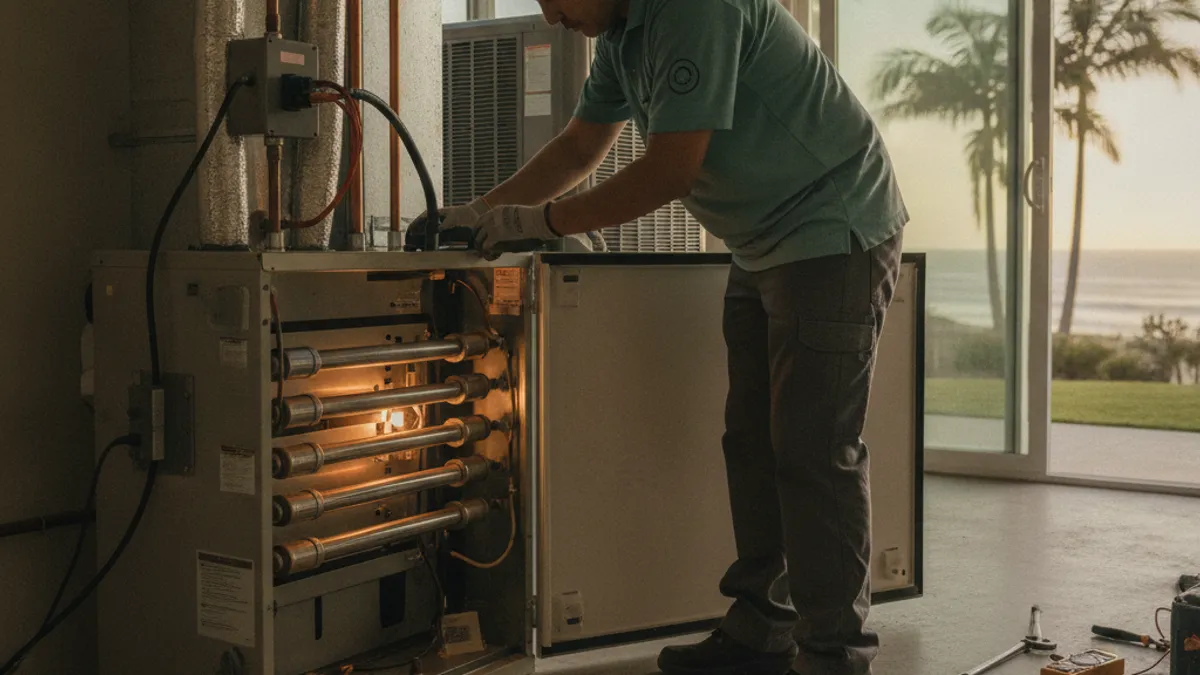
Why coastal furnaces fail differently
The core issue with a Solana Beach furnace isn’t the ocean air directly hitting it, since most units sit inside a garage or a conditioned closet, away from direct salt exposure. It’s how little the furnace runs. Solana Beach rarely sees more than a handful of genuinely cold nights each winter, and a lot of homes run their furnace for only a few dozen hours across an entire season. Ignition components, pressure switches, and inducer motors are all designed for regular cycling. Long stretches of inactivity let dust settle in pressure switch tubing, let spiders build webs in the inducer port, and let igniters sit unused long enough that the first cold-weather startup is also the first real test of parts that haven’t run in eight months.
That’s the opposite problem from an inland furnace in El Cajon or Escondido, which runs enough through a real winter that wear shows up gradually. Here, failures cluster right around the first genuinely cold nights of the season, because that’s the first real workout the system gets.
Common Solana Beach furnace failures
Ignition failure on the first cold night. This is far and away the most common call. The furnace tries to light, fails, and goes into lockout, or it never attempts ignition at all. A pressure switch tube blocked by dust or a small insect nest is a frequent, almost seasonal cause here, since the tube sits open and unused most of the year. We walk through the general diagnostic sequence in our furnace won’t ignite guide, and it applies the same way here, just triggered more predictably by the long idle stretch.
Oversized equipment short-cycling. Because heating demand is so low here, a furnace sized for a typical San Diego County home can be oversized for how little Solana Beach actually needs. An oversized furnace reaches temperature fast, shuts off, and cycles on and off frequently rather than running a longer, steadier cycle. That’s harder on ignition components and shortens their working life. Right-sizing at replacement time, based on an actual heat loss calculation rather than a rule-of-thumb swap, tends to matter more here than in hotter inland zones. The matched licensed contractor sizes and installs; Climate Pros SD does not.
Thermostat and control issues after a long idle period. Smart thermostats that manage both a furnace and an AC or heat pump sometimes lose their scheduled heating programming, or a wiring connection loosens over a long unused season, causing the system to fail to call for heat at all when the first cold night arrives.
Condensate and venting issues on higher-efficiency units. Newer high-efficiency furnaces vent through a PVC pipe and produce condensate that needs to drain properly. A line that’s gone unused for months is more prone to a clog or a cracked fitting going unnoticed until the first real heating cycle backs water up into the unit.
Is a furnace even the right call here?
We’ve made this case in our AC and HVAC guide already, and it holds for furnaces specifically too: given how mild Solana Beach’s winters are, a heat pump often makes more sense than keeping a separate gas furnace, since a single piece of equipment handles both heating and cooling without a furnace sitting idle most of the year. See our heat pump versus furnace comparison for the honest tradeoffs, and our heat pump service page if you’re deciding whether to replace an aging furnace altogether rather than keep repairing one that barely runs.
Do not budget a 2026 federal 25C credit, TECH single-family reservation, or HEEHRA single-family rebate as currently open money. Confirm program status at quote time.
What a furnace repair quote in Solana Beach should include
| Issue | What to ask for |
|---|---|
| Pressure switch or tubing service | Named part, labor scope, diagnostic fee in dollars |
| Igniter replacement | Exact part number, not a universal substitute |
| Thermostat wiring or programming fix | Whether the thermostat itself is condemned |
| Condensate line clearing (high-efficiency units) | Whether a cracked fitting is included |
| Full ignition system diagnostic | Tests run (manometer, resistance, flame signal) |
For a county-wide quote checklist, see our furnace repair cost guide. Climate Pros SD does not publish 2026 dollar ranges.
Frequently asked questions
Why does my Solana Beach furnace only fail in winter?
Because it only runs in winter. Most Solana Beach furnaces sit unused for eight or nine months at a stretch, so ignition components, pressure switches, and inducer motors get their real test only when the first cold night arrives, and any dust or debris buildup from the idle period shows up right then.
Should I even bother fixing my furnace, or switch to a heat pump?
That depends on the age and condition of your current system. If your furnace is still within its normal service life and just needs a routine repair, fixing it makes sense. If you’re facing a bigger failure or planning a replacement anyway, a heat pump is worth serious consideration in a climate this mild, since it replaces both your furnace and your AC with one system.
Do I need to run my furnace occasionally even in warm weather?
Running the system briefly once every month or two, even outside heating season, can help keep moving parts from sitting completely idle and can surface a developing issue, like a failing igniter, before the first real cold night when you actually need heat.
Is a furnace repair in Solana Beach more expensive than inland San Diego?
Not as a published county split. Parts and labor are quoted by the company. What differs is when the failures happen, clustered around the first cold nights of the season here rather than spread across a longer, colder winter.
Related services: furnace repair and AC repair.
When to call us
Call if your furnace won’t ignite, cycles on and off too quickly, or hasn’t been checked in over a year. A service visit before the first genuinely cold night catches most of these issues before they leave you without heat. Call (442) 777-6440. Climate Pros SD matches you with a licensed pro. Ask whether a tech is available today, yes or no.