The blower motor is the part of the furnace that moves air through the ducts. The burners can fire and you will still feel nothing at the registers if the wheel is not spinning. Here’s how to tell when the blower itself is the problem, and how to talk to a licensed tech without a fake price table.
Climate Pros SD matches you with licensed HVAC companies. We do not repair furnaces, own trucks, or publish repair prices.
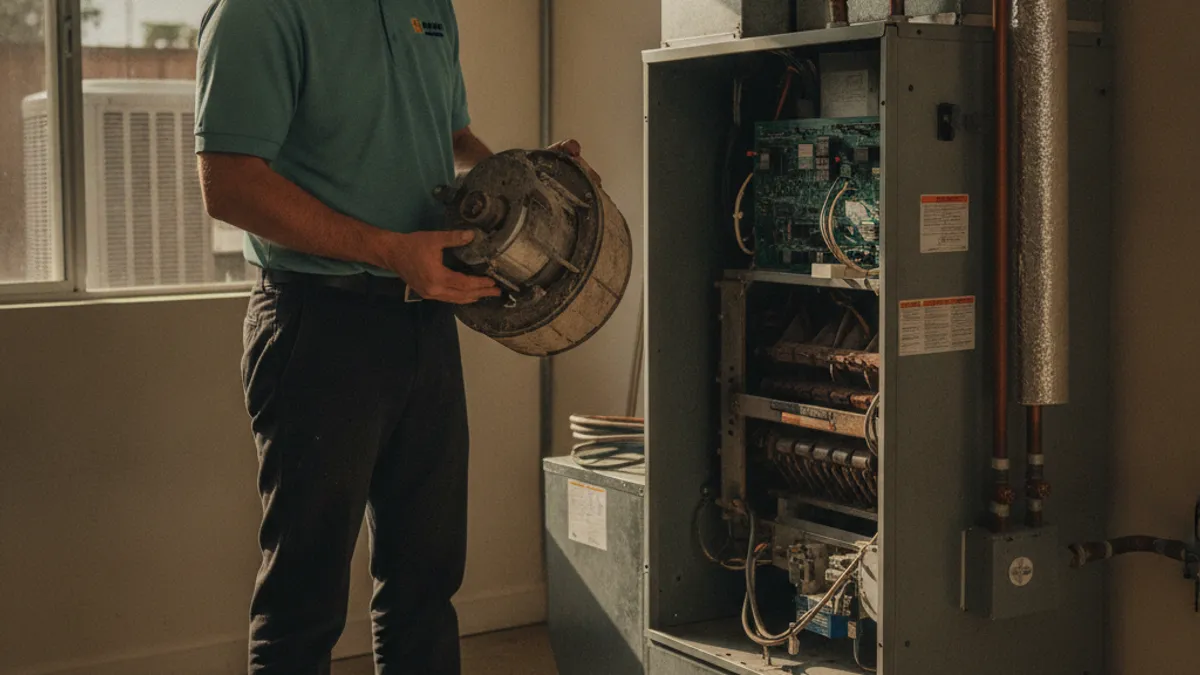
What are the two blower motor types?
Older and budget furnaces often use a PSC motor: one speed when it is called. Higher-efficiency furnaces more often use an ECM: variable speed, ramps, sometimes low-speed circulation. Both wear out. They fail differently.
A PSC motor’s usual warning is a weak run capacitor. The motor hums, starts slow, or pulls too much current. An ECM’s electronics module can fail without a simple capacitor test. Newer boards may show error codes. Ask the tech which motor you have before you compare quotes.
What are the signs the blower motor is failing?
Weak or no airflow at all registers while the furnace clearly runs. Burners on, no air: motor, capacitor, or a wheel that slipped on the shaft.
Grinding, screeching, or rattling from the cabinet. Bearings. It usually gets louder before the motor seizes.
Blower runs constantly and will not shut off. More often a control board or limit than the motor. Rule out a stuck relay before you replace the motor.
Furnace short-cycles or overheats. A weak blower starves the heat exchanger of air, the high-limit trips, and you get bursts of then-cold air. That chain is in furnace blowing cold air.
Burning smell on startup after a long idle. A light dust smell for a few minutes at the start of the season can be normal. A persistent electrical smell: shut it down and call.
What causes blower motors to fail?
Clogged filter. The motor works harder, runs hotter, dies earlier. Cheapest prevention.
Bearing wear after years of hours.
Capacitor failure on PSC motors. Common across HVAC, not just furnaces.
Electrical. Wrong signals to an ECM, loose connections, failing board.
What does blower motor repair cost in San Diego?
This site does not publish capacitor, PSC, ECM, or diagnostic prices. Ask the matched company to test the capacitor before they condemn the motor. ECM replacements cost more than PSC because of the electronics. If the furnace is otherwise at end of life, compare that quote to furnace replacement cost and furnace repair service.
A named trade heuristic is the 50% rule: a major repair on an old furnace versus about half of replacement. Heuristic only, no promised dollar outcome.
FAQs
Can I run my furnace with a bad blower motor?
Do not. A weak blower overheats the exchanger and trips safeties. A motor near seizure is an electrical risk. Off, then call.
How long do furnace blower motors last?
There is no single published life for every San Diego furnace. Hours, filter neglect, and motor type all matter. The tech should inspect bearings and amp draw, not quote a blog average.
Is it the blower motor or just the capacitor?
A motor that hums and will not spin, or spins weakly, often points at the capacitor. A meter test takes minutes. Worth doing before you buy a motor.
Why does my furnace blower screech only when it starts?
Worn bearings that are worse at start. The noise usually becomes constant as wear progresses.
Related services: furnace repair, AC repair, HVAC maintenance. Cities: San Diego County.
When to call us
Call if the furnace runs but barely moves air, grinds or screeches, or the blower will not shut off. Have the furnace’s age and the noise pattern ready. Call (442) 777-6440.