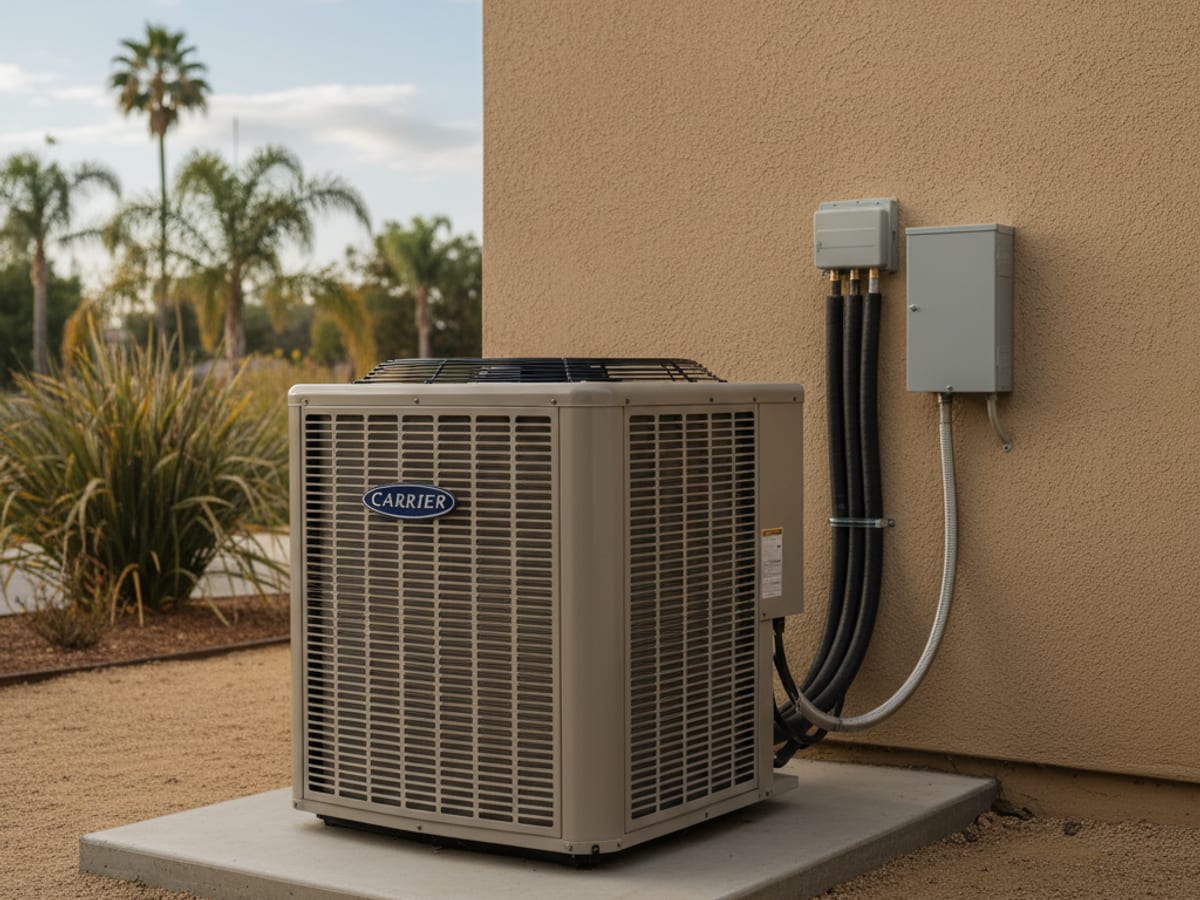
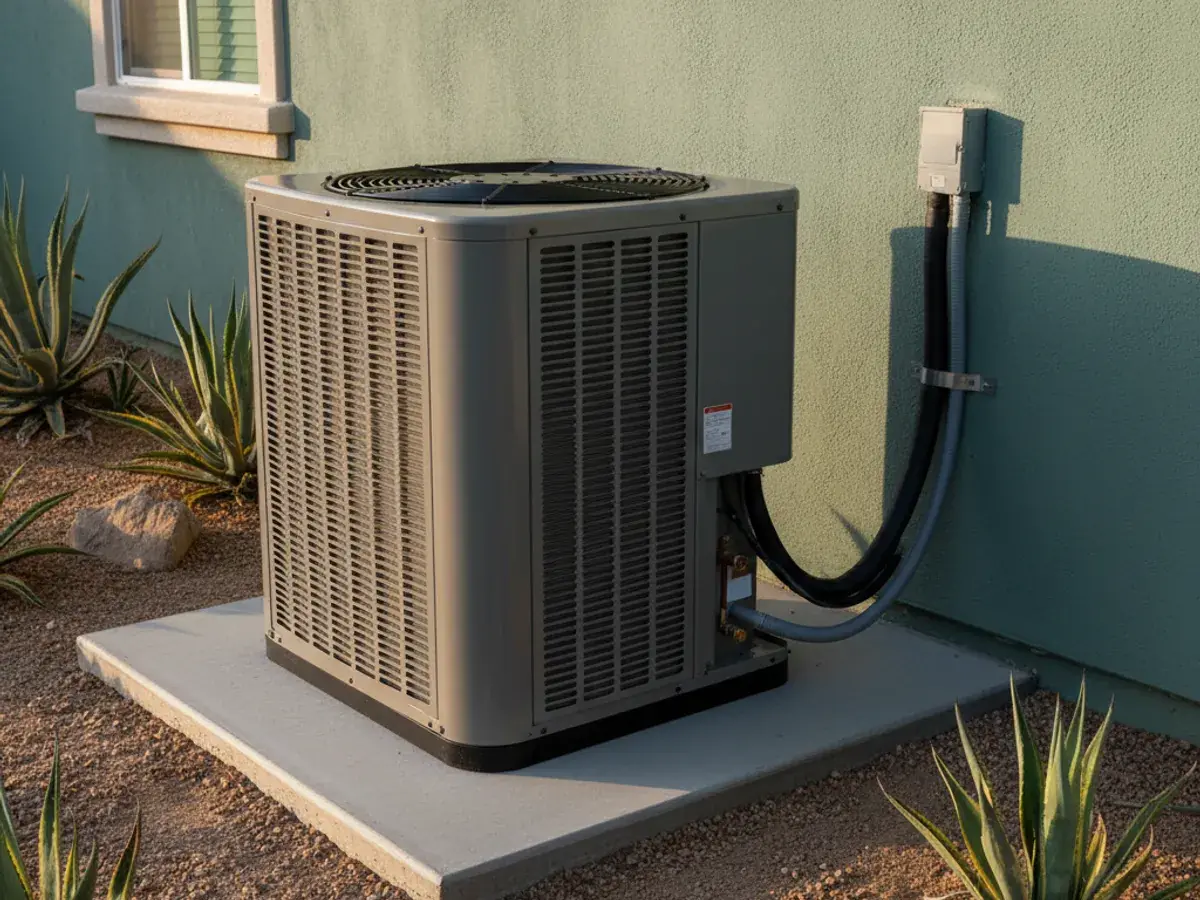
Climate Pros SD matches Fallbrook homeowners with a licensed HVAC company for AC installation. That company quotes after an in-home estimate. Timing and price are theirs. This brand does not install equipment.
Fallbrook sits in North County Inland at the edge of avocado and citrus country. Summers peak 87 to 89 degrees through July and August, drier than the coast and with less overnight recovery than coastal towns. The cooling load here is real and sustained. What makes Fallbrook different from other inland cities is the range of properties: older wood-frame homes in the historic downtown, newer custom builds out toward De Luz and Live Oak Park, agricultural parcels with detached workshops and packing sheds, and horse properties where long runs to outbuildings are part of the install. Sizing and equipment specs follow what is actually on the lot.
Installs happen across the full Fallbrook area. That includes the historic downtown and the blocks around the Fallbrook Community Center, the avocado-belt properties along Olive Hill Road and De Luz, the equestrian parcels near Live Oak Park and Reche Road, the Fallbrook Airpark community, and the newer custom homes on the east and south sides of town. Each area has its own property type and its own installation variables.
AC installation cost in Fallbrook
The matched company quotes the install in writing after an in-home estimate. You see equipment, labor, materials, and permit broken out before you decide. Cost depends on system size, property type, and how far equipment has to run.
| Repair | Typical range | Notes |
| In-home installation estimate | Quoted in writing | A real measured quote, not a phone guess |
| Manual J load calculation | Ask whether it is included | Ask the matched company to size the house, not guess from square footage |
| Standard central AC system, installed | Entry-tier pricing, quoted after estimate | 14.3 SEER2 single-stage, typical Fallbrook home |
| High-efficiency system, installed | Runs above the standard tier, quoted after estimate | Two-stage or variable-speed, 16-20+ SEER2 |
| Heat pump conversion, installed | Comparable to the high-efficiency tier before rebates | Replaces AC and propane or gas furnace, qualifies for largest rebates |
| Larger 4-5 ton system (De Luz, custom builds) | Runs above the standard-tonnage system, quoted after estimate | Rural and larger custom homes typically need bigger tonnage |
| Ductless mini-split for detached structure | Priced by structure size and number of heads | Workshop, barn, or ADU where running new ductwork is not practical |
| Long refrigerant line set run (over 50 ft) | Priced by run length | Common on rural lots with detached structures |
| Electrical panel or circuit upgrade | Priced after panel inspection | Common on older downtown Fallbrook homes |
| County of San Diego mechanical permit | Set by the county, passed through at cost | Pulled by the matched company if they include permitting |
| Duct sealing or partial duct replacement | Priced after duct inspection | Quoted only if the duct inspection finds real loss |
Should you repair or replace your AC?
Before committing to a new system, it is worth asking honestly whether you need one. A new install is the right call when the unit is old, uses R-22 refrigerant, or is facing a major repair. It is the wrong call when a small fix would buy several more good years. Two simple rules help sort it out.
The 50% rule
If a repair costs more than half of what a new system would run, replacement is the better money. An expensive repair, like an evaporator coil, on a 14-year-old unit points clearly to replacement. A cheap repair, like a capacitor, on a 7-year-old unit does not. Spending big on an old system rarely pays back.
The 5,000 rule
Multiply the age of the system by the repair cost in dollars. If the result tops 5,000, replacement is the better move. A repair that would be minor on a newer system can still clear that threshold once a unit hits 15 years old, which points toward a new system. The same repair on a unit just a few years old usually stays well under it, which points to fixing it.
Age and refrigerant matter on their own. Fallbrook has a mix of housing eras, and older homes still running R-22 systems face a clear calculation: once the system needs a recharge, replacement usually wins because R-22 is no longer produced and is expensive to source. Ask the estimate to give you the repair cost, the replacement cost, and a straight read. The decision is yours.
Local angle AC installation built for Fallbrook properties
What makes Fallbrook installs different
Most HVAC companies size Fallbrook homes the same way they size a suburban tract house in El Cajon. That misses what makes Fallbrook different: the rural lot, the detached structures, the propane setups, the avocado-grove sun exposure, and the older housing stock in the historic downtown. Sizing and specs follow what is actually on the property, not a template.
Summers here run well above the coastal normals regularly and can push far higher in the hotter stretches. The air is dry and the elevation varies enough across the city that cooling load changes block by block. A property on the south-facing Olive Hill Road hillside runs a different load than a shaded downtown bungalow, even at the same square footage. Manual J accounts for orientation, insulation, and window area, not just floor plan.
Propane homes and the heat pump decision
A meaningful share of Fallbrook properties run on propane, especially out toward De Luz, Live Oak Park, and the rural parcels east of town. When you are on propane, the heat pump question changes the math in a specific way. A propane furnace costs significantly more to operate per BTU than a heat pump does on grid power, and the efficiency gap is wide enough that a heat pump conversion often pencils out faster in Fallbrook than in a coastal city on natural gas.
Modern variable-speed inverter heat pumps handle every winter temperature Fallbrook sees, down through the cold nights in the upper elevations of De Luz. One outdoor unit replaces both your AC and your propane furnace. The SDG&E rebate and the federal 25C tax credit can together cut the upfront cost meaningfully. The propane-versus-heat-pump comparison gets run side by side during the on-site estimate so you can see the actual payback for your property.
Fire-zone equipment placement
Parts of Fallbrook sit in CAL FIRE High and Very High Fire Hazard Severity Zones, and that affects where and how outdoor equipment gets placed. The condenser needs adequate clearance from combustible vegetation, and placement decisions should not create a service access problem if evacuation or fire activity ever reaches the property.
Placement options get reviewed during the on-site estimate, any clearance concerns get flagged, and the final location is both code-compliant and practical for the property. This is not a common conversation in a coastal city install, but it matters out here and it does not get skipped.
Long runs to detached structures
Rural Fallbrook properties often have detached workshops, garages, accessory dwelling units, packing sheds, or tack rooms that need cooling. Extending a central system to a detached structure is possible in some cases, but long refrigerant line set runs add cost and complexity, and zoning or airflow balance issues can undermine the whole system.
In most cases, a ductless mini-split on the detached structure is the cleaner solution. One or two heads on a dedicated outdoor unit, independent of the main house system, sized exactly for that building, with no duct loss and its own thermostat. Every structure gets assessed during the estimate and the right approach gets recommended for each one.
The housing stock in Fallbrook
Fallbrook spans a wide range of housing eras. The historic downtown and the blocks around Fallbrook Community Center hold older wood-frame homes, some built before central air was standard and some with add-on systems installed years later with undersized ducts or panels that were never updated for a modern condenser. Both the ducts and the panel get checked as part of the estimate on those homes.
The De Luz, Live Oak Park, and Avocado Avenue areas hold a mix of older rural homes, newer custom builds on larger lots, and agricultural properties. Many of those homes are on propane, have longer refrigerant line runs, or have detached structures with their own cooling needs. The newer builds on the east and south sides of town tend to have better duct layouts and larger panels, but two-story plans often need zoning or a second unit upstairs.
Permits and rebates in Fallbrook
Fallbrook is an unincorporated community in San Diego County, so AC replacements fall under County of San Diego mechanical permit jurisdiction rather than a city building department. That permit is pulled as part of the job, the inspection is scheduled, and the work is recorded. A permitted install is on record at resale. Check your equipment certificate for what the manufacturer warranty requires.
If you move to a heat pump and an SDG&E offer is open, it is typically largest for qualifying heat pump systems. The federal 25C tax credit ended for systems installed after December 31, 2025, so it does not apply to a 2026 install. The matched company may file live SDG&E paperwork if an offer exists. Check sdge.com/rebates for any offer that is currently open. 25C does not apply to a 2026 install. Propane-to-heat-pump conversions in Fallbrook often qualify for the higher rebate tiers.
What else is ac installation in Fallbrook called?
Homeowners search for this a few different ways. In Fallbrook it also goes by air conditioning installation in Fallbrook , AC install in Fallbrook , and AC replacement in Fallbrook . They all reach the same licensed local pros, and the operator who answers will
sort out which one your job actually is.