In dry inland and desert San Diego, a swamp cooler can cool well on dry days. Near the coast, where humidity stays high, it barely helps. So the answer depends on your zip code. East County and the backcountry can run evaporative coolers through much of summer. Coastal and central homes usually need refrigerated AC. Named sources below show where each one wins, and what converting actually involves.
Climate Pros SD matches you with licensed HVAC companies. We do not install equipment, set conversion prices, or promise arrival windows.
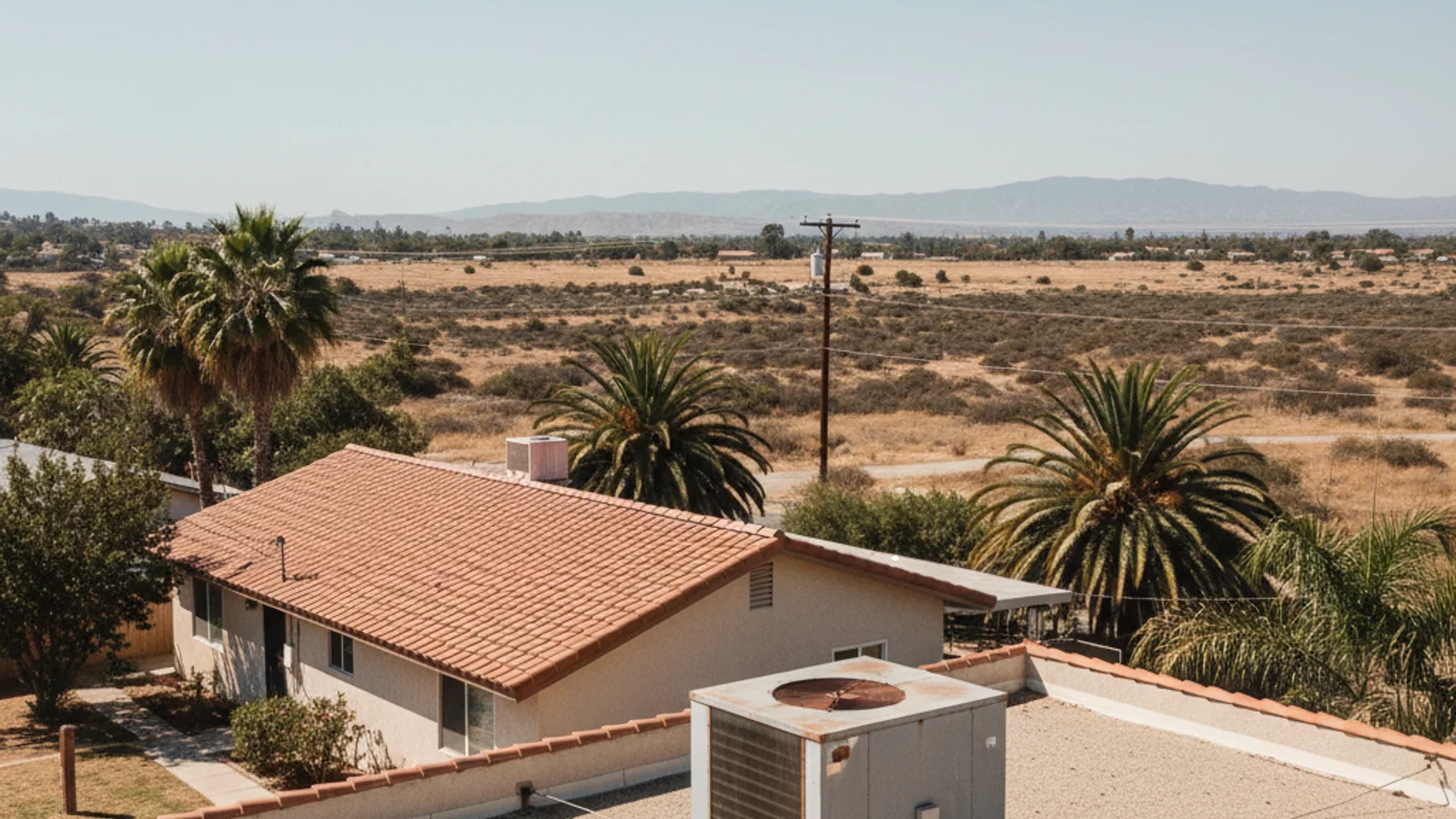
If you own an older home in El Cajon, Lakeside, Alpine, Julian, or Borrego Springs, there is a good chance you have a swamp cooler on the roof. They were the standard inland cooling system for decades. The question most owners ask now is whether to keep it, fix it, or convert to AC.
How does a swamp cooler actually work?
A swamp cooler, or evaporative cooler, cools air using water instead of refrigerant. A fan pulls hot, dry outside air through wet pads. As the water evaporates, it absorbs heat and drops the air temperature before pushing it into your home. According to the U.S. Department of Energy, that process can lower incoming air by 15 to 40 degrees in the right conditions.
That is the whole trick. No compressor, no refrigerant, no sealed loop. Just a fan, a pump, and water. The Department of Energy notes that evaporative coolers cost about half as much to install as central AC and use roughly one-quarter of the energy. Those DOE comparisons are national typical figures, not a San Diego bid.
The catch is in that phrase “the right conditions.” A swamp cooler only works when the outside air is dry enough to soak up more water. The more humid the air already is, the less it can cool.
Where do swamp coolers work in San Diego, and where do they fail?
San Diego County is not one climate. That is why this question has different answers depending on where you live.
Evaporative coolers perform best when relative humidity sits below 40%. Above 50%, the cooling effect drops off hard. Industry humidity charts such as HeatTalk’s evaporative cooler humidity chart show a much larger temperature drop at low humidity than at 50% humidity. Treat the chart as a named industry source, not a measurement of your street.
Now map that onto the county.
| Area | Typical summer humidity | Swamp cooler verdict |
|---|---|---|
| Coastal (La Jolla, Coronado, Carlsbad) | High, marine layer | Poor. Air is too humid to cool well |
| Central / inland coastal (Mira Mesa, El Cajon valley) | Moderate, swings daily | Mixed. Works mornings, struggles on humid afternoons |
| East County hills (Alpine, Lakeside) | Low to moderate | Good on dry days, less reliable in monsoon season |
| Mountains (Julian) | Low, mild summers | Good, though cooling need is small |
| Desert / backcountry (Borrego Springs) | Very low, very hot | Strong, except during late-summer monsoon humidity |
The pattern is clear. The closer you are to the ocean, the worse a swamp cooler performs. The drier and more inland you are, the better it works. Borrego Springs, with its desert air, is close to ideal evaporative cooler territory for most of the year. La Jolla is close to the worst.
There is one wrinkle for everyone inland: monsoon season. Late summer brings humid air up from the south, and during those stretches even a Borrego swamp cooler turns muggy and ineffective. That is the week your inland neighbors with AC are the comfortable ones.
Swamp cooler vs AC: cost, comfort, and humidity
Operating cost is where swamp coolers look great on paper. A typical evaporative cooler draws a few hundred watts, mostly for the fan and a small water pump. A central AC compressor draws much more. That gap shows up on your SDG&E bill, especially on time-of-use plans with a 4 p.m. to 9 p.m. on-peak window. Confirm your plan on sdge.com.
PIEC publishes a named national roundup of roughly $10 to $60 per month to run a swamp cooler, versus $60 to $350 a month for central AC depending on home size and efficiency. Those are not a San Diego bid and not Climate Pros SD prices. Ask the matched company to compare operating cost against your actual SDG&E or CCA plan.
Cost is only one column. Here is the fuller picture.
| Factor | Swamp cooler | Central AC / heat pump |
|---|---|---|
| Monthly operating cost | Lower electricity when humidity is low (PIEC national range above) | Higher compressor load |
| Works in humid coastal air | No | Yes |
| Adds humidity to the home | Yes (a downside in muggy weather) | No, removes humidity |
| Cools below outdoor wet-bulb temp | No | Yes |
| Water use | Uses water while running | None for cooling |
| Filters and dehumidifies | No | Yes |
| Maintenance | Pad swaps, water lines, mineral buildup | Filter, coils, refrigerant checks |
The comfort difference comes down to control. AC cools to a set temperature regardless of outside humidity, and it dries the air out. A swamp cooler can only cool as far as the dry air allows, and it pushes moisture into your home, which is the opposite of what you want on a sticky August afternoon.
For dry-climate inland homes that want the lowest bill and do not mind some humidity, a swamp cooler can be the frugal choice. For consistent comfort, allergy filtering, or any home near the coast, AC wins.
What does converting a swamp cooler to AC or a heat pump involve?
This is the part most inland homeowners are really weighing. The swamp cooler is aging, the monsoon weeks are miserable, and central AC is tempting.
The conversion depends on what the house already has. If branched ducts are sound, the job is mostly new cooling equipment, electrical, and sealing the old roof opening. If the home used a single swamp-cooler trunk, adding proper ducts dominates the work. A 240-volt circuit and panel capacity can be the other limiter. Climate Pros SD does not publish a conversion price. National roundup sites quote ranges that are not a San Diego bid. The matched company inspects ducts, the roof opening, and the panel, then quotes in writing.
Three things drive the scope on older East County and backcountry homes:
Ductwork. Many homes with swamp coolers used a single large supply duct, not the branched system AC needs. Adding proper ducts is a separate line item. A roof-mounted swamp cooler opening also has to be sealed and patched.
Electrical capacity. Refrigerated AC needs a 240-volt circuit and real amperage. Older homes on a 100-amp panel may need a panel upgrade. That is extra, and sometimes overdue anyway.
Equipment choice. A heat pump often beats a straight AC swap in colder inland and mountain areas like Alpine and Julian, because one system cools in summer and heats in winter. Do not treat 2026 as a rebate stack you can count on. Section 25C does not apply to property placed in service after December 31, 2025. TECH Clean California single-family HVAC reservations stopped November 14, 2025. HEEHRA single-family was fully reserved February 24, 2026. Design caps of $8,000 and $4,000 AMI are not live money. Do not stack TECH and HEEHRA. Confirm current utility offers at sdge.com/rebates.
For most homeowners, the right move is a proper AC installation sized to the home, using existing ducts wherever possible. A licensed contractor measures the home, checks the panel, inspects the ducts, and gives you both the AC-only and heat-pump options with real numbers, not a guess off the roof.
If you are in El Cajon, Lakeside, or anywhere across East County and the backcountry, ask the matched pro whether they have converted swamp-cooler houses of this vintage. They can tell you whether your ducts and panel are ready.
Related service: AC repair.
When should you call?
If your swamp cooler cannot keep up during humid weeks, or you want a written comparison of repair versus converting to AC or a heat pump, call (442) 777-6440. Climate Pros SD is a referral service. The matched company scopes ducts, the panel, and equipment.
FAQs
Do swamp coolers work in San Diego?
It depends where you live. In dry East County, the mountains, and the desert, swamp coolers work well most of the year. Near the coast, where the marine layer keeps humidity high, they barely cool at all. They also struggle countywide during late-summer monsoon humidity. The drier and more inland your home, the better an evaporative cooler performs.
Is it cheaper to run a swamp cooler or AC?
A swamp cooler usually uses far less electricity than central AC because it is a fan and a pump, not a compressor. The U.S. Department of Energy notes evaporative coolers typically cost less to install and use less energy than refrigerated AC when humidity is low enough. The tradeoff is that a swamp cooler only cools well in dry air and adds moisture to the house. Ask the matched company to compare operating cost against your actual SDG&E or CCA plan rather than a national monthly range.
How much does it cost to convert a swamp cooler to AC?
If your home has usable ducts, conversion is mostly equipment, electrical, and sealing the old roof opening. Without usable ducts, or if the panel cannot carry 240-volt cooling, the job grows. Ask for a written scope. Do not treat a national website range as your bid.
Should I get a heat pump instead of AC when I convert?
Often yes, especially in inland and mountain areas like Alpine and Julian that get cold winters. A heat pump cools in summer and heats in winter from one system. A straight AC swap is simpler upfront, but it only cools. A local pro can price both options for your home. Do not subtract closed 2026 rebate programs from either quote.
Why does my swamp cooler stop working in late summer?
Late summer brings monsoon moisture into San Diego, pushing humidity up. Swamp coolers can only cool dry air, so when humidity climbs above 50%, the cooling effect drops sharply. Even desert homes in Borrego Springs feel it during these humid stretches. That seasonal failure is one of the most common reasons inland homeowners decide to convert to AC.