Climate-controlled self-storage in San Diego County is mostly a moisture problem. National Weather Service San Diego describes ocean moderation near the coast and warmer summer days inland. Hot easterly winds can still push heat toward the coast. Stored cardboard, leather, paper, and electronics care about sustained high relative humidity at least as much as they care about a thermostat number.
Climate Pros SD is a referral service. We match facility owners with licensed, independent HVAC professionals. Those contractors design, permit, and install. We do not quote per-square-foot prices, tenant premiums, or payback years. Ask the matched pro and your own rent roll for those figures.
Why is humidity the first design load here?
Phoenix storage fights heat. Minneapolis storage fights freeze. San Diego fights damp air that sits on goods for weeks.
Coastal sites pick up marine-layer moisture in late spring. Inland sites (El Cajon, Santee, San Marcos, Escondido) are drier most of the year and still see humid stretches. Mold risk rises when indoor RH stays high. Tenants notice the smell even if they never quote a dew point.
A system that hits a cool setpoint and then shuts off on a mild May afternoon can leave humidity high. Dehumidification has to be a named mode, not an accident of cooling.
What equipment types do storage buildings actually use?
A licensed commercial HVAC contractor will usually discuss some mix of:
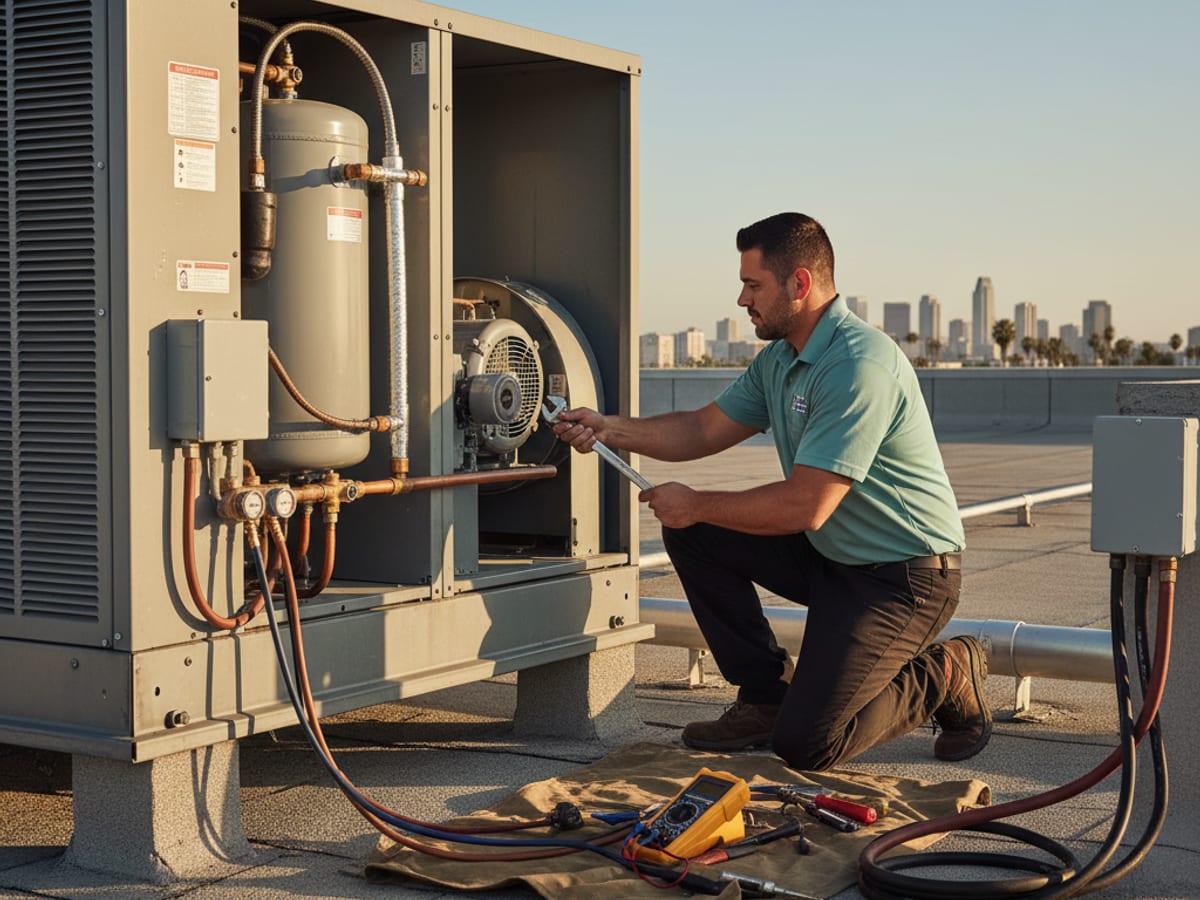
Packaged rooftop DX with a dehumidify or reheat mode. Common on mid-size new buildings. Weakest when outdoor temperature is already mild and the compressor never runs.
Dedicated outdoor air plus a dehumidifier. Better year-round moisture control. More to maintain. Often the conversation near the coast.
Multiple heat-pump systems by building. Useful on campuses where one giant duct run is impractical.
Coastal outdoor coils also see salt. Coated coils and cleaning schedules are a durability conversation, not a guaranteed year count.
How should an operator think about cost without fake ROI?
There is no Climate Pros SD installed cost, kWh forecast, or occupancy model. A matched pro prices after walking the envelope, doors, roof color, and electrical service.
Questions that actually change the job:
- Do walls and roof hold a vapor barrier, or will the HVAC fight a wet building forever?
- Do unit doors leak the air you paid to condition?
- Is the roof dark and hot inland, raising cooling load?
- Who owns the roof curb versus the HVAC in the CC&Rs if this is a multi-owner site?
New-build math and conversion math are different because retrofit often means envelope work, not just a rooftop swap. The contractor should say so in writing.
How do SDG&E time-of-use rates change operations?
SDG&E prices many commercial and residential plans by time of use. Current listed residential TOU plans (and many commercial schedules) put a 4 p.m. to 9 p.m. on-peak window on the table. Confirm the facility’s actual tariff. Do not use invented cents per kWh.
Operational ideas a controls contractor can implement without promising a percent:
- Hold a slightly higher dry-bulb during peak if humidity stays in range and goods stay safe.
- Run dedicated dehumidifiers in off-peak hours when the building is empty of people.
SDG&E Golden State Rebates retail offerings have ended. Do not treat that program as a current equipment discount. Recheck sdge.com.
Section 25C is a residential energy-efficient home improvement credit. Property placed in service after December 31, 2025 does not qualify. It is the wrong tool for a commercial storage plant. TECH Clean California single-family heat pump incentives stopped new reservations on November 14, 2025. HEEHRA single-family rebates were fully reserved as of February 24, 2026. Multifamily HEEHRA has its own pause on new Stage 1 applications even when budget remains. A project cannot receive both a TECH incentive and a HEEHRA rebate (TECH rules as of July 15, 2025). Recheck before anyone stacks names on a bid.
What about Title 24, refrigerants, and permits?
Conditioning a building that was previously unconditioned can trigger envelope and energy-code work, not just a mechanical permit. City of San Diego mechanical rules require a permit to install, alter, replace, or repair HVAC or refrigeration in that city. Other cities and the county have their own counters. The licensed contractor pulls permits.
California Title 24 requires field verification when HVAC is altered or replaced, performed by a CEC-certified rater under the current Energy Code Compliance path. Do not cite an unverified leakage percentage.
ENERGY STAR says a typical forced-air house can lose about 20% to 30% of the air moving through ducts because of leaks. That is a national house statement. Still ask how storage corridor ducts are sealed.
New residential and light-commercial air conditioning and heat pump equipment manufactured or imported after January 1, 2025 must meet EPA’s GWP limit of 700 under the AIM Act. Existing R-410A plants remain serviceable with R-410A. Do not treat service refrigerant as banned. Do not invent refrigerant prices.
When might full climate control be the wrong spend?
A small inland facility whose competitors do not collect a climate premium may get more from door seals, roof reflectivity, and ventilation than from a full plant. That is a market question. Call nearby operators. Do not use a national average rent table as your pro forma.
FAQ
How much does it cost to add climate control to an existing San Diego storage facility?
Ask the licensed commercial HVAC contractor for a scoped bid after they see envelope, power, and roof. Climate Pros SD does not publish a per-square-foot number.
Do tenants pay more for climate control?
Sometimes, in some micro-markets. Pull live listings near your site.
What humidity should a climate-controlled building hold?
The matched engineer sets a target for the goods you store. “Climate-controlled” in ads often means temperature only. Ask whether dehumidification is dedicated or leftover cooling.
Can I run storage with dehumidifiers and no AC?
On some well-sealed coastal buildings, maybe. Inland summer heat usually needs real cooling. The pro models both loads.
How long does storage HVAC last near the ocean?
Salt shortens coil life if you ignore coatings and washdowns. There is no county-wide year guarantee.
Do you install the rooftop equipment?
No. Climate Pros SD refers. The customer contracts the licensed contractor. That company states its own timing. We do not.
Related: commercial HVAC, AC repair, AC installation, coastal humidity, small-business HVAC.
Where to start
Survey competitor climate units before you buy equipment. Put the HVAC designer on the architectural team early so roof color, doors, and vapor control are not afterthoughts.
Call (442) 777-6440. We will match you with a licensed local pro who can walk the facility and write a scope before any work starts.