TL;DR
- Section 25C does not apply to property placed in service after December 31, 2025. Qualifying 2025 heat pumps had a $2,000 annual IRS limit, nonrefundable, with QMID on the return.
- TECH Clean California single-family heat pump HVAC and heat pump water heater incentives stopped accepting new reservations on November 14, 2025.
- HEEHRA single-family rebates were fully reserved statewide as of February 24, 2026. No new single-family income-verification applications. Existing approved reservations may continue. A submitted request is not approved funding.
- As of July 15, 2025, a project cannot receive both a TECH incentive and a HEEHRA rebate.
- SDG&E Golden State Rebates Program retail rebate offerings have ended. Confirm any other SDG&E program on the current rebates page. Use a participating contractor if a live utility program requires one.
If you’re replacing a furnace or AC in 2026, a heat pump can still make sense on comfort and operating cost. Incentive help is smaller and must be confirmed. Climate Pros SD is a referral service. We match you with licensed, independent HVAC professionals. We do not enroll you in SDG&E programs.
Programs change. Verify current status with SDG&E, TECH, CEC, and the IRS before you purchase. Not tax advice.
What SDG&E offers in 2026
SDG&E says the Golden State Rebates Program retail rebate offerings have ended. Name that program. Do not treat the ending as every SDG&E offering. A residual product table on the rebates page is not evidence of a current offer.
Confirm anything still open, including income-qualified utility assistance, on sdge.com/rebates and the program portal named there. This page will not publish invented equipment rebate ranges, whole-home electrification bonuses, or per-ton dollar amounts.
Current listed SDG&E residential time-of-use plans have a 4 p.m. to 9 p.m. on-peak period. That is a rate-plan fact, not a rebate.
What TECH Clean California adds (when you already have a reservation)
TECH Clean California single-family heat pump HVAC and heat pump water heater incentives were fully reserved and stopped accepting new reservations on November 14, 2025. Describe availability, enrollment, product eligibility, reservation, approval, and payment as separate conditions.
You cannot plan a new 2026 single-family reservation around TECH money. If you already hold an approved reservation, that reservation may still move through payment rules. Recheck TECH before you purchase.
Source: techcleanca.com/incentives
HEEHRA (not an SDG&E program)
HEEHRA single-family rebates were fully reserved statewide as of February 24, 2026. No new single-family income-verification applications were being accepted. Existing approved reservations may continue. Do not describe a waitlist or submitted request as approved funding.
Program design permits up to $8,000 below 80 percent AMI and up to $4,000 from 80 to 150 percent AMI for qualifying replacement of an existing primary heating source with a heat pump. Reservations must be approved before installation. Those are caps and conditions, not currently available money. HEEHRA is not retroactive.
Multifamily HEEHRA funding may show as available while new Multifamily Application Stage 1 submissions are paused. Available budget does not mean you can submit a new Stage 1 application.
As of July 15, 2025, a project cannot receive both a TECH incentive and a HEEHRA rebate.
Federal 25C tax credit (ended for 2026 placed-in-service dates)
Qualifying 2025 installations may fall within the Section 25C credit period. Property placed in service after December 31, 2025 does not. For qualifying 2025 property, report QMID. The IRS annual limit for qualified heat pumps and heat pump water heaters was $2,000. Nonrefundable. Tax professional for tax questions.
If you installed in 2025, that is a 2025 return issue, not a 2026 SDG&E rebate.
What the old stack is not
This page will not reprint a $5,500 stack that brought a $14,000 install down to $8,500. Those figures were never a verified 2026 offer, and they mixed programs that no longer accept new single-family reservations with a federal credit that does not apply to 2026 placed-in-service dates.
How to actually claim what is still live
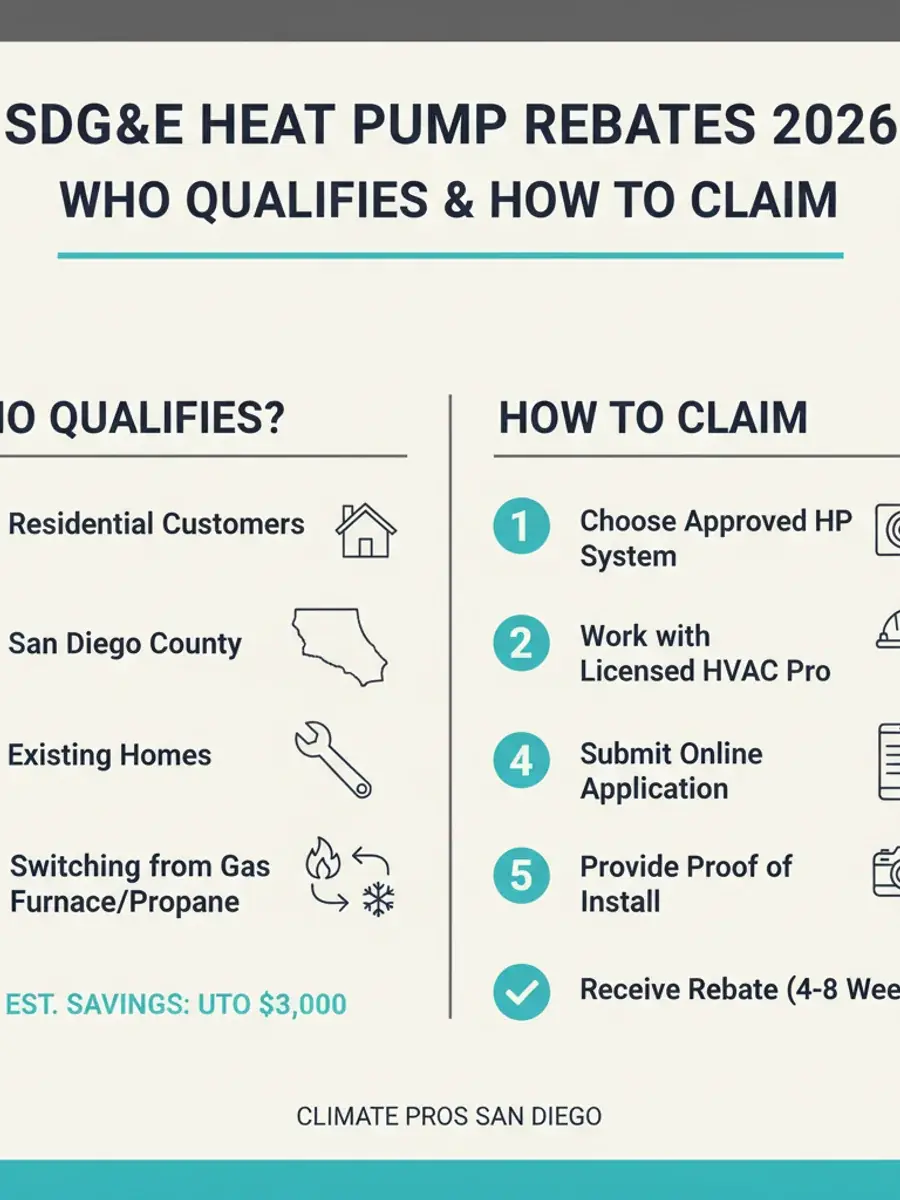
1. Use a participating contractor if the live program requires one. Not every HVAC company is enrolled in every utility program. Ask before you sign. Climate Pros SD is not the installing contractor. The matched company answers for their own enrollments.
2. Verify equipment eligibility against the live program’s list (AHRI, SEER2/HSPF2, whatever that program names).
3. If the program requires approval before install, do not install first. HEEHRA is not retroactive. Reservations must be approved before installation.
4. If you installed in 2025, file 25C on the 2025 return with QMID. There is no 25C credit for a 2026 placed-in-service date.
Pitfalls to avoid
Don’t install before checking eligibility. If the model is not on the approved list, a live rebate can disappear after the fact.
Don’t assume TECH or HEEHRA will pay a new 2026 single-family job. TECH new reservations stopped November 14, 2025. HEEHRA single-family income verification stopped February 24, 2026.
Don’t try to stack TECH and HEEHRA.
Don’t assume your panel can handle a heat pump. That is an electrician’s load calculation. This site will not publish a panel-upgrade price.
Don’t treat Golden State retail as still paying. It has ended.
Common denial reasons
Wrong equipment model. Uncertified or off-list equipment.
Install before required approval. HEEHRA is not retroactive.
Claiming 25C for 2026 placed-in-service.
TECH plus HEEHRA on one project.
Property type mismatch. Ask the program whether owner-occupied, rental, or multifamily rules apply. Do not invent rental caps here.
Related services: AC repair and AC installation.
When to call us
The installers in our network pull permits in the jurisdictions that require them, and they file whatever live rebate they actually enroll in. See heat pump service for scope, or heat pump installation cost for how quotes are built (verify any dollar figures there against a live bid).
Call (442) 777-6440 for a heat pump match in San Diego County. Ask the matched installer what, if anything, is funded for your address this week.