Most San Diego homeowners finance a new HVAC system at 6–13% APR over 60–120 months, which works out to roughly $150–$280 per month on a $12,000–$18,000 system. Some installers offer 0% promotional periods of 12–24 months for well-qualified buyers. After rebates from HEEHRA and TECH Clean California, the amount you finance can drop by $2,000–$8,000, cutting your monthly payment significantly.

Homeowner reviewing HVAC financing paperwork at a kitchen table with a tablet sh

Not all financing is equal, though. The difference between a deferred-interest promo and a fixed-APR installment loan can cost San Diego homeowners thousands if they pick wrong. Here’s how to sort the options and choose what actually fits your budget.

What HVAC financing actually looks like in 2026

When a contractor offers “financing,” they’re typically talking about a specialized home improvement loan offered through a third-party bank. These are not store credit cards. They are unsecured personal loans designed specifically for projects like a new AC installation.

In San Diego, most established HVAC companies work with a few major national lenders. You’ll frequently see programs from:

  • Synchrony Bank: One of the largest providers of consumer financing, known for a wide range of promotional offers.
  • GreenSky: A popular platform that connects homeowners, contractors, and banks to offer installment loans for home improvement projects.
  • Wells Fargo Home Projects: A long-standing program offering revolving lines of credit and special financing terms through authorized dealers.

The process is usually straightforward. During your in-home estimate, your technician can help you apply online. Approvals are often instant and based on your credit score and history, a FICO score of 680 or higher is typically needed for the best rates.

These loans offer a variety of terms, from short-term promotional plans to longer-term installment plans stretching out as long as 12 years (144 months). While a longer term means a lower monthly payment, it also means you’ll pay more in total interest over the life of the loan. It’s a trade-off between monthly cash flow and total long-term cost.

0% promo financing, when it’s real and when it’s a trap

The most eye-catching offer you’ll see is “0% APR for 18 months” or a similar promotion. This can be a fantastic deal, but you have to understand exactly how it works to avoid a very expensive trap.

These offers are almost always “deferred interest” plans.

Here’s how it works: Interest is calculated and tracked in the background from the very first day of your loan. If you pay off the entire loan balance before the promotional period ends, all of that accrued interest is waived. You truly pay $0 in interest. For homeowners who have the cash flow to pay off a large purchase over a year or two, this is a great way to manage the expense.

The trap is what happens if you don’t. If you have even a single dollar of the original balance remaining on the day the promo expires, the bank will add all of that back-dated, accrued interest to your loan.

Let’s say you finance a $15,000 system on a “0% for 18 months” plan with a standard APR of 19.99%. If you miss the payoff deadline by a day, you could suddenly see over $4,500 in interest added to your balance. It’s a brutal penalty.

A safer, more predictable alternative is often a reduced-APR loan. An offer of 7.99% for 10 years might not sound as exciting as 0%, but it gives you a fixed, reasonable monthly payment with no risk of an interest bomb. For many San Diego families, this predictability is worth far more.

HEEHRA and TECH Clean California rebates that lower the loan

The best way to make your HVAC financing more affordable is to finance a smaller amount. This is where San Diego’s incredible stack of rebates and incentives comes in. Instead of just focusing on the loan terms, you should first focus on slashing the total project cost.

The two biggest programs available in 2026 are:

  • HEEHRA (Home Electrification and Appliance Rebate Program): This federal, income-qualified rebate program may cover up to $8,000 toward a new heat pump, depending on your household income relative to the area median income. Funding is limited and allocated by state. California is still distributing available dollars, but availability can change. Check current eligibility before counting on this amount.
  • TECH Clean California: This statewide program offers point-of-sale rebates for switching from a gas furnace to a qualifying heat pump. Eligible SDG&E-territory homeowners may qualify for $1,000 or more applied directly by the contractor at installation. Income-qualified households may see higher amounts.

These aren’t tax credits you file for later. When available, they’re instant price reductions at the point of sale, which means less to finance. Combining programs could cut a project cost by several thousand dollars. Financing $10,000 instead of $16,000 drops your monthly payment noticeably and reduces total interest paid.

Before settling on a loan amount, ask your contractor which rebates you qualify for and confirm the programs are funded at the time of your installation. You can learn more in our detailed guide to the San Diego heat pump rebate stack.

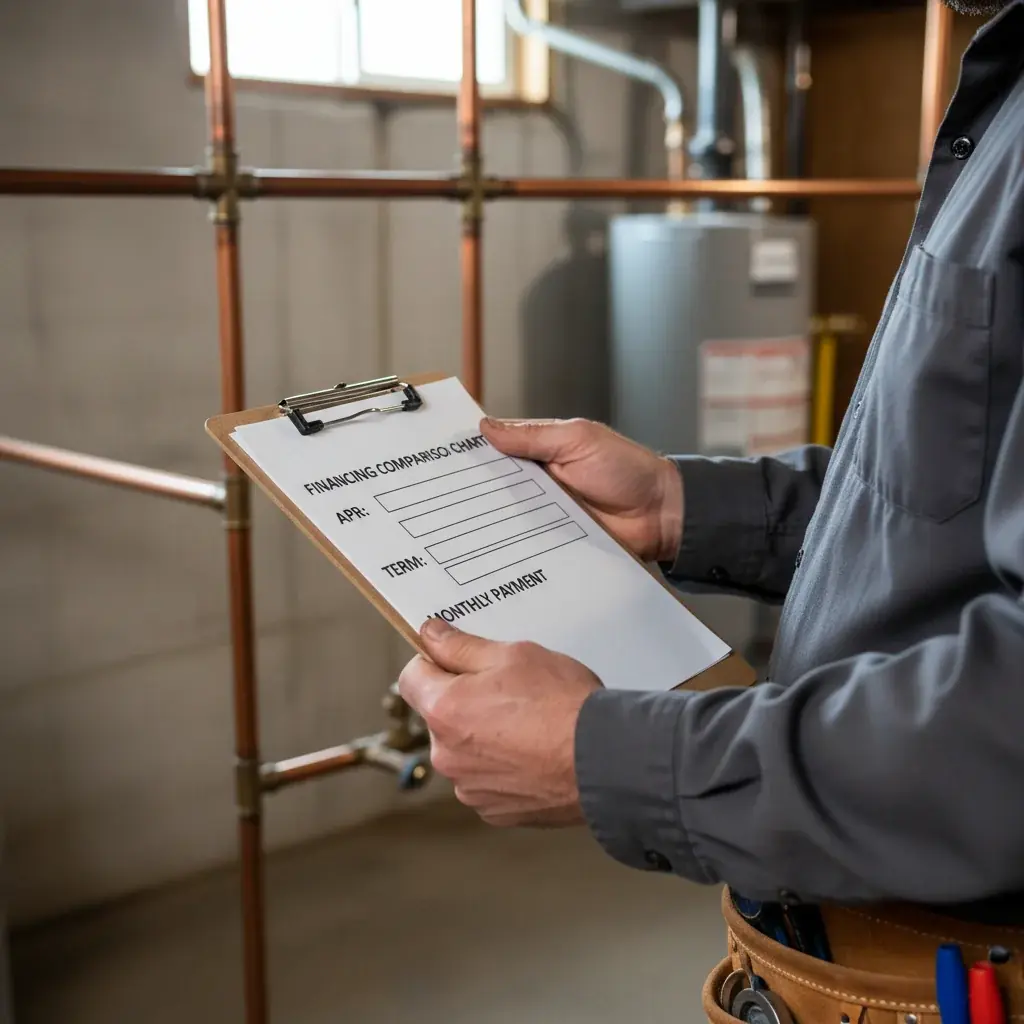
Close-up of a financing comparison chart on a clipboard showing APR, term, and m

PACE financing on your property tax bill, pros and the big con

You may hear about another type of financing called PACE, which stands for Property Assessed Clean Energy. In California, common program names have included HERO and Ygrene. The concept sounds appealing at first.

Instead of a personal loan based on your credit, PACE financing is tied to your property itself. The loan is paid back over 10 to 20 years as a special assessment added to your annual property tax bill. Because it’s secured by your home, approval is based on your home equity, not your FICO score. This makes it accessible to more homeowners.

But there is a very big con.

The PACE loan is recorded as a lien against your property, and it takes first priority. This means if you sell your home, the PACE lien must be paid off before the mortgage company gets their money. As a result, most mortgage lenders will not approve a new loan for a buyer until the PACE lien is paid off in full.

This can be a deal-killer when you try to sell or refinance. We’ve seen San Diego homeowners who are forced to come up with $20,000 or more at closing to pay off the remaining PACE balance, wiping out a huge chunk of their equity. While the idea of rolling payments into your property taxes sounds simple, the potential complications down the road are significant. We generally advise homeowners to explore traditional financing options first.

How to compare two financing offers honestly

When you’re looking at different quotes and payment options, it’s easy to get confused. To make an apples-to-apples comparison, you need to look beyond the monthly payment.

Here’s what to check:

  1. Ask for the cash price vs. the financed price: Those “0% APR” or “low APR” offers aren’t free for your contractor. The financing company charges a “dealer fee” to buy down the interest rate, often 5–20% of the project cost, and many companies build that into the financed price. Asking for a cash-discount price reveals the true cost of borrowing.
  2. Calculate the total cost: Don’t just look at the monthly payment. Multiply the monthly payment by the total number of months. A $150/month payment for 144 months is $21,600. A $280/month payment for 60 months is $16,800. The lower monthly payment costs $4,800 more over the loan life.
  3. Understand the loan type: Is it a deferred-interest plan with a promotional period, or a simple installment loan with a fixed APR? Know the rules before you sign. The deferred-interest trap catches a lot of San Diego homeowners who meant to pay it off faster.
  4. Get at least two contractor bids: Financing terms differ by contractor because they partner with different lenders. A second quote on a full AC installation often surfaces a better loan option, not just a lower equipment price.

Choosing the right financing is just as important as choosing the right equipment. Take your time, ask questions, and confirm the total cost before you sign.

Frequently asked questions

What credit score do I need to finance an HVAC system in San Diego?

Most HVAC lenders in San Diego look for a FICO score of 640 or higher for standard approval, and 680 or higher for the best promotional rates. Scores below 640 may still qualify through some programs, though the APR will be higher and the term shorter. If your credit is thin, asking a co-signer or exploring a PACE loan (with full awareness of its property-lien risks) are alternative paths.

How much does a financed HVAC system actually cost per month?

On a $14,000 system at 9.99% APR over 84 months, expect a payment around $220/month. At 6.99% over 60 months, closer to $275/month. Monthly payments drop significantly once rebates reduce the financed amount. For example, a $10,000 loan at 9.99% over 84 months runs about $160/month. These are estimates; your lender will give exact figures based on your credit and chosen term.

Is 0% APR HVAC financing too good to be true?

Not necessarily, but the details matter. Most 0% offers are deferred-interest plans, not true zero-interest loans. If you pay off the full balance before the promotional period ends (usually 12–24 months), you pay no interest. If you don’t, all back-dated interest charges at the standard APR (often 19–26%) get added to your balance at once. For a $15,000 system at 24.99% APR, missing the payoff date by even a month can add more than $5,000 in interest. Only take a deferred-interest offer if you’re confident you can pay it off in time.

Can I use HVAC rebates and financing at the same time in San Diego?

Yes, and you should. Rebates reduce the amount you need to finance, which cuts your monthly payment and total interest. SDG&E-territory homeowners may qualify for TECH Clean California rebates at the point of sale, which come off the invoice before you finance anything. HEEHRA rebates, when available and funded, work similarly. Apply every rebate first, then finance the remainder.

How long does HVAC financing approval take?

Most contractor-partnered lenders (Synchrony, GreenSky, Wells Fargo) offer instant or same-day approval decisions online. The technician can walk you through the application during your in-home estimate. Funding to the contractor typically happens within 24–48 hours of project completion, so same-day or next-day installation is possible once you’re approved.

What happens to my HVAC financing if I sell my home?

Traditional unsecured installment loans (the most common type) stay with you, not the home. You keep paying them after the sale. PACE loans are different. They’re recorded as a lien against the property and must typically be paid off at closing, which can complicate or delay a home sale or refinance. This is one of the main reasons we recommend traditional financing over PACE for most San Diego homeowners.

When to call us

Navigating financing options, rebate paperwork, and system choices can feel overwhelming. A professional, licensed HVAC contractor can lay out all the options clearly, helping you find the right balance of performance and affordability for your home. Every estimate comes with upfront pricing for both cash and financed projects so you can make a fully informed decision.

Call us at (442) 777-6440 for a same-day estimate.