California Title 24 requires mechanical ventilation in all new homes and most major remodels. Modern tight construction doesn’t leak enough air to ventilate naturally, so code mandates an active fresh-air system delivering 7.5 CFM per occupant plus 3 CFM per 100 sqft of conditioned space. ERVs (energy recovery ventilators) and HRVs (heat recovery ventilators) are the two systems that meet this requirement while keeping energy use low. Climate Pros SD does not publish an installed dollar menu. The matched company quotes after they see ducts and the Title 24 CFM.
ERV vs HRV is the most common question. Here’s how it actually applies to San Diego homes.
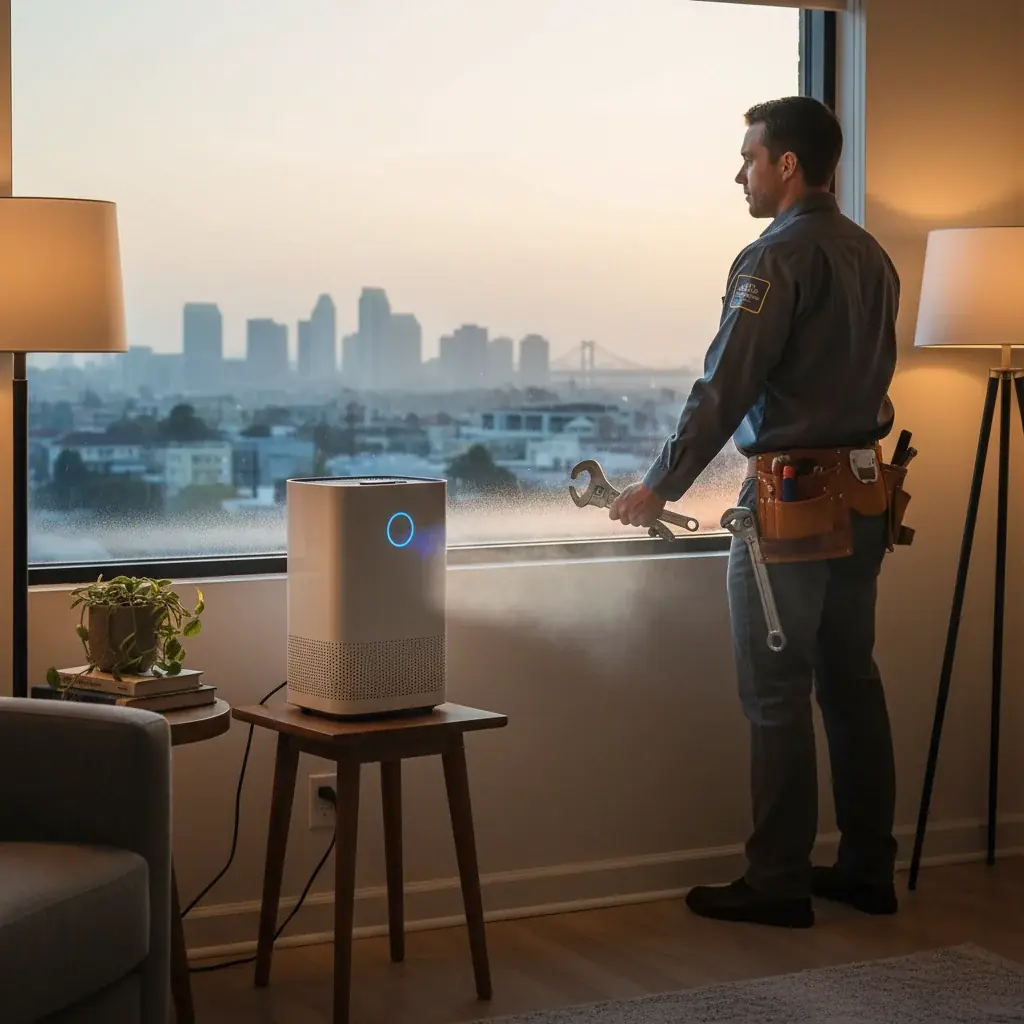
ERV vs HRV in one paragraph
Both ERVs and HRVs use a heat exchanger to transfer heat between the outgoing stale air and the incoming fresh air, recovering 60-90% of the energy that would otherwise be lost. The difference: an ERV also transfers moisture between the two air streams; an HRV transfers only heat. ERVs are better in humid coastal climates and in dry climates with humidity-control needs. HRVs are better in cold climates where you want to dump moisture outdoors.
For San Diego: ERVs are the default choice for coastal and most inland homes. HRVs only make sense in specific inland scenarios.
What Title 24 actually requires
California’s energy code mandates mechanical ventilation in residential construction certified after 2008 (more restrictive after each three-year code cycle). The current rule (ASHRAE 62.2-2019, adopted by Title 24):
Whole-house ventilation rate: 7.5 CFM per occupant + 3 CFM per 100 sqft of conditioned floor area.
For a typical 2,000 sqft, 4-occupant San Diego home: (4 × 7.5) + (2,000 × 0.03) = 30 + 60 = 90 CFM continuous fresh air.
Acceptable systems:
- Continuous exhaust fan with passive intake (meets code, wastes conditioned air)
- Continuous supply fan (rarely used)
- Balanced ventilation with ERV or HRV
- Central-fan-integrated supply ventilation (CFIS)
The exhaust-only approach meets code but throws away heated or cooled air. ERV/HRV captures most of that energy back. CFIS is a middle ground that uses the existing HVAC blower to pull in outdoor air through a controlled damper. Climate Pros SD does not publish a dollar table for those four paths.
The exhaust-only approach meets code but throws away heated or cooled air. ERV/HRV captures most of that energy back. CFIS is a middle ground that uses the existing HVAC blower to pull in outdoor air through a controlled damper.
When required: every new construction project. Any addition over 1,000 sqft. Any “major renovation” that touches more than 50% of the conditioned envelope. Many remodels that replace HVAC equipment also trigger ventilation compliance.
Why San Diego usually picks ERV over HRV
The choice depends on climate. The ERV/HRV decision matrix:
| Climate type | Best choice | Reason |
|---|---|---|
| Hot humid (Houston, Miami) | ERV | Block humidity from entering |
| Cold humid (Minneapolis) | HRV | Dump indoor moisture outside |
| Hot dry (Phoenix) | ERV | Retain indoor humidity in summer |
| Mild humid (San Diego coastal) | ERV | Manage marine layer humidity |
| Mild dry (San Diego inland) | ERV | Retain indoor humidity in winter |
San Diego coastal humidity averages 65-75% with regular fog and marine layer days. Inland communities run dry in summer (20-40% RH) and modestly humid in winter (45-65%). An ERV moderates both extremes; an HRV doesn’t help with either.
The single exception: homes with persistent indoor moisture problems (basement-style construction, bathroom-heavy occupancy, indoor pool) sometimes benefit from an HRV’s tendency to dump moisture. Rare in San Diego residential.
What moves an ERV/HRV quote in 2026
Climate Pros SD does not publish equipment or installed bands. Ask the matched company to price the path that actually applies:
| System type | What you are buying |
|---|---|
| Exhaust-only (continuous fan plus intake) | Code path. Throws away conditioned air. |
| CFIS (smart damper plus outdoor sensor) | Uses the existing HVAC blower. |
| HRV | Heat recovery only. Rare default in San Diego. |
| ERV | Heat plus moisture transfer. Usual San Diego pick. |
| Premium ERV with high-grade filtration | Extra filtration hardware. Quote separately. |
Installation complexity drives the quote. New construction during framing is the easier labor case. Retrofitting a finished home with no existing duct pathways takes more time. That is not a Climate Pros SD bid.
When ERV retrofit pays off in San Diego
Title 24 only requires ventilation in new construction and major remodels. Older homes (pre-2008 construction) often have enough natural infiltration to ventilate adequately without mechanical help. That said, three retrofit scenarios make sense:
1. Wildfire smoke filtration. A balanced ERV with high-MERV or HEPA filtration provides clean outdoor air on smoke days. Most homes during fire events face an impossible choice: open windows for fresh air but get smoke, or close everything but suffocate. An ERV with proper filtration solves it. Ask for that filtration spec on the quote. Strongest case for asthma, young kids, or canyon-adjacent fire-risk zones.
2. Tight new home with comfort issues. Homes built 2015 or later with foam insulation and good air sealing often feel stuffy and have humidity or odor complaints. An ERV solves both. Symptom check: windows fog from inside in winter, persistent cooking smells, occupant complaints of stuffiness.
3. Bathroom-heavy or kitchen-heavy occupancy. Homes with multiple bathrooms running long showers, or heavy daily cooking, produce more indoor moisture than coastal air infiltration can handle. An ERV moderates without requiring open windows. Less common driver but real.
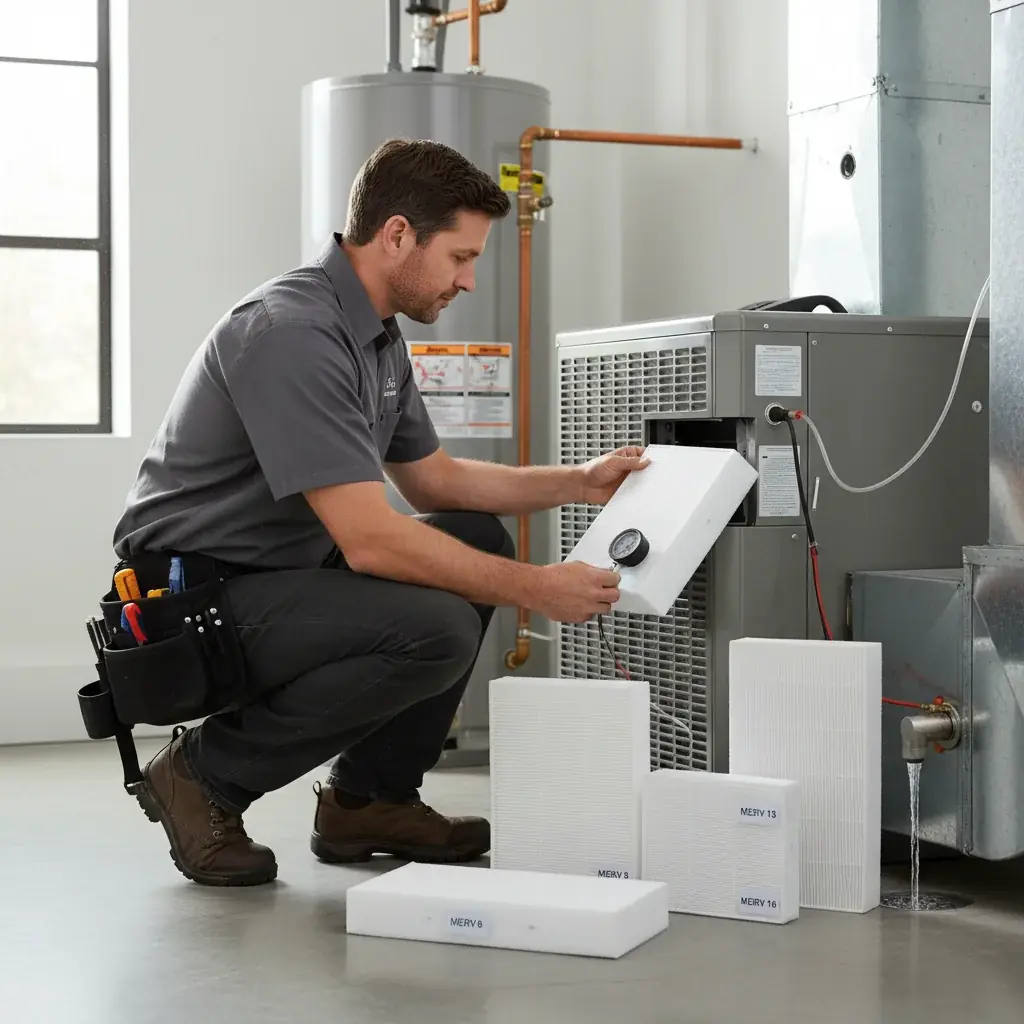
ERV sizing and CFM math
The Title 24 calculation gives total CFM. Sizing the ERV is straightforward:
| Home size | Occupants | Required CFM | Recommended ERV size |
|---|---|---|---|
| 1,200 sqft | 2 | 51 | 60-90 CFM |
| 1,800 sqft | 3 | 77 | 90-120 CFM |
| 2,400 sqft | 4 | 102 | 110-150 CFM |
| 3,200 sqft | 5 | 134 | 140-200 CFM |
| 4,000 sqft | 6 | 165 | 175-250 CFM |
Oversize 15-25% above minimum so the unit doesn’t run at maximum continuously. Continuous operation at 60-70% of rated capacity uses less energy and lasts longer than burst operation at 100%.
Integration with HVAC equipment
Three integration patterns are common in San Diego:
Standalone ERV (separate ducts, dedicated fresh-air vents and return points). Best performance, most duct labor on a retrofit. The ERV operates independently of the heating/cooling system.
Tied-in ERV (ERV ducts connect to the return side of the air handler). Uses existing distribution. The HVAC blower runs more often to circulate ventilation air, raising electric use slightly.
Smart-coupled ERV (ERV with integrated control linked to thermostat). Newer Broan AI Series and Panasonic Intelli-Balance units optimize runtime based on indoor RH, CO2, and outdoor conditions. Slightly more control hardware than a basic tied-in unit.
For most San Diego retrofits, the tied-in approach is the right balance of cost and performance.
What besides ERV/HRV matters
Mechanical ventilation alone doesn’t solve every indoor air issue. Three things matter as much:
Filtration. MERV 13+ on the supply side blocks particles. See our HVAC filter MERV guide for what your system can actually handle.
Source control. Combustion appliances (gas range, gas furnace, gas water heater), off-gassing materials, and cleaning chemicals add load. A heat pump replacement removing combustion equipment reduces ventilation requirement effectiveness.
Humidity targets. Indoor RH should stay 30-50%. Below 30% causes dry-air symptoms; above 50% promotes mold and dust mites. An ERV moderates but doesn’t actively control humidity. That’s a whole-house dehumidifier or AC sizing question.
Decision framework
Building new in SD County: balanced ERV is the right answer. Spec it during design phase to integrate cleanly with HVAC.
Doing a major remodel that triggers Title 24: balanced ERV or CFIS depending on the written quote. CFIS uses more HVAC blower energy long-term.
Retrofitting an older home with no compliance pressure: justify the retrofit on wildfire smoke, indoor comfort, or occupancy load grounds. Not just because code says new houses need it.
Old leaky home with no comfort complaints: skip the ventilation upgrade. The infiltration is already ventilating the house. Put money into insulation and air sealing first, then revisit.
What to ask a contractor about ERV install
- “What’s my Title 24 required CFM for this house?”
- “Are you sizing the ERV to the calculated load plus 15-25% headroom?”
- “Will you tie into the existing HVAC return or run dedicated ventilation ducts?”
- “What filtration grade does this unit support, and what is the replacement filter schedule?”
- “Will the unit’s controls integrate with my thermostat or smart home system?”
- “What’s the manufacturer’s warranty on the heat exchange core?”
For more on indoor air quality at the home level, see what is indoor air quality in San Diego. For new-construction HVAC planning, see HVAC new construction San Diego Title 24.
FAQs
Is ERV required in California?
Mechanical ventilation is required by Title 24 in new construction and major remodels. ERV is one of four approved compliance paths. The others are HRV, exhaust-only with passive intake, and central-fan-integrated supply (CFIS).
What’s the difference between ERV and HRV?
Both recover heat between outgoing stale air and incoming fresh air. An ERV also transfers moisture between the streams; an HRV transfers only heat. ERV is better for San Diego’s mixed humidity climate.
How much does an ERV cost installed in San Diego?
Ask the matched company. Climate Pros SD does not publish a retrofit band. New construction integrated during framing is usually less labor than a finished-house retrofit. Premium HEPA-filtered models are a separate line.
Can an ERV help with wildfire smoke?
Yes, with proper filtration. A balanced ERV with MERV 13 or HEPA filtration on the supply side delivers filtered fresh air while keeping windows closed. One of the strongest arguments for ERV retrofit in fire-zone-adjacent SD homes.
Does my existing HVAC need to change to add an ERV?
Usually no, but the install method changes labor. Tying the ERV into the existing return ductwork is the most common retrofit approach. Standalone ERV systems (separate ducts) take more time and operate independently of the HVAC blower.
What’s the maintenance on an ERV?
Filter changes every 3-6 months, heat exchange core cleaning annually. Ask the installer which cores are washable versus replaceable (some are rated for 10-15 years). Climate Pros SD does not publish an annual materials dollar range. See HVAC maintenance.
Related service: AC repair. Local coverage: all 67 cities we cover in San Diego County.
When to call us
If you’re trying to figure out whether ERV makes sense for your San Diego home, what size you need, or how to integrate ventilation with an HVAC replacement, we’ll run through it honestly. Call (442) 777-6440 for a free in-home assessment.