Coronado’s island charm comes with its own set of challenges, especially for your home’s air conditioning system. The relentless salty air and the unique demands of historic architecture mean that AC repair here isn’t quite like anywhere else in San Diego County.
Climate Pros SD matches you with licensed HVAC companies. We do not publish an island price table.
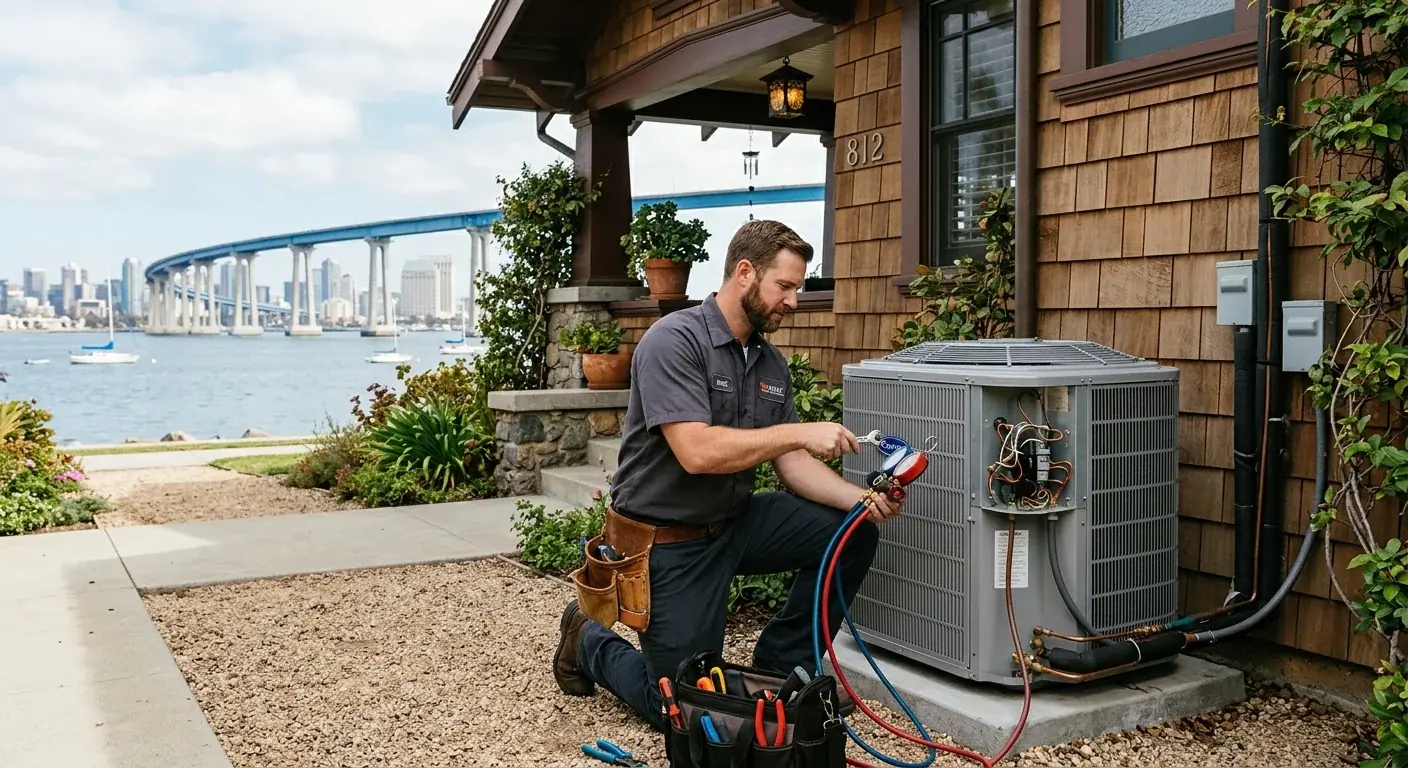
Why Coronado is the toughest environment for an AC unit
Coronado’s stunning ocean views and bayfront properties are a constant draw, but they also expose your home’s HVAC system to some of the harshest conditions in San Diego County. The primary culprit is salt air. Unlike other coastal cities further north, such as Carlsbad or Oceanside, Coronado’s island geography often means salt-laden air impacts systems from multiple directions. Airborne salt particles, carried inland by sea breezes, accelerate corrosion on critical outdoor components. This environment degrades condenser coils, copper lines, and electrical connections, reducing efficiency and shortening lifespan.
This issue isn’t limited to homes directly on the ocean side of the island. Properties in Coronado Village and even the Cays, while sometimes slightly more sheltered, still experience this corrosive environment. Bay-side homes are affected by moisture and salinity from the bay. Technicians routinely find units in Coronado exhibiting advanced signs of corrosion that would take years longer to develop inland. Understanding this environmental stress is the first step in effective AC repair and proactive maintenance.
Common AC failures we see in 92118
Corrosion-related damage. This affects the outdoor condenser unit’s fins and coils, reducing heat transfer, and internal components like electrical contacts, wiring, and even the compressor over time. Refrigerant lines, particularly at connection points, can develop leaks due to corrosion. This can lead to your system blowing warm air.
Electrical component failure. Salt air degrades insulation and causes oxidation on terminals, leading to short circuits, motor failures, and issues with capacitors. It’s not uncommon to see a compressor contactor pitted and corroded, preventing the unit from starting. The fan motor in the outdoor unit can seize from rust in its bearings.
Drainage problems. High humidity combined with corrosion can lead to algae growth in condensate drain pans and lines. Blockages cause water overflow, which can damage indoor components and even ceiling or wall structures, especially in older homes where drainage was never designed for it.
Retrofit challenges in older Coronado Village homes
Coronado Village is renowned for its historic homes, many built decades ago, long before central air conditioning was a standard feature. Retrofitting an AC system into these older structures presents challenges that differ from new construction.
Space constraints. Historic homes weren’t designed with large ducts or bulky air handlers in mind. Wall cavities may be narrow, attics might be tight or inaccessible, and basements rare. This often necessitates high-velocity duct systems, or strategically placed mini-split units that provide zoned cooling without extensive ductwork.
Maintaining architectural integrity. Homeowners in Coronado Village want to preserve the aesthetic and historical value of their properties. That means careful planning to hide ductwork, vents, and outdoor units. Any new AC installation should complement the existing structure.
Electrical system upgrades are also common. Older homes may not have the electrical capacity to support a modern central AC system, requiring panel upgrades or dedicated circuits. Navigating local building codes and historical preservation guidelines adds another layer. For some homes, a traditional central system might be impractical, making ductless mini-splits the practical path.
What belongs on a Coronado repair quote
| Line to insist on | Why it matters |
|---|---|
| Diagnostic fee, in dollars | Confirm before the visit |
| Named electrical part | Capacitor and contactor fail faster in salt air |
| Leak search vs recharge | Top-off is not a long-term fix |
| Drain clearing | Humidity plus algae is a regular island ticket |
| Motor type | PSC versus ECM changes labor and parts |
| Compressor vs replace | Age plus corrosion often tips the math |
Climate Pros SD does not publish those dollar ranges. Get a detailed estimate from a licensed HVAC professional. For more coastal context, see AC repair in Carlsbad. Coronado’s conditions are often more extreme.
Coastal-grade equipment that lasts longer here
Investing in coastal-grade AC equipment isn’t an extravagance in Coronado. Standard AC units, while effective inland, simply aren’t built to withstand the salt air in 92118.
- Specialized coatings: Heat exchanger coils often come with enhanced epoxy or polyester coatings (like “Blue Fin” or “Gold Fin”) that create a barrier against salt.
- Corrosion-resistant cabinets: Heavier gauge galvanized steel with multiple paint layers, or non-corrosive composite materials.
- Sealed electrical components: Manufacturers often seal critical connections and boards from moisture and salt.
- Non-corrosive fasteners: Stainless steel or specially treated fasteners.
Ask for that spec as a line item on the install bid. Regular professional HVAC maintenance still matters even on the toughest coastal units.
When to call us
If your Coronado home’s AC isn’t performing as it should, if you notice strange noises, diminished cooling, or visible signs of corrosion on your outdoor unit, call a licensed HVAC professional. DIY repairs on complex AC systems, especially in Coronado, can lead to further damage or safety risks.
For Coronado-specific coastal equipment specs and historic home retrofit guidance, see our full AC repair in Coronado service page. Call us at (442) 777-6440.