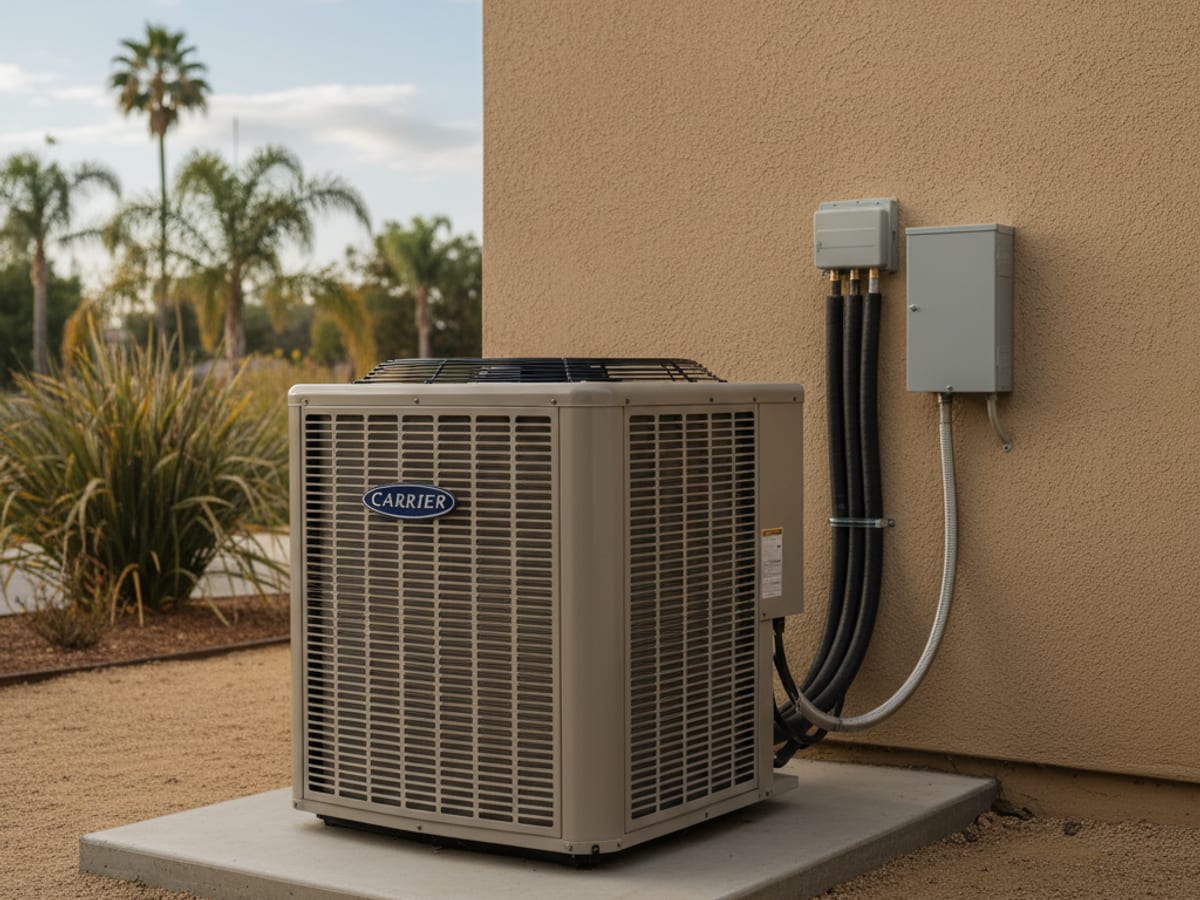
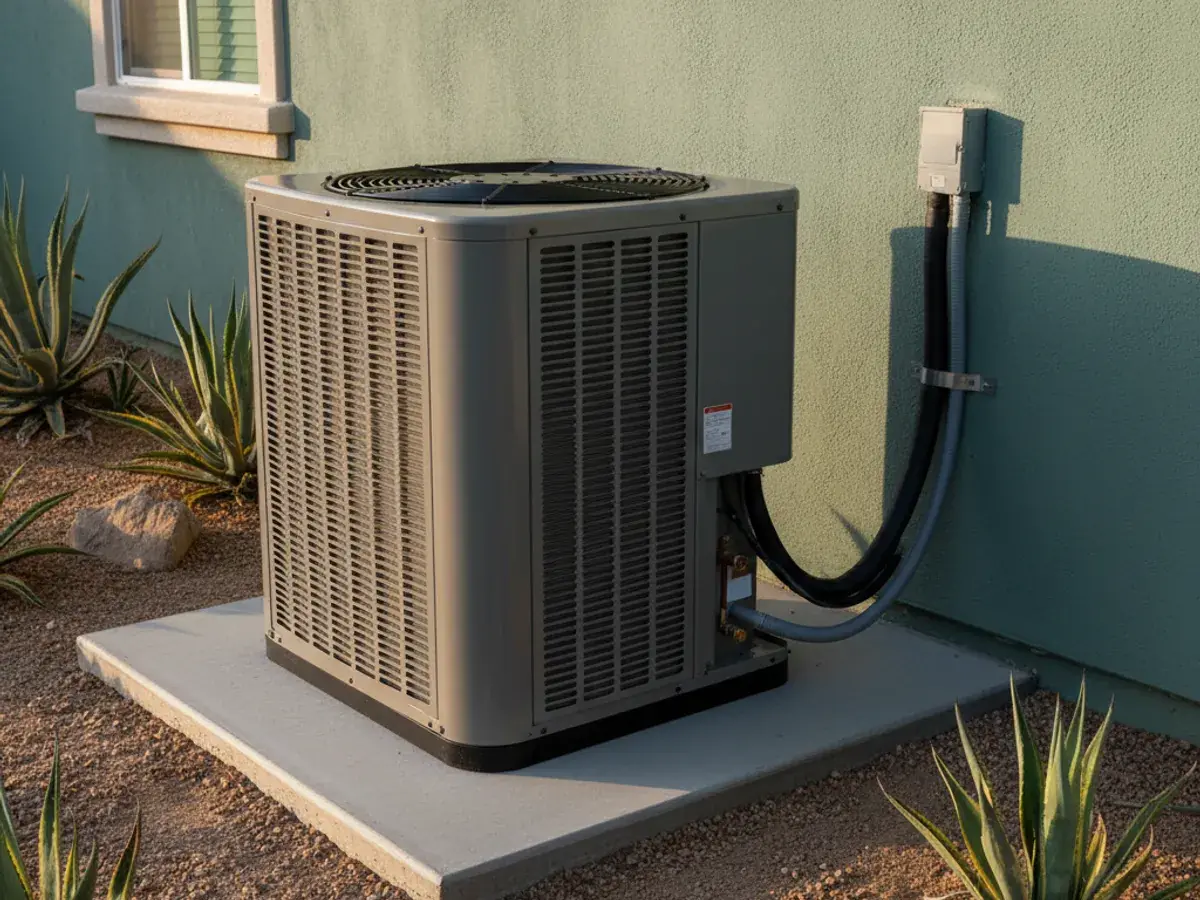
Rancho Bernardo runs 82 to 83 degrees in summer and most of the community falls under HOA architectural review before a condenser goes in. Ask the matched company how they handle HOA review, permitting, and sizing for the 1970s through 1990s housing stock that dominates here.
Climate Pros SD matches Rancho Bernardo homeowners with a licensed HVAC company for AC installation. That company quotes after an in-home estimate. Timing and price are theirs. This brand does not install equipment.
Rancho Bernardo is an inland planned community in the northern part of the City of San Diego. Summers peak 82 to 83 degrees through July, August, and into September, running significantly hotter than the coast. The community was developed primarily from the early 1970s through the 1990s, and the housing stock reflects that era: single-story and two-story tract homes and condos, mostly in the 1,500 to 2,500 square-foot range, with duct systems and electrical panels that were designed for that period. Many of those systems are now on their second or third replacement cycle.
What makes Rancho Bernardo distinctive as an installation market is the HOA density. Bernardo Heights, 7 Oaks, Westwood, Oaks North, Eastview, and nearly every other neighborhood within the community falls under a homeowners association with architectural review authority over exterior changes. That includes condenser placement and, in some communities, condenser screening or appearance requirements. The HOA process is a routine part of the work here, and the requirements of the common associations are well known.
What's included in a Rancho Bernardo AC installation
Ask the matched company what their install includes. A complete central system job typically covers the items below.
Manual J load calculation sized to the actual home, not a square-footage shortcut
HOA approval documentation prep: site plan, equipment spec sheet, placement diagram
Removal and haul-away of the old condenser, coil, and furnace, with proper refrigerant reclamation
New outdoor condenser set on a level pad, meeting HOA setback and screening requirements where applicable
Matched indoor air handler or evaporator coil, paired to the outdoor unit as a matched system for rated efficiency
New refrigerant line set, or flush and pressure test of the existing set when reuse is sound
Duct inspection and airflow assessment on all 1970s-90s Rancho Bernardo homes before equipment selection is finalized
Electrical work, including disconnect, whip, and panel check
Smart thermostat install and app commissioning
City of San Diego mechanical permit pulled for 92127/92128 and inspection scheduled
Startup and commissioning, with refrigerant charge verified by superheat and subcooling
AC installation cost in Rancho Bernardo
The matched company quotes the install in writing after an in-home estimate. You see equipment, labor, materials, and permit broken out before you decide. Duct work and HOA screening requirements add to the total when they apply.
Repair
Typical range
Notes
In-home installation estimate
Quoted in writing
A real measured quote, not a phone guess
Manual J load calculation
Ask whether it is included
Ask the matched company to size the house, not guess from square footage
Standard central AC system, installed
Entry-tier pricing, quoted after estimate
14.3 SEER2 single-stage, typical Rancho Bernardo home
High-efficiency system, installed
Runs above the standard tier, quoted after estimate
Two-stage or variable-speed, 16-20+ SEER2
Heat pump conversion, installed
Comparable to the high-efficiency tier before rebates
Replaces AC and furnace on one unit, qualifies for largest rebates
HOA approval documentation package
Quoted by the matched company
Site plan, spec sheet, placement diagram for architectural review
HOA-required condenser screening or enclosure
Priced by size and material required
Quoted separately when the HOA requires visual screening of the condenser
Duct sealing or partial duct replacement
Priced after duct inspection
Common on 1970s-90s Rancho Bernardo homes, quoted after duct inspection
Electrical panel or circuit upgrade
Priced after panel inspection
When older panel cannot support modern condenser load
City of San Diego mechanical permit (92127/92128)
Set by the city, passed through at cost
Pulled by the matched company if they include permitting
Two-story home with zoning
Runs above a non-zoned system, quoted after estimate
When upstairs and downstairs need independent temperature control
Pricing is set by the company you are matched with, not by this brand. Ask that company for a written quote for the house. An open SDG&E offer, where one applies, can lower the heat pump numbers above significantly, and the estimate tells you exactly what your home qualifies for.
Should you repair or replace your AC?
Before committing to a new system, it is worth being honest about whether you need one. A new install is the right call when the unit is old, uses R-22 refrigerant, or is facing a major repair. It is the wrong call when a small fix would buy several more good years. Two simple rules help sort it out.
The 50% rule
If a repair costs more than half of what a new system would run, replacement is the better money. An expensive repair, like an evaporator coil, on a 14-year-old unit points clearly to replacement. A cheap repair, like a capacitor, on a 7-year-old unit does not. Spending big on an old system rarely pays back.
The 5,000 rule
Multiply the age of the system by the repair cost in dollars. If the result tops 5,000, replacement is the better move. A repair that would be minor on a newer system can still clear that threshold once a unit hits 15 years old, which points toward a new system. The same repair on a unit just a few years old usually stays well under it, which points to fixing it.
Many Rancho Bernardo homes are now on their second system, installed in the early 2000s to replace the original 1980s equipment. Those second-generation systems are approaching 15 to 20 years, which is the expected end of service life on an inland San Diego system. When that second system starts showing issues, the third replacement is usually the right call. Ask the estimate to give you the repair cost, the replacement cost, and a straight read. The choice stays yours.
Local angle
AC installation built for Rancho Bernardo homes
Working with HOA architectural review
Nearly every neighborhood in Rancho Bernardo falls under an HOA with architectural review authority over exterior modifications, and a new condenser qualifies as an exterior modification in most of those communities. Some HOAs care only about placement setbacks. Others require visual screening of the condenser from the street or adjacent properties. A few have specific rules about condenser color or finish.
There is direct experience working with the Bernardo Heights Community Association, 7 Oaks HOA, Westwood HOA, Oaks North HOA, and others in the community, and the common associations' requirements for an AC approval are well known. The documentation package gets prepared as part of the estimate: a site plan showing the proposed condenser location, an equipment specification sheet with the unit dimensions, and a placement diagram showing setback compliance. Most HOA architectural review committees move quickly on routine AC replacements when the paperwork is complete.
Timeline with HOA review
HOA review adds time to the schedule that a standard tract install does not have. Most Rancho Bernardo HOA committees review applications at monthly or bi-weekly meetings, though many allow the architectural review committee to approve routine items by email between meetings. A standard AC replacement with a straightforward condenser location often clears in one to two weeks. An installation with screening requirements or an unusual placement may take a full committee cycle.
The realistic timeline gets set at the estimate stage and the HOA review gets built into the schedule from the start. Nobody promises next week if your HOA needs three weeks. A quick turnaround versus one that needs a full review cycle gets flagged upfront.
Duct assessment on the 1970s through 1990s housing stock
Rancho Bernardo was built in distinct phases from the early 1970s through the mid-1990s, and the duct systems in those homes reflect the construction norms of their era. The 1970s and early 1980s builds often have flex duct runs that are beginning to age, joints that were never properly sealed, and duct trunks that are occasionally undersized for the floor plan. The 1980s and 1990s builds tend to have better duct layouts but may still show air loss at collar joints and boots after 30 to 40 years of thermal cycling.
The ducts get inspected before finalizing the equipment selection on every Rancho Bernardo estimate. A new system on a leaky duct network will not perform the way its efficiency rating promises. If the ducts need sealing or partial replacement, that gets quoted separately with the expected performance difference explained. It is a meaningful conversation on homes in this age range.
Matched-pair systems and efficiency requirements
California energy code requires that a replacement condenser be matched to a compatible indoor coil or air handler, operating as a system rather than a mix of unrelated components. This matters in practice because mismatched equipment cannot achieve its rated SEER2 efficiency, may void the manufacturer warranty, and can cause control compatibility issues with modern communicating thermostats.
On an older Rancho Bernardo home where the indoor coil or air handler is approaching the same age as the failing condenser, replacing both at the same time is often the right call. The incremental cost of adding the indoor coil when the system is already being replaced is smaller than replacing it separately after the condenser install is already done, which costs more and requires a second permit and inspection. Both matched-system paths get quoted during the estimate so you can make an informed decision.
Sizing for the Rancho Bernardo climate
Rancho Bernardo sits in the northern part of the City of San Diego but far enough inland that the cooling load is significantly heavier than the coast. Summer afternoons hit 82 to 83 degrees through the core of the season, and the distance from the marine layer means less overnight recovery than coastal communities get. A system that might handle a Mira Mesa home can fall behind in Rancho Bernardo.
Ask whether Manual J is in the written estimate. For a typical 2,000-square-foot Rancho Bernardo two-story, that calculation accounts for the west-facing glass, attic insulation level, ceiling height in vaulted great rooms, and the sustained afternoon heat. Undersizing is the most common reason Rancho Bernardo systems fail in the first heat wave after a new install.
Permits in 92127 and 92128
Rancho Bernardo falls within the City of San Diego, and AC replacements require a mechanical permit from the City of San Diego Building and Safety department, not a separate Rancho Bernardo municipal department. That permit is pulled for the 92127 or 92128 ZIP code as part of the job, the inspection scheduled, and the work put on record. A permitted install is on record at resale. Check your equipment certificate for what the manufacturer warranty requires.
The permit and HOA review are separate processes, and both have to clear before the install can happen. The permit timeline through the City of San Diego is typically one to two weeks for standard residential mechanical permits. Both the permit and the HOA timeline get tracked, with the install date coordinated around whichever takes longer.
What else is ac installation in Rancho Bernardo called?
Homeowners search for this a few different ways. In Rancho Bernardo it also goes by air conditioning installation in Rancho Bernardo , AC install in Rancho Bernardo , and AC replacement in Rancho Bernardo . They all reach the same licensed local pros, and the operator who answers will
sort out which one your job actually is.
Rancho Bernardo ac installation questions
How much does AC installation cost in Rancho Bernardo?
It depends on system size, efficiency tier, and whether duct work or HOA-required screening applies, which is why every install starts with an in-home estimate rather than a phone quote. You get a line-itemed quote before you decide anything.
Do I need HOA approval to install a new AC in Rancho Bernardo?
Almost certainly yes. Most Rancho Bernardo neighborhoods are under HOA architectural review, and replacing an outdoor condenser is classified as an exterior modification. The documentation package (site plan, spec sheet, placement diagram) gets prepared as part of the estimate, drawing on direct experience with the common associations in the community. Most routine replacements clear in one to three weeks.
How long does HOA approval take?
Most standard AC replacements in Rancho Bernardo HOA communities clear in one to two weeks if the paperwork is complete. Some associations allow the architectural review committee to approve routine items by email between meetings. Unusual placements or installations requiring screening may need a full committee meeting cycle. The HOA timeline gets built into the install schedule from the start.
My HOA requires a condenser screen. How does that affect cost?
A HOA-required condenser screen or enclosure adds to the total depending on the size and material required, and gets quoted as a separate line item. The screen has to allow adequate airflow around the condenser, which gets verified before installation. A screen that blocks airflow causes the condenser to overheat and reduces system lifespan.
Do I need a matched indoor coil when I replace my condenser?
California energy code requires a matched system, and most manufacturer warranties also require it. If your indoor coil is close in age to the failing condenser, replacing both at the same time typically costs less than doing it separately and avoids a second permit and inspection later. Both options get quoted during the estimate.
My Rancho Bernardo home was built in the 1980s. Do the ducts need to be replaced?
Not always, but they need to be inspected. The duct system gets checked before finalizing the equipment selection on every estimate. Older flex duct runs often show air loss at joints after 30 to 40 years of thermal cycling. If the ducts are limiting airflow, sealing or partial replacement gets quoted separately. Putting a new system on leaky ducts reduces performance regardless of the equipment efficiency rating.
What permit do I need for an AC install in 92127 or 92128?
A City of San Diego mechanical permit for the relevant ZIP code. Rancho Bernardo is within the city limits, not a separate municipality. Ask whether the matched company pulls that permit as part of the job, schedules the inspection, and puts the work on record. The permit and HOA review run on separate tracks, with the install date coordinated around whichever clears last.
How hot does Rancho Bernardo actually get?
Summer afternoons in Rancho Bernardo peak at 82 to 83 degrees through July, August, and into September. The distance from the coast and the marine layer means less overnight cooling than coastal communities get. The sustained load is heavier than a coastal city of the same square footage, which affects both sizing and system lifespan.
Should I install a heat pump instead of an AC in Rancho Bernardo?
In most cases, yes. Modern variable-speed heat pumps handle Rancho Bernardo's 82 to 83-degree summer and its mild winter nights without a gas backup. SDG&E rebates reduce the upfront cost meaningfully. The federal 25C tax credit ended for systems installed after December 31, 2025. For an aging AC plus an aging furnace, a heat pump conversion often beats replacing each separately even before rebates.
Are there rebates for a new AC or heat pump in Rancho Bernardo?
Yes. Where an SDG&E offer is open, it is typically largest for qualifying heat pump systems. The federal 25C tax credit does not apply to a 2026 install. The matched company may file live SDG&E paperwork if an offer exists. Check sdge.com/rebates for any offer that is currently open. 25C does not apply to a 2026 install.
How fast can you install once the HOA approves?
Once the HOA approval and permit are cleared and you have approved the quote, the matched company quotes the timing. Ask the matched company how long a standard changeout takes. Installs that need duct work, a panel upgrade, or a zoned two-story design take two to three days. The matched company confirms the schedule before they book.
How long does a new AC last in Rancho Bernardo?
Service life for a central AC system in Rancho Bernardo depends on runtime, exposure, and maintenance more than on any published average. The long inland summers and heavy annual run hours shorten the service life compared to coastal systems. Right-sizing, annual maintenance, and clean filters are the biggest factors in whether you land closer to 12 years or 18.