Your air conditioner works hard to keep your San Diego home cool, especially during warmer months. Over time, the coils inside and outside your AC unit collect dirt, dust, and grime. When that happens, the system struggles, uses more electricity, and can fail earlier.
Climate Pros SD matches you with licensed HVAC companies. We do not clean coils, set a cleaning price, or promise arrival windows.
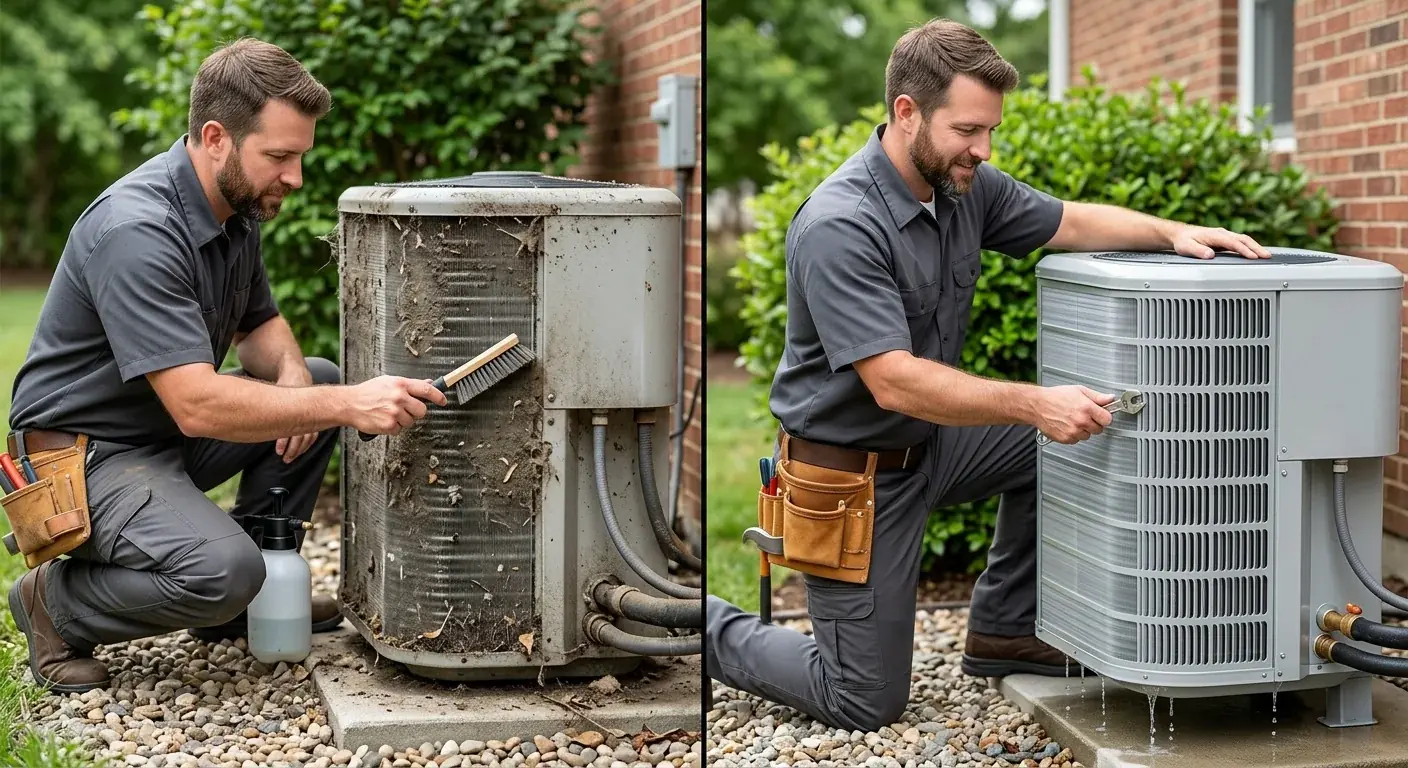
Keeping AC coils clean is part of routine maintenance. Some outdoor condenser cleaning is safe for a homeowner. Indoor evaporator coils are usually a licensed-pro job. Knowing the difference protects the equipment.
Why do dirty coils hurt efficiency?
Your air conditioner relies on two sets of coils to transfer heat: the condenser coils outside and the evaporator coils inside. The outdoor condenser coils release heat from your home into the outside air. The indoor evaporator coils absorb heat from your home’s air. For this heat exchange to happen well, the coil surfaces need to be clean.
When these coils become covered in dirt, dust, pollen, pet dander, or other debris, a common sight in dusty San Diego County, they cannot transfer heat as designed. The grime acts like an insulating blanket. The system runs longer to reach setpoint. Bills can rise. Wear on the compressor and fan motors goes up. This page does not publish a dollar savings from cleaning.
Over time, that strain can lead to breakdowns. You might notice the system running constantly, struggling to cool, or emitting odd smells. Regular cleaning is a practical way to protect the equipment. It is not a health or efficiency guarantee.
What outdoor condenser cleaning is safe for you to do?
The outdoor unit, called the condenser, houses coils that are generally more accessible and durable than their indoor counterparts. Cleaning these coils yourself can be a straightforward part of home maintenance. Safety comes first.
First, always disconnect power to your AC unit at the outdoor disconnect box or your main electrical panel before you touch anything. This prevents accidental startup. Once the power is off:
- Clear surrounding debris: Remove leaves, grass clippings, spiderwebs, or other loose debris from around the unit. Trim back bushes so the unit has clear airflow on all sides.
- Rinse the fins: Using a garden hose with a gentle spray nozzle, lightly spray the condenser fins from the inside out, if possible. This helps push dirt outwards. Avoid high-pressure washers. They can bend the aluminum fins.
- Brush away stubborn dirt: For caked-on dirt, use a soft-bristle coil brush. Brush in the direction of the fins, not against them.
- Consider a specialized cleaner: You can purchase non-acidic coil cleaning solutions designed for condenser coils at most hardware stores. Follow the product instructions. Wear gloves and eye protection.
- Check for bent fins: If you notice bent fins, a fin comb can straighten them. This is delicate. Stop if you are not sure, and leave it to a professional.
Regularly performing these steps, perhaps as part of your spring AC tune-up checklist, helps the outdoor unit move air. Use water carefully, as encouraged by the San Diego County Water Authority.
Why are indoor evaporator coils a job for a professional?
Indoor evaporator coils are a different story. These coils sit inside your air handler or furnace, often in a dark, damp cabinet where they collect condensation. That environment collects dust and can grow mold and mildew.
Attempting to clean evaporator coils yourself has several risks:
- Accessibility: Evaporator coils are typically housed deep within the system, requiring panel and sometimes duct disassembly.
- Delicacy: The fins on evaporator coils are thin and easily bent. Mishandling them can restrict airflow and reduce efficiency.
- Electrical components: The indoor unit contains wiring. DIY work can damage those parts.
- Mold and mildew: Disturbing growth without proper protection can release spores into the home. Cleaning is not a proven health cure.
- Specialized cleaning: Licensed technicians use coil cleaners and tools meant for the cabinet, then reassemble it.
For these reasons, leave evaporator coil cleaning to a qualified HVAC professional. Climate Pros SD matches you with those companies. We do not dispatch crews ourselves.
What belongs on a professional coil-cleaning quote in San Diego?
Climate Pros SD does not publish a $150 to $400 coil-cleaning price, or any other job table. Ask the matched licensed contractor for:
- Access: Whether the evaporator requires extra disassembly.
- Soil level: Heavy biofilm or blocked drain pans take more time.
- What is included: Coil only, or a broader tune-up with electrical checks and filter replacement.
- What is excluded: Refrigerant work, leak search, or duct cleaning.
A clean system can run more effectively. It does not guarantee a bill cut or a longer compressor life. You can learn more about quote questions in HVAC maintenance cost in San Diego.
When are dirty coils just part of a bigger problem?
Dirty coils are a common cause of AC inefficiency. Sometimes they are one symptom of a larger issue.
Watch for:
- Significantly reduced cooling: If the AC is blowing air that is not cold, even after you checked the outdoor unit, dirty evaporator coils could be involved. It could also be a refrigerant leak or a failing compressor.
- Higher bills after you already rinsed the outdoor coil: The issue may be indoor, or the system may be undersized or failing.
- System running constantly or short-cycling: Dirty coils can contribute. So can thermostat problems or a failed component.
- Ice on coils or refrigerant lines: That can be poor airflow (which dirty coils cause) or a low refrigerant charge. Do not chip ice off.
- Loud or unusual noises: Squealing, grinding, or banging point to mechanical problems, not just dirt.
- Musty odors: Dirty evaporator coils can harbor growth. Persistent smells can also come from ducts or a clogged condensate drain.
If you are seeing those signs, call for diagnosis, not just a rinse. A licensed HVAC technician can recommend AC repair if something besides dirt is wrong.
Related services: AC installation and HVAC maintenance. Local coverage: all 67 cities we cover in San Diego County.
When should you call?
For indoor evaporator coil cleaning, or if you suspect dirty coils are masking a larger AC problem, call (442) 777-6440. Climate Pros SD matches you with a licensed pro. Ask for the diagnostic or cleaning fee in dollars and what the visit includes.