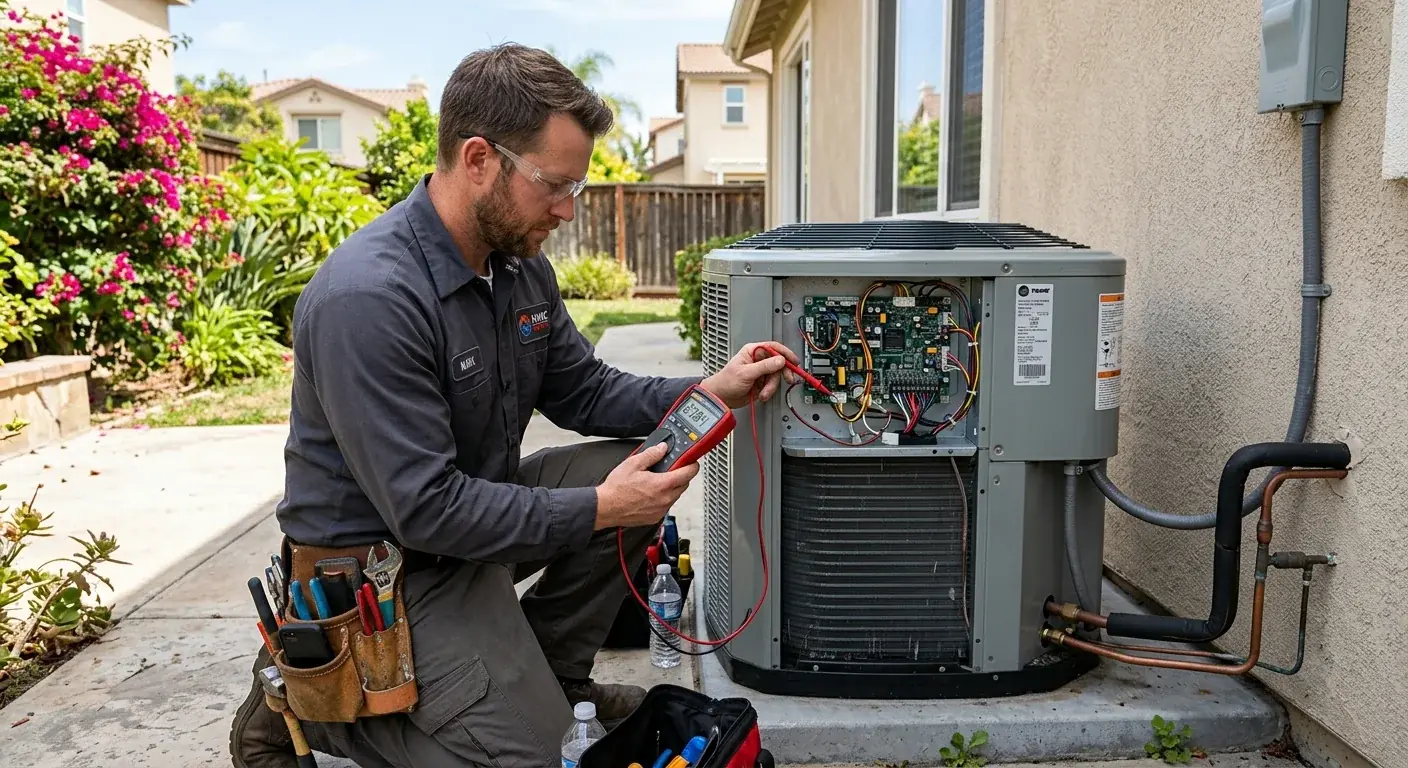
Heat pump maintenance in San Diego usually belongs twice a year, not once, because the same outdoor unit cools in summer and heats in winter. A furnace here may work hard for only part of the year. An AC-only system can rest in winter. A heat pump does neither.
Climate Pros SD matches you with licensed HVAC companies. We do not perform maintenance, own trucks, or publish plan prices.
If you searched because you are not sure what a real visit includes, or whether twice a year applies to your house, this covers both.
Why is heat pump maintenance different from an AC or furnace tune-up?
A heat pump reverses refrigerant with a reversing valve. Neither a straight AC nor a gas furnace has that part. Heating also needs a defrost path so the outdoor coil does not ice over on cold mornings. A generic AC checklist that never cycles the valve or tests defrost is an AC tune-up with a different name on the invoice.
Because the compressor works in both seasons, electrical wear (contactor, capacitor) shows up on a harder duty cycle. Charge should be checked against the manufacturer’s spec. A system can look fine in one mode and be wrong in the other.
What should a real heat pump maintenance visit cover?
Ask the company to put this on the work order:
- Refrigerant charge, with the system able to be evaluated in both directions when conditions allow
- Reversing valve cycled both ways
- Defrost sensor and board, including whether the unit will enter defrost when the coil needs it
- Electrical: connections, contactor, capacitor
- Outdoor coil cleaning (salt on the coast, dust inland)
- Indoor filter and blower, condensate drain
- Thermostat changeover settings for your house, not a leftover factory default
If the quote never mentions reversing valve or defrost, ask what you are actually buying.
How often is it needed in San Diego?
Twice a year fits most homes: spring before cooling, fall before heat. Spring catches cooling-side charge and electrical issues. Fall catches defrost and valve issues before inland cold mornings.
Homes that replaced an old AC with a heat pump and run the unit most months get more from two visits than a house that barely heats. If the system sits idle for long stretches, one thorough visit before the primary season still covers a lot. The matched company should set the cadence after they see the equipment, not a blog.
How do coastal salt air and inland heat change the schedule?
Along the coast, from Solana Beach through Encinitas and Imperial Beach, salt-laden air corrodes fins and outdoor electrical contacts. An extra coil look between the two seasonal visits is a reasonable ask. Corrosion is easier to catch early than to reverse.
Inland, in Escondido, Santee, and El Cajon, summer heat soak and sun on a pad stress capacitors and compressors. NWS San Diego describes ocean moderation near the coast and warmer summer days in nearby valleys. That is qualitative. It is not a published “degrees hotter on the pad” figure.
What happens if you skip it?
Efficiency usually drops first. The valve sticks. Defrost runs too long or not at all. The bill creeps. By the time heat or cooling feels obviously wrong, charge can be off enough to strain the compressor.
Stuck reversing valve and a dead defrost board are the failures skipped seasons tend to produce. Neither is something this site will price.
ENERGY STAR says a typical forced-air house can lose about 20% to 30% of the air moving through ducts because of leaks, holes, and poorly connected ducts. That is a national typical-house statement, not a measured result for your house (ENERGY STAR duct sealing). Sealing leaks is not the same job as cleaning ducts. EPA does not recommend routine duct cleaning on a fixed schedule (EPA duct cleaning).
What does it cost in San Diego?
Ask the matched company. Standalone visit versus a two-visit plan are different products. A heat pump visit should take more time than an AC-only checklist. If an existing “HVAC plan” was priced for AC-only, ask whether reversing valve and defrost are in it.
SDG&E residential plans can price electricity by time of use, with listed TOU plans using a 4-9 p.m. on-peak window. Confirm your plan on SDG&E pricing plans. Maintenance will not publish a bill savings percentage here.
If a visit turns into a replacement talk, recheck IRS 25C (not for 2026 placed-in-service), TECH, and SDG&E heat pump rebates.
Get the heat pump checked before the season turns
Call if the last “tune-up” never mentioned a reversing valve. Start at heat pump service or HVAC maintenance. System choice: heat pump vs furnace. Already broken: heat pump repair.
FAQs
How often does a heat pump need maintenance in San Diego?
Twice a year for most homes: spring and fall. Light seasonal use can sometimes stretch to once a year. Ask the pro after they see runtime and location.
Is heat pump maintenance different from an AC tune-up?
Yes. Reversing valve and defrost are the extra items. Skip those and you are not covering the heat-pump-specific failures.
What does it cost in San Diego?
The contractor sets the price. This site does not. Ask whether the visit is standalone or part of a plan, and whether both modes are on the checklist.
Does coastal salt air change how often it’s needed?
It can. Homes near the water see faster outdoor corrosion. Ask about an extra coil inspection, not a invented mileage rule.
What happens if I skip it for a few years?
Bills can rise first. Then a stuck valve or a defrost failure shows up as no heat or ice on the outdoor unit.
Can I do any of this myself?
Filter changes and keeping the outdoor unit clear, yes. Charge, valve tests, and defrost diagnostics need a licensed tech with gauges.
When to call us
Call (442) 777-6440. Ask whether a tech is available for a maintenance visit, and what that visit includes in writing.