Your bedroom is too hot at night for one or more of three reasons: it’s the farthest room from the central AC, it faces west and absorbs afternoon sun, or your thermostat is in a cooler part of the house and shuts the system off before your bedroom catches up. In San Diego the sleep-quality cost is real. Sleep science puts the optimal bedroom temperature at 65 to 68 degrees. Most San Diego master bedrooms run 74 to 80 degrees at bedtime in summer. Fixes range from a ceiling fan to a dedicated bedroom mini-split, and the right one depends on which of those three causes is doing the work.
Climate Pros SD matches you with licensed HVAC companies. We do not sell fans, film, or mini-splits at a published price.
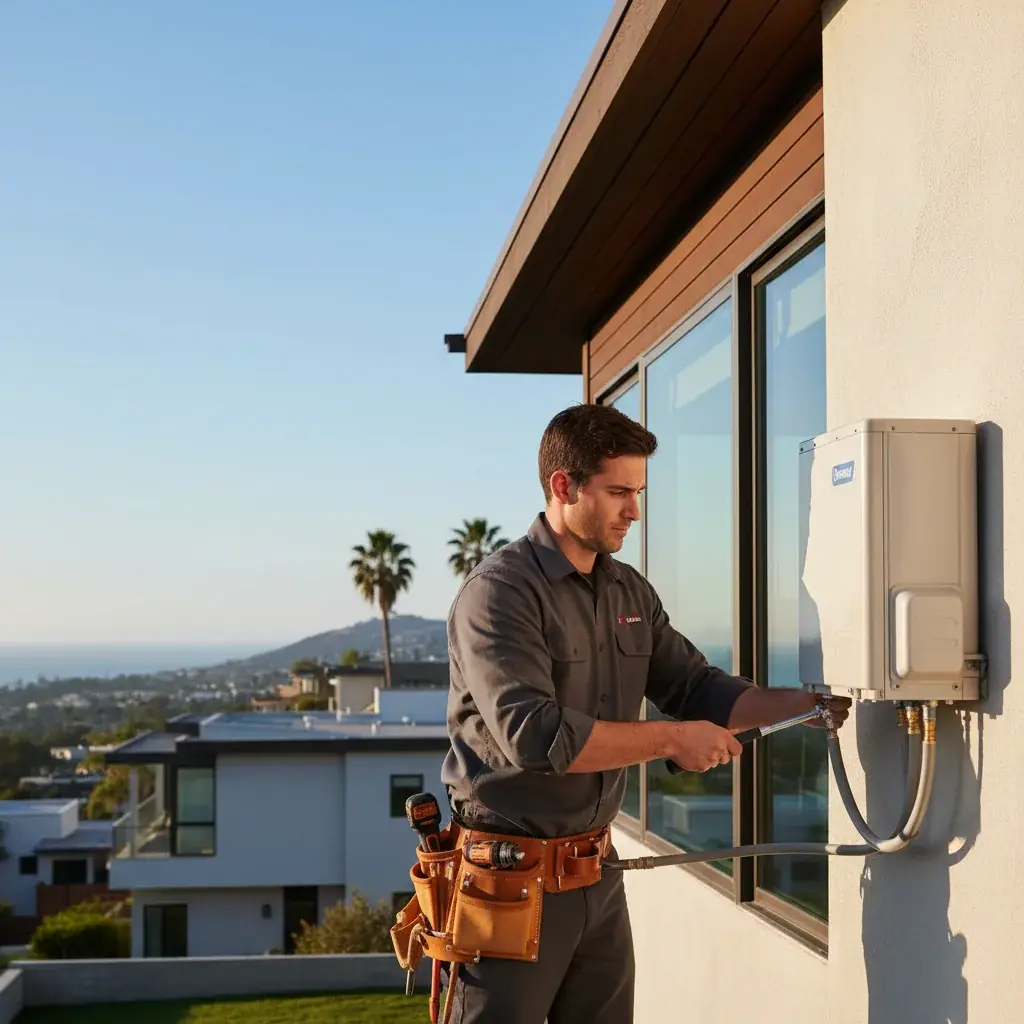
Why your bedroom is hotter than the rest of the house
It’s the farthest room from the AC
Cold air loses energy every foot it travels through a duct. By the time conditioned air reaches the master bedroom at the far end of the house (or the upstairs back corner of a two-story), it’s noticeably warmer than what’s coming out of the closest vent. Duct leakage in unconditioned attic space makes it worse. A standard San Diego tract home built decades ago loses 20 to 30 percent of its cooling capacity to attic duct leaks. The room at the end of the longest duct run pays the highest price.
West-facing wall and window heat gain
The San Diego sun pounds west and southwest walls from about 2 p.m. through sunset. A master bedroom on the west side of an inland home in Escondido, Poway, Rancho Bernardo, or East County picks up so much radiant heat through the walls and windows that it stays warm well into the night. Even after the AC catches up to the rest of the house, the bedroom drywall and framing are still radiating stored heat.
Electronics, body heat, and a closed door
A modern bedroom has more heat load than people realize: a TV, a phone charger, an Apple TV, two people’s body heat (about 400 BTU per hour each), and a closed door that blocks return airflow. A closed bedroom door is the silent killer. With one downstairs return in most San Diego two-story homes, a closed-door bedroom has nowhere for warm air to exit. The supply vent pushes cold air in, the room pressurizes, and airflow chokes within a few minutes.
One thermostat that’s nowhere near your bedroom
This is the structural problem in almost every San Diego home. Your thermostat is in a hallway or living room. It reads the temperature there, hits the setpoint, and shuts the AC off. Your bedroom is 8 degrees hotter and the system doesn’t know. This is a control-system problem, not an equipment-capacity problem, and no amount of “running the AC harder” will solve it.
What the sleep science actually says
The National Sleep Foundation and most peer-reviewed sleep research agree: the optimal bedroom temperature for adults is 65 to 68 degrees Fahrenheit. Core body temperature has to drop about 1 to 2 degrees for sleep to initiate and stay consolidated through the night. Above 75 degrees, sleep latency increases (you take longer to fall asleep), REM sleep decreases, and overnight wake events go up.
In San Diego specifically, this is hard. Inland summer overnight lows are 65 to 70 degrees, which means even with all the windows open, the air coming in is already at the upper end of the optimal range. Coastal homes get more help from the marine layer (overnight lows in the high 50s and low 60s in Encinitas, Carlsbad, La Jolla). Inland and East County homes have to do the work with mechanical cooling, full stop.
Four bedroom-cooling fixes ranked by first cost
| Fix | What you buy | Drops temp by | Best for |
|---|---|---|---|
| Ceiling fan plus AC combo | Fan hardware, not HVAC labor | 2 to 4 degrees felt | Any bedroom |
| Smart thermostat repositioning | Thermostat plus optional remote sensor | 1 to 3 degrees actual | Wrong thermostat location |
| Window film plus blackout curtains | Film and drapes on west glass | 3 to 5 degrees | West-facing rooms |
| Dedicated bedroom mini-split | Separate condenser and wall head | Whatever you set | Persistent hot bedroom |
Climate Pros SD does not publish installed dollar ranges for those four paths. Ask the matched contractor (or a licensed electrician for a thermostat move) for a written line. Retail fan and curtain prices are not a Climate Pros SD bid.
Ceiling fan plus the AC
A ceiling fan doesn’t change the room temperature, but the moving air makes you feel 2 to 4 degrees cooler at skin level. The combination of a ceiling fan running counterclockwise on medium plus the AC set to 73 feels the same as the AC alone set to 70, with much less compressor runtime. That helps on SDG&E peak rates. Install a remote-control DC-motor fan (Hunter, Big Ass Fans, or similar) with a quiet bedroom-grade motor. Run it only when the room is occupied, since fans cool people, not rooms.
Smart thermostat repositioning or a remote sensor
The cheapest “real” HVAC fix for a bedroom that’s the wrong temperature because of where the thermostat lives. Two paths:
-
Add a remote temperature sensor. A Nest Learning Thermostat with a Temperature Sensor in the bedroom, or an Ecobee with SmartSensor, tells the system to control off the bedroom’s temperature at night while still using the hallway during the day. Labor goes up if a C-wire has to be added.
-
Move the thermostat physically. Worth it only when the current location is genuinely broken (over a heat register, in direct sun, next to a kitchen). Use a licensed electrician.
This is the highest-return HVAC control fix in most San Diego homes. Most people don’t realize the AC is doing exactly what it’s told, just based on the wrong temperature reading.
Window film plus blackout curtains
For a west-facing bedroom, killing solar gain at the window is the most effective single move. Layered approach:
- Spectrally selective window film blocks 60 to 80 percent of solar heat while letting visible light through. Apply to the west and southwest windows only.
- Blackout curtains with thermal lining. The thermal lining adds R-value when drawn during the afternoon.
That combo drops the room several degrees on a hot afternoon and reduces overnight heat radiation from the walls.
Dedicated bedroom mini-split
The surgical fix when nothing else works. A single-zone ductless mini-split is one outdoor condenser and one indoor wall head, sized 9,000 to 12,000 BTU for a typical 200-to-400-square-foot bedroom.
What you get:
- A bedroom-only thermostat that holds 65 to 68 degrees regardless of what the rest of the house is doing.
- Whisper-quiet operation (a modern indoor head is very quiet on low).
- Heat-pump heating in winter, included in the same equipment.
- Zero impact on the rest of the house’s AC system.
For a full breakdown, see how a mini-split works and ductless mini-split cost in San Diego.
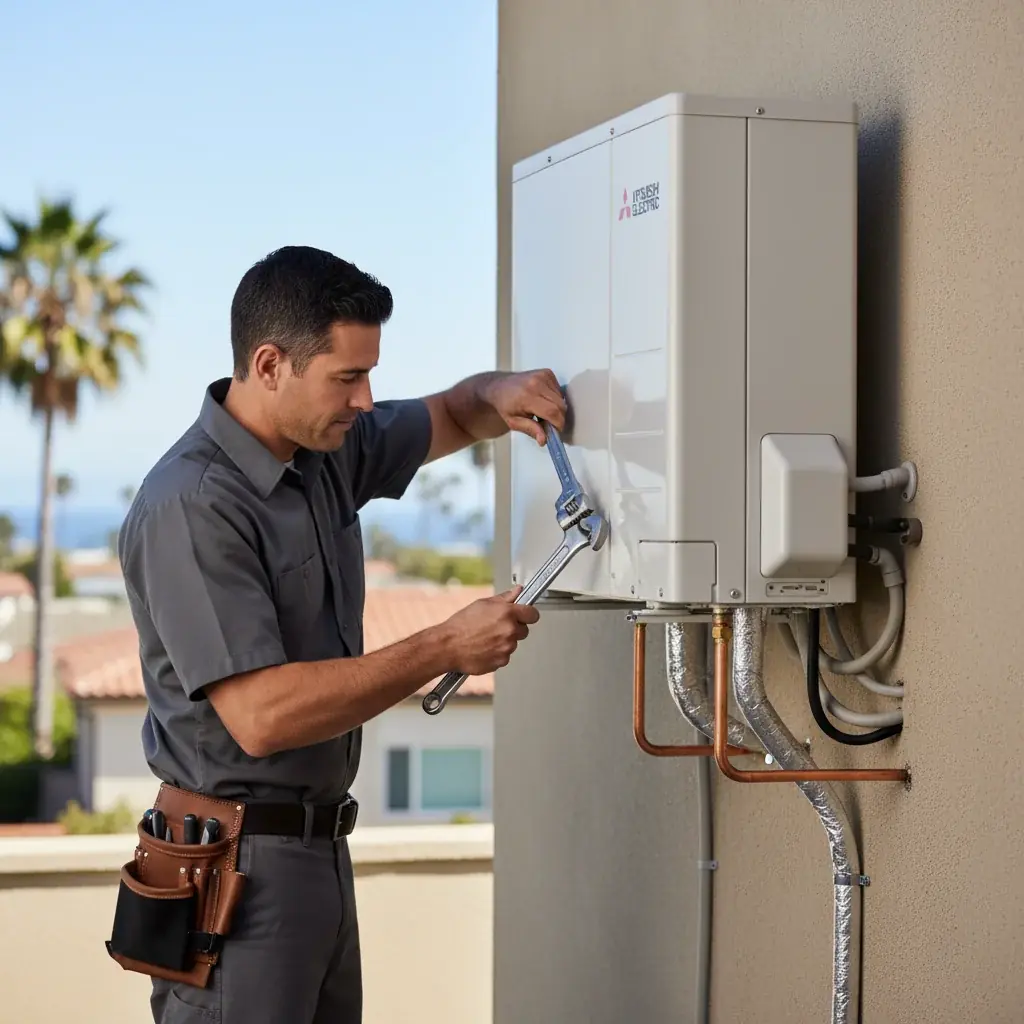
Decision framework: which bedroom fix do you need?
Work cheapest to most expensive, and only escalate if the cheaper step didn’t solve it.
Start here if:
- You’ve never tried a ceiling fan or have an old loud one: install a quiet DC-motor ceiling fan first. Test for two weeks.
- The bedroom is fine in winter but unbearable in summer afternoons: it’s a solar-gain problem. Window film plus blackout curtains first.
- The AC cools the whole house but the bedroom lags: it’s a thermostat-location problem. Add a remote sensor (Nest or Ecobee).
- The bedroom door is closed at night and the room won’t cool: it’s a return-airflow problem. Cut a transfer grille over the door, or add a jumper duct. A contractor prices that after seeing the door and return path.
- All of the above failed and it’s still 76 degrees at bedtime: it’s a capacity problem. A bedroom mini-split is the right answer.
- It’s a guest room or detached primary suite that’s far from the central AC: skip the smaller fixes. Mini-split.
Don’t:
- Don’t close vents in other rooms to push more air to the bedroom. It damages the system without helping.
- Don’t buy a portable AC. They vent heat back into the room they’re cooling, use a lot of electricity, and are loud enough to wreck sleep.
- Don’t oversize a mini-split. A 24,000 BTU unit in a 300-square-foot bedroom will short-cycle, sound louder, and dehumidify poorly. Match the BTU to the room.
FAQs
What temperature should my bedroom be for sleep in San Diego?
65 to 68 degrees Fahrenheit, per the National Sleep Foundation and most sleep research. Core body temperature drops 1 to 2 degrees as you fall asleep, and a cooler bedroom helps that happen faster. Above 75 degrees you’ll see longer sleep latency, less REM, and more overnight wake events. In inland San Diego, getting a bedroom into the 65-to-68 range in summer almost always requires mechanical cooling.
Why is my bedroom hotter than the rest of the house?
Three usual causes: it’s the farthest room from the AC and the duct run loses cooling capacity along the way, it faces west and absorbs afternoon solar heat, or the thermostat is somewhere cooler and shuts the system off before the bedroom catches up. Closed bedroom doors with no return airflow make all three worse.
Will a smart thermostat fix my hot bedroom?
It can, especially the Nest Learning Thermostat or Ecobee paired with a remote sensor placed in the bedroom. The remote sensor tells the system to control off the bedroom temperature at night instead of the hallway, which directly fixes the most common cause of a hot bedroom in San Diego homes. Ask the matched contractor for a written thermostat-plus-sensor quote if you need a C-wire.
How much does a bedroom mini-split cost in San Diego?
Climate Pros SD does not publish a single-zone bedroom install price. A 9,000-to-12,000 BTU unit from a major brand (Mitsubishi, Daikin, LG) includes the outdoor condenser, indoor wall head, line set, condensate drain, electrical disconnect, and start-up. Heat-pump heating is included in the same equipment. Get the number after a site visit.
Can I cool just one bedroom without affecting the rest of the house?
Yes. A ductless mini-split is the cleanest way. It’s a completely separate system with its own thermostat and zero impact on your central AC. A window AC is the cheap version but loud and inefficient. A portable AC is the worst option because it vents the heat it removes back into the room it’s cooling.
Do ceiling fans actually cool the room?
No. Ceiling fans move air, which makes occupants feel 2 to 4 degrees cooler at skin level, but they don’t change the room temperature. Because of that, leaving a ceiling fan running in an empty room wastes electricity. Run it only when the room is occupied, and pair it with the AC set 2 to 3 degrees warmer than usual.
Get a free bedroom comfort assessment
Pinpointing why one specific room runs hot takes a walk-through. Duct runs, return paths, solar exposure, and thermostat location all factor in. We’ll match you with a licensed pro who can find the cheapest fix that actually works. Call us at (442) 777-6440 to get matched with a vetted pro for an estimate, or see our mini-split installation service for ductless options.
Related services: AC installation and AC repair.