A high-pitched squeal from your AC almost always points to one of three things in San Diego homes: failing motor bearings (most common), a slipping belt on an older furnace blower (rare now), or a refrigerant high-pressure relief discharging from an overpressurized system. The fix and the cost are different for each. Don’t keep running a squealing unit. The sound means a mechanical part is on the edge of seizing, and a seized motor turns a motor visit into a compressor bid.
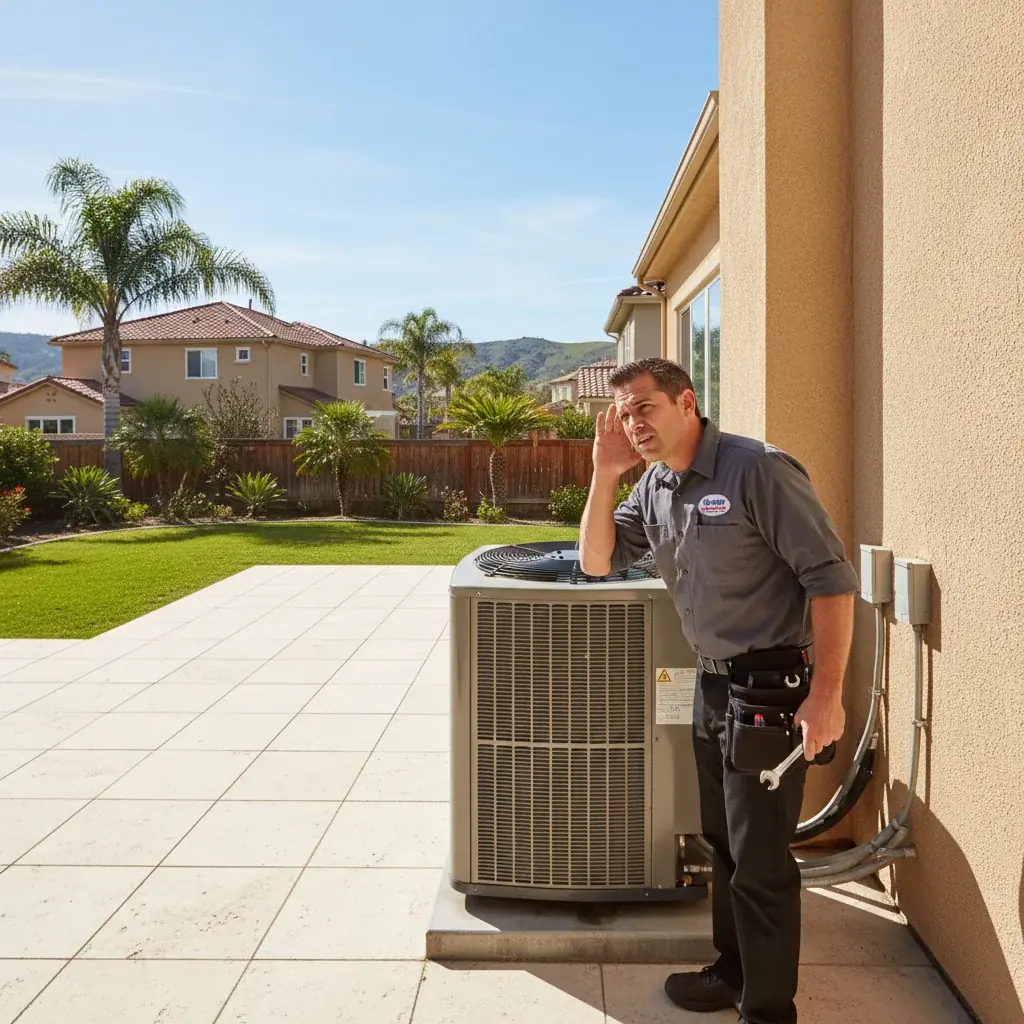
The three real causes of an AC squealing noise
Most internet content lumps every squeal into “it’s the belt.” That advice is 20 years out of date. Modern San Diego HVAC systems built since around 2005 are almost all direct-drive, no belts involved. Here’s the actual breakdown of what turns up on service calls in San Diego County.
Failing motor bearings (about 70 percent of squeal calls). Your AC has two motors that can squeal: the outdoor condenser fan motor and the indoor blower motor inside the furnace or air handler. Both spin on sealed bearings. When those bearings lose lubrication or wear out, the metal-on-metal friction produces a piercing squeal that gets worse the longer the motor runs. Coastal San Diego homes from La Jolla to Encinitas burn through fan motors faster than inland homes because salt air corrodes the bearing housing from the outside in. Coastal motors fail at 8 to 12 years, inland motors at 12 to 18.
Refrigerant high-pressure release (about 20 percent). If your system is overcharged with refrigerant, has a clogged condenser coil, or has lost airflow across the outdoor coil, internal pressure climbs above safe limits. A safety valve opens and discharges, producing a short, sharp squeal or hiss. You’ll usually hear it once when the unit cycles on, not continuously. If you’re hearing this on Santa Ana days when the outdoor temp tops 95, it’s almost always a dirty condenser coil starved for airflow. A good wash-down restores normal operation.
Belt-driven blower in an older system (about 10 percent). If your furnace or air handler is from before 2000 and still has the original blower assembly, it may have a belt connecting the motor to the blower wheel. A worn or slipping belt squeals on startup and during high-load operation. The fix is a belt and a short visit. Almost everything installed in San Diego in the last 20 years is direct-drive.
The diagnostic sequence: do this before saying yes to a repair
Use this order. It catches the cheap problems first and avoids being upsold on a motor when the issue is a capacitor.
- Identify which unit is squealing. Stand next to the outdoor condenser. If the squeal is loud there and quiet inside, it’s the condenser fan motor. If it’s loud at a supply register or near the furnace closet, it’s the indoor blower. Squealing from both means a system-wide pressure issue.
- Check the timing. A squeal that happens only on startup and clears within 10 seconds is usually a bearing on its way out but not yet critical. A continuous squeal that gets louder as the unit runs is an active failure. A one-time squeal with a hiss is a pressure release.
- Cut the power and spin the fan by hand. With the breaker off, push the outdoor fan blade. It should spin freely for 3 to 5 rotations. If it stops within one rotation, grinds, or wobbles, the bearings are gone. This is a field test that tells you what’s coming.
- Look at the outdoor coil. Hose down the condenser fins from the inside out (with power off). A coil clogged with grass, jacaranda blossoms, or coastal salt buildup throttles airflow and triggers pressure events. This shows up constantly in San Diego homes that landscape close to the condenser.
- Skip the belt check unless your system is from the 1990s. If your AC was installed by SDG&E rebate programs after 2005, there is no belt.
If steps 1 through 4 don’t identify the cause, you need a technician with a manifold gauge to check refrigerant pressures and a multimeter to test the capacitor. Both jobs take a tech about 20 minutes.
What to ask for on the quote
Climate Pros SD does not publish a squeal-repair menu. National repair sites quote averages that skip San Diego labor and coastal access. Ask the matched licensed contractor for named lines:
Outdoor condenser fan motor. Motor, labor, and a new capacitor (always replace the cap with the motor; they’re matched pairs).
Indoor blower motor. More access time because the air handler usually has to be partly disassembled.
Belt (legacy systems). Belt plus labor. Almost nothing installed here in the last 20 years still uses one.
Condenser coil cleaning when the squeal is a pressure event. Worth doing every 2 years on coastal homes, every 3 to 4 years inland.
Capacitor when it tests out of spec, often on the same visit as a motor.
If a tech quotes you a full compressor replacement based on a squealing diagnosis, get a second opinion. Compressors don’t squeal , they hum, knock, or fail to start. A squeal pointing to a compressor diagnosis is usually a misread.
When to shut the system off and when to keep running
Shut it off immediately if:
- The squeal is continuous and getting louder as the unit runs
- You smell anything burning, even faintly
- The outdoor fan stops spinning at any point
- You hear the squeal paired with a thump or knock
Keep running, but schedule service within a week, if:
- The squeal happens only on startup and clears in 10 seconds
- The unit is otherwise cooling normally
- You haven’t heard any other unusual sounds
Squealing rarely fails over a weekend. But a seized motor on a 95-degree Santa Ana day leaves you without cooling while you wait on a part. Book on your schedule, not under after-hours rates. Climate Pros SD does not promise same-day arrival.
FAQs
Can I just spray WD-40 on a squealing AC motor?
No. Modern AC motors use sealed bearings , there’s no port to lubricate. Spraying WD-40 on the motor housing does nothing useful, and the propellant can damage rubber seals on the capacitor and contactor. If a motor needs lubrication, it needs replacement.
Is a squealing AC dangerous to keep running?
Not in the sense of fire or electrical danger if the unit was properly installed. But it’s dangerous to the system itself. A failing bearing can seize at any moment, and a seized motor pulls high amperage that often takes out the capacitor, the contactor, and sometimes the compressor. The longer you run a squealing unit, the more parts you replace.
How long does an AC fan motor replacement take?
A standard outdoor condenser fan motor swap takes 1 to 2 hours. Indoor blower motors take 2 to 3 hours because the air handler has to be partly opened up. Many shops carry common motor sizes on the truck. The matched company confirms timing; this brand does not.
Why does my AC only squeal in the morning when it first turns on?
Cold-start squeals are usually early-stage bearing wear. The bearing grease hasn’t warmed up yet, so the friction is at its highest. As the motor runs and the housing warms, the squeal fades. This is the warning phase. You probably have 2 to 6 months before the motor fails completely. Replace it on your schedule, not on a 95-degree afternoon.
Does coastal San Diego eat AC motors faster than inland areas?
Yes, significantly. Salt air corrodes the motor housing and bearing seals. Motors get replaced on coastal homes in Encinitas, La Jolla, Carlsbad, and Pacific Beach at 8 to 12 years. Inland homes in El Cajon, Escondido, and Santee average 12 to 18 years. If you live within 2 miles of the coast, plan on a motor replacement before the unit’s 12th birthday.
Will a squealing AC raise my SDG&E bill?
Yes, but not as much as people think. A struggling motor pulls 10 to 25 percent more amperage than a healthy one. On a typical San Diego home running AC 4 to 6 hours a day in summer, that extra draw shows up on the SDG&E bill. The bigger cost is the collateral damage when the motor finally fails and takes other components with it. Ask the matched company to compare kWh if you want numbers for your house.
Get the diagnosis right before the squeal becomes a no-cool
A squealing AC is the cheaper version of the problem you’re about to have. Replacing a fan motor on your schedule beats a seized motor plus a capacitor plus an after-hours visit in August. If you’re hearing a squeal that doesn’t clear within 10 seconds of startup, get it looked at this week.
Related reading on AC noises and diagnostics:
- AC making loud noises: a full sound-by-sound guide
- AC fan motor not spinning: causes and costs
- AC capacitor replacement in San Diego
For service, see AC repair or call (442) 777-6440 to get matched. Climate Pros SD does not dispatch a truck, does not offer a free diagnosis, and does not promise same-day arrival.
Related services: AC installation and HVAC maintenance. Not sure this is your symptom? Our HVAC symptom finder matches what the system is actually doing to the likely cause.