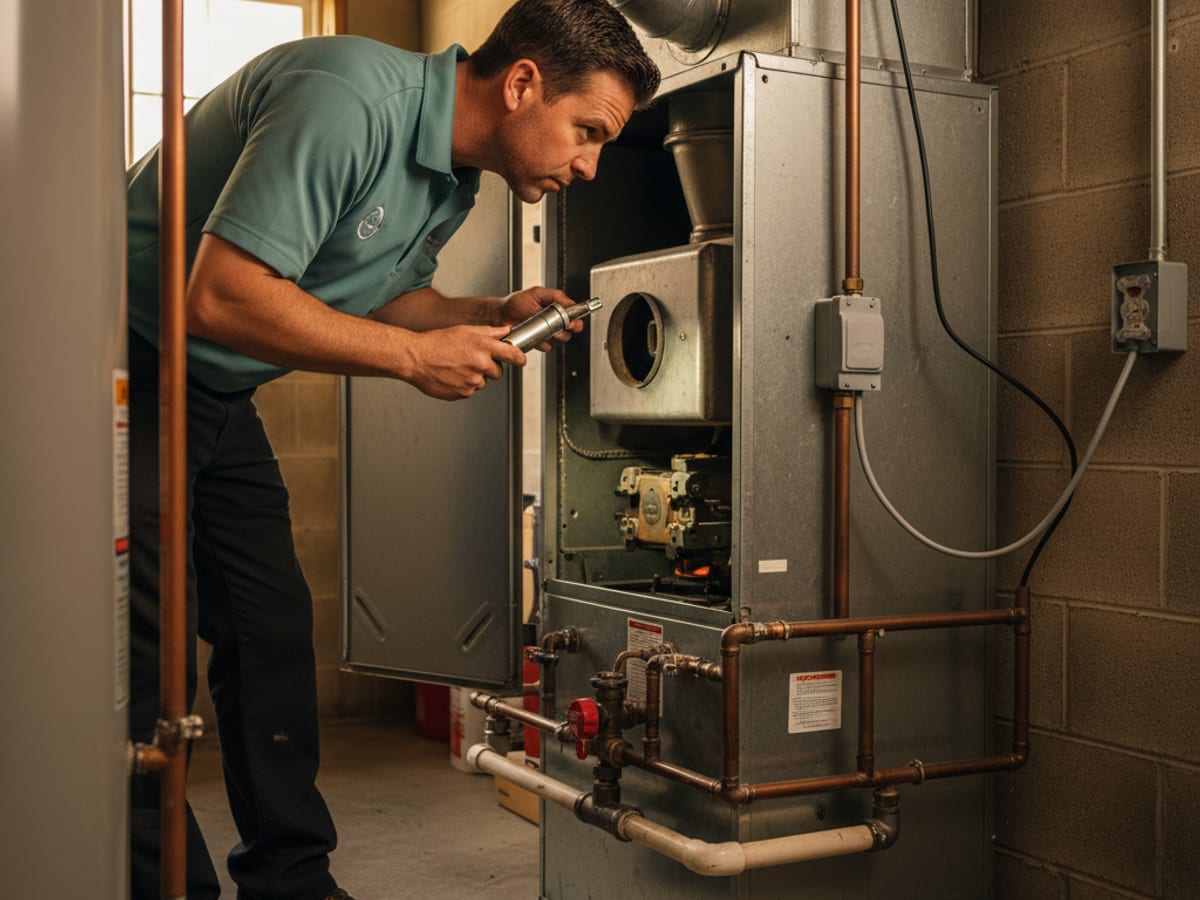
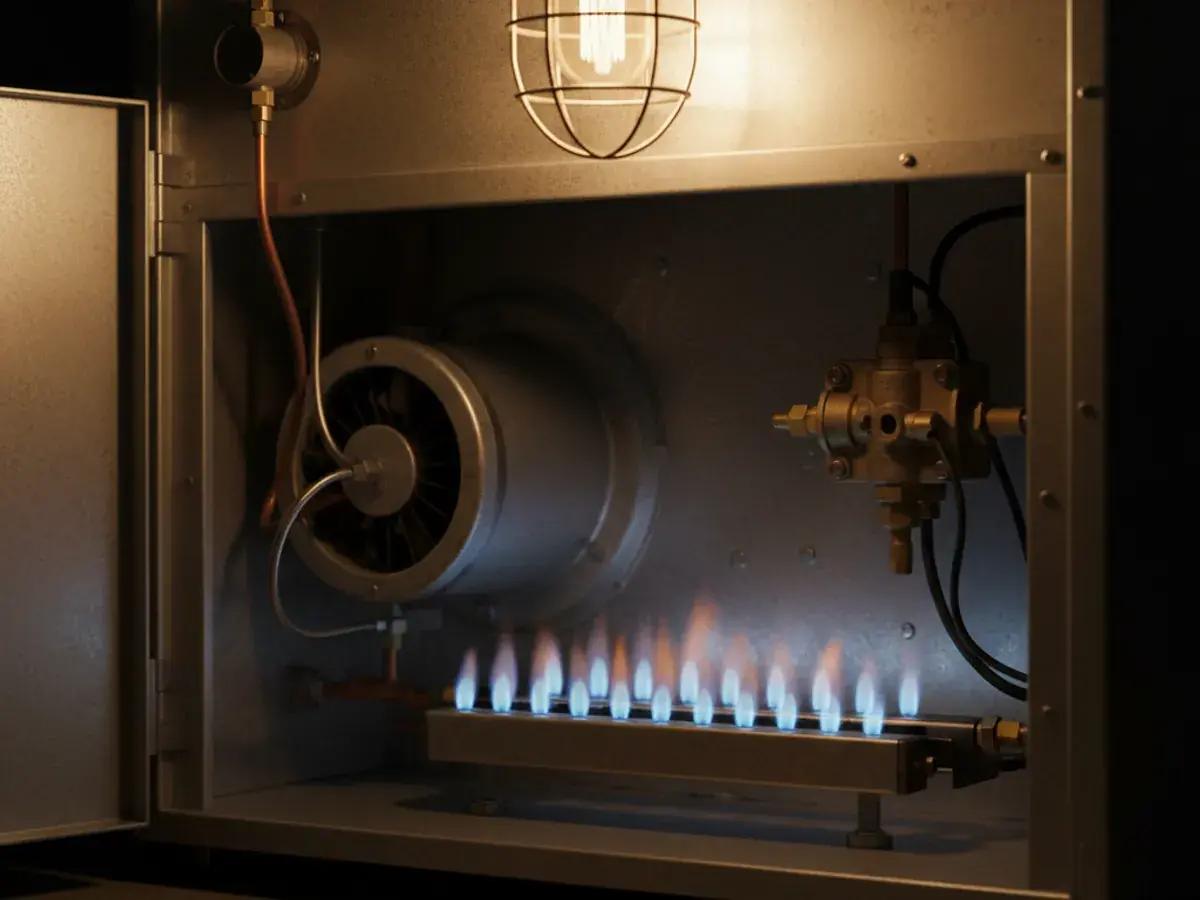
Furnace repair in Chula Vista starts with a diagnostic visit from the pro you are matched with, priced by that company. What the repair costs after that depends on the failed part, the brand, and whether the furnace is still under warranty. Ask the matched company which common parts they stock. A Chula Vista no-heat repair is only finished in one visit if that company has the part and confirms it in writing.
Chula Vista sits in South County, close to the bay and the border, and the winters here are mild. December and January highs sit in the low 60s, and overnight lows rarely touch freezing, though the inland eastern hills run cooler than the bayside west side. The furnace sits idle most of the year, then gets asked to run on the first cool morning. Igniters that grew brittle while idle, flame sensors crusted with residue, and seized blower bearings all surface in that first cold snap. The furnace did not break overnight. It broke months ago and you just found out.
Matching covers homes across Chula Vista. That includes the older 1950s and 1960s homes on the west side near Third Avenue and F Street, the 1970s and 1980s neighborhoods around Rancho del Rey and Bonita-adjacent streets, the master-planned communities in EastLake and Otay Ranch, and the newer builds toward Millenia. Ask the matched company how they price an address in Chula Vista.
Should you repair or replace your furnace?
Repair makes sense when the fix costs less than half the price of a new system. Replace when the unit is older, when the heat exchanger is cracked, or when repairs are stacking up. A few simple rules help you decide.
The 50% rule
If a repair costs more than half the price of a new furnace, replacement is the better money. A heat exchanger swap on an older unit is a clear replace. A minor part like an igniter on a newer furnace is a clear repair.
The 5,000 rule
Multiply the age of the furnace by the repair cost. If the result is over 5,000, replacement is likely the better move. An old furnace with even a moderate repair bill scores high and points toward replacement. A young furnace with the same repair scores low and points toward repair.
A cracked heat exchanger ends the conversation
A cracked heat exchanger is a carbon monoxide risk, and the matched company may red-tag the furnace when they find one. On an older unit the exchanger alone often costs as much as a new furnace, so replacement is almost always the call. On a newer furnace still under warranty, the part may be covered, though labor is not.
The heat pump option
San Diego's mild winters make this the right time to ask whether you need a gas furnace at all. A heat pump heats and cools from one unit, costs less to run, and may qualify where an SDG&E offer is open. The matched company should quote the furnace repair number, the furnace replacement number, and the heat pump number, then let you decide.
Local angle Furnace repair built for Chula Vista homes
Why Chula Vista furnaces fail the way they do
Chula Vista sits in South County, near San Diego Bay, and the winters are mild. Daytime highs stay in the low 60s through December and January, and overnight lows rarely touch freezing. The bayside west side runs slightly warmer, while the eastern hills around EastLake and Otay Ranch can be a few degrees cooler in the morning. A furnace here might run only a few weeks a year.
That light duty cycle is the real problem. A furnace that sits idle from spring through fall collects dust on the burners, lets the igniter grow brittle, and gives moisture a chance to corrode the flame sensor. The first cold snap puts all of that to the test at once. Most Chula Vista no-heat calls are not from a worn-out furnace. They are from a furnace that sat too long and was never checked before the season.
The local housing stock
Chula Vista splits cleanly between an older west side and a newer east side, and the era guides the diagnostic. West of Interstate 805, near Third Avenue, F Street, and the older downtown grid, you find 1950s and 1960s homes where the original furnace has been replaced once or twice, often in a hallway closet or garage on a single-stage burner. South County also has a high share of rental and military-adjacent housing, where furnaces see hard use and deferred maintenance.
East of the 805, Rancho del Rey filled in through the 1980s and 1990s, and EastLake, Otay Ranch, and Millenia are master-planned communities built from the late 1990s onward. Those newer homes run higher-efficiency furnaces with sealed combustion, which bring their own pressure switch and condensate faults. Many sit in HOA neighborhoods with specific access and equipment rules. We match the diagnostic to the home in front of us.
Permits and rebates in Chula Vista
A straight furnace repair does not need a permit. Replacing the furnace does. The City of Chula Vista normally requires a mechanical permit through its Development Services Department for a furnace changeout, and that permit gets pulled as part of the job so the work is inspected and on record.
If you do end up replacing and an SDG&E offer is open, it is typically strongest for heat pump systems rather than gas furnaces. The matched company should walk you through what your home and system actually qualify for. Ask for the offer amount in writing rather than a rounded verbal figure.
How a visit is scheduled
Say that the heat is out, plus whether anyone is vulnerable to cold. The matched company confirms whether they can take the job, when they can arrive, and any outside-hours fee. Climate Pros SD does not run a dispatch desk or promise same-day or 24/7 service.
Gravity-vent furnaces and floor units in west Chula Vista
A real share of homes west of the 805, especially the 1950s and 1960s tract houses around Castle Park, Otay, and the older Broadway corridor, still have gravity-vent furnaces or original floor furnaces. They were never high-efficiency, the heat exchangers are reaching end of life, and replacement parts are getting hard to source. When one of those units fails, the diagnostic conversation is short. The honest call is almost always replacement, not repair.
The right replacement for a gravity-vent home is often not a like-for-like furnace. Many of those houses have undersized or no ductwork, and converting to a heat pump with a small-diameter or mini-split distribution can be cheaper than retrofitting a high-efficiency furnace into a gravity-vent flue. The matched company should quote both numbers when the time comes. If the unit is still working and only needs a minor repair, we will do that too. We do not push replacements on customers who do not need them.
Eastlake and Otay Ranch: 1990s and 2000s sealed-combustion failures
Eastlake, Otay Ranch, Rolling Hills Ranch, and Millenia run high-efficiency, sealed-combustion furnaces installed during the 1990s and 2000s buildout. Those units bring a different failure pattern than the older west-side equipment. The most common no-heat calls here are pressure switch faults from a blocked PVC vent, condensate trap blockages that flood the inducer, and cracked secondary heat exchangers on units that have been running for 15 to 25 years.
The vent and condensate side is fixable on the first visit. A cracked secondary heat exchanger usually is not, because parts on older units have lead times that run weeks and labor on the swap eats most of a replacement cost. When the matched company may red-tag a secondary heat exchanger on an Otay Ranch furnace, the heat pump conversion conversation becomes the practical option, and the rebates make the math better than it looks at first.
Bilingual service across South Bay
Chula Vista is bilingual, and a no-heat call in winter is exactly the kind of stressful conversation where language barriers matter. Ask whether the matched company can take the call in Spanish. Diagnostic findings, the repair quote, and any safety red-tag should be explained in whichever language is easier for the household. Climate Pros SD does not run a dispatch desk.
Typical repair cost by Chula Vista neighborhood
Repair mix still shifts by neighborhood, but the repair mix shifts by neighborhood because the equipment is different. West of the 805, calls tend toward gravity-vent units at end of life, older 80% AFUE furnaces with igniter and flame sensor failures, and floor furnaces with corroded burners. Older parts availability tends to push these tickets toward the higher end.
In Eastlake and Otay Ranch, calls tend toward pressure switch and condensate faults on 90%+ AFUE sealed-combustion units, and cracked secondary heat exchangers on the oldest of those installs. A secondary exchanger involved in the repair pushes the ticket higher. Diagnostic and repair pricing are the same in every neighborhood, and any repair quote comes before any work starts.
What else is furnace repair in Chula Vista called?
Homeowners search for this a few different ways. In Chula Vista it also goes by heating repair in Chula Vista , gas furnace repair in Chula Vista , furnace service and repair in Chula Vista , furnace maintenance in Chula Vista , furnace replacement in Chula Vista , and heating service in Chula Vista . They all reach the same licensed local pros, and the operator who answers will
sort out which one your job actually is.