A hissing AC is the one noise that usually means call now, not later. In a San Diego home, hissing almost always means refrigerant is escaping under pressure. The quote depends on one critical question: is your system running R-22 or R-410A? R-22 systems are pre-2010. The refrigerant itself is restricted and wholesale pricing has climbed a lot since 2015. R-410A is standard for modern systems and the same labor steps usually land lower because the gas is still common. Less commonly, hissing comes from a high-pressure relief discharge or a failing internal valve. Here’s how to tell which one you have. Climate Pros SD does not publish those job bands.
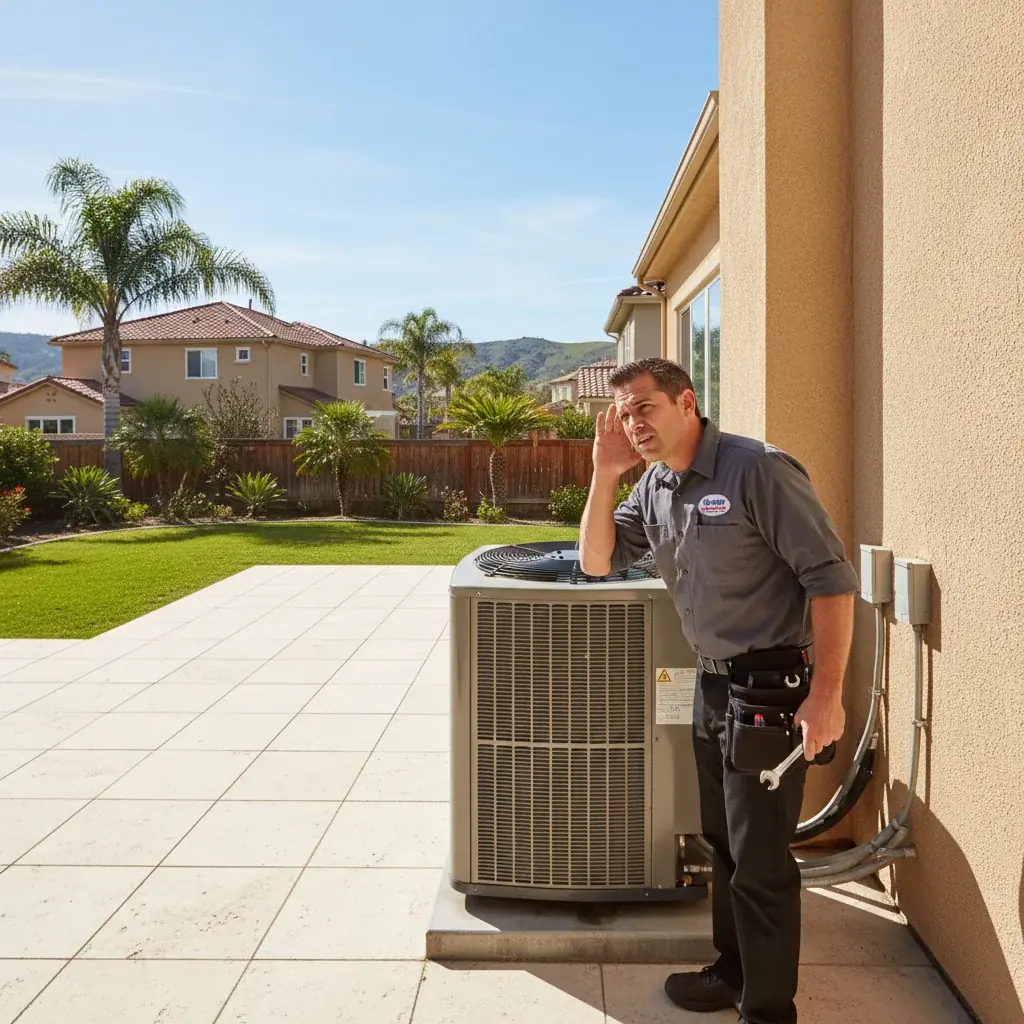
The three causes of an AC hissing noise
These are listed in order of how often we see them on San Diego service calls.
Refrigerant leak (about 80 percent of hissing calls). Refrigerant moves through copper lines under 100 to 400 psi of pressure depending on the system state. When a pinhole, corroded section, or vibration crack develops in the line set, evaporator coil, or condenser coil, the escaping refrigerant produces a steady, soft hiss. The leak gets larger over time, and the hiss gets louder. Coastal San Diego homes from Encinitas to Imperial Beach see evaporator coil leaks faster than inland because salt air promotes formicary corrosion, a microscopic pitting that perforates copper from the inside out. We see coastal coils leaking at 8 to 12 years, inland coils at 14 to 20.
High-pressure relief valve discharge (about 15 percent). If your system is overcharged with refrigerant, or the condenser coil is so dirty that heat can’t escape, internal pressure climbs past safe limits. A safety valve opens and discharges, producing a short, sharp hiss-and-pop on startup or during peak heat. You’ll usually hear it once per cycle, not continuously. The fix is condenser cleaning or a refrigerant adjustment. Ask for those as named lines.
Failing internal valve or service port (about 5 percent). The Schrader valves on the refrigerant service ports can develop slow leaks, especially after a recent service call where a tech didn’t properly seat the cap. Compressor internal valves (reed valves, expansion valves) can also crack and produce a hiss from inside the outdoor cabinet. These are uncommon but worth a tech ruling out.
R-22 vs R-410A: why it matters so much for the cost
You need to know which refrigerant your system uses before you authorize any leak repair. Look at the data plate on the outdoor unit, it’s a metal sticker on the side of the cabinet with the model number and refrigerant type listed.
R-22 systems (pre-2010, sometimes called Freon). The EPA phased out R-22 production in 2020. Existing stockpiles still circulate, but pricing has climbed a lot since 2015. A typical 3-ton San Diego home holds 6 to 9 pounds, so refrigerant alone can dominate the invoice before labor. Add leak detection, repair, and labor as separate lines. For R-22 systems older than 12 years, the math usually points to system replacement rather than repair. Confirm live SDG&E heat pump rebates at quote time. The federal 25C tax credit ended for systems installed after December 31, 2025.
R-410A systems (2010 to 2024). Standard for nearly every San Diego HVAC system installed in the last 15 years. Wholesale R-410A is still common. Ask for leak search, repair, and recharge as named lines. Worth fixing on systems up to about 12 years old. Past that, evaluate against replacement.
R-454B systems (2025 and newer). The new EPA-mandated low-GWP refrigerant phasing in now. Pricing is still settling. Fewer techs are trained on it yet, so service can run higher. Ask for a 454B leak repair as a named bid in 2026.
If you don’t know what you have, look at the outdoor unit data plate. If you see “R-22” or “HCFC-22,” that’s the old stuff. If you see “R-410A” or “HFC-410A,” that’s the standard modern refrigerant. If you see “R-454B” or “Puron Advance,” that’s the newest.
The diagnostic sequence
Don’t authorize a leak repair without these steps completed first.
- Confirm it’s actually a hiss, not a squeal or a bang. Hisses are steady, soft, and continuous during operation. Squeals are high-pitched and pulse with motor rotation. Bangs are intermittent and percussive.
- Locate the source. Walk along the refrigerant lines, they’re the two copper lines wrapped in foam insulation running from the indoor unit to the outdoor condenser. Hiss usually localizes to one section. Check the service valves on the outdoor unit. Check the evaporator coil access panel on the air handler or furnace.
- Look for other leak signs. Ice on the refrigerant lines or evaporator coil. AC running but not cooling well. Higher SDG&E bills than the same month last year. Oil residue near a copper joint (refrigerant oil leaks with the gas). If you see any of these along with hissing, leak is confirmed.
- Check when the hiss happens. Continuous during runtime equals active leak. Once on startup equals pressure relief. Once on shutdown equals normal pressure equalization (this is fine, not a problem).
- Don’t try to “top off” the refrigerant yourself. Even if you can find a refrigerant kit online, recharging without finding and fixing the leak is illegal under EPA Section 608, wastes the new refrigerant within weeks, and stresses the compressor in the meantime.
Why coastal San Diego sees more refrigerant leaks
Formicary corrosion is the technical term, a microscopic, ant-tunnel-like corrosion pattern in copper that’s accelerated by formic acid in salt air, certain household VOCs, and cleaning chemicals. Coastal San Diego (anywhere within 3 miles of the ocean) sees this faster than inland. The evaporator coil sits in the air handler and is exposed to whatever’s in the home’s air, plus moisture from the cooling process. Coils typically develop pinhole leaks at 8 to 12 years coastally, 14 to 20 years inland.
Aluminum evaporator coils (standard in most systems since around 2015) resist formicary corrosion better than older all-copper coils. If you have a 2015-or-newer system in a coastal home, your odds are better.
What to ask for on the quote
Climate Pros SD does not publish a hiss-repair menu. Ask the matched licensed contractor for:
R-410A leak repair (modern systems): leak detection (electronic or UV dye); repair at an accessible joint or valve; evaporator coil work plus refrigerant if that is where it is; recharge by weight. Those are different tickets.
R-22 leak repair (pre-2010 systems): same labor steps. Refrigerant alone can dominate. Consider system replacement. Confirm live SDG&E heat pump rebates. The federal 25C tax credit ended for systems installed after December 31, 2025.
Evaporator coil replacement: often the right call when a leak is in the coil itself rather than a line joint. R-22 coil jobs include scarce refrigerant. Ask for coil vs full system on the same visit.
Condenser cleaning for pressure-relief hisses.
When to shut the system off
Shut off immediately if:
- You smell anything sweet, chemical, or ether-like (refrigerant leak in a confined space)
- The hiss is loud and the unit isn’t cooling at all
- Ice has formed on the refrigerant lines or indoor coil
- The hiss is coming from inside the home, not just the outdoor unit
You can usually keep running short cycles until the service call if:
- The hiss is faint, only audible right next to the unit
- The system is still cooling reasonably
- You’ve scheduled the repair within 48 hours
Refrigerant in normal residential quantities isn’t acutely toxic, but it displaces oxygen in enclosed spaces and shouldn’t be inhaled directly. If you can smell it inside, ventilate and shut the system off.
FAQs
Is a hissing AC dangerous to my family’s health?
In a well-ventilated home, no. R-410A and R-454B are non-toxic in normal indoor concentrations. R-22 is similar. The bigger health concern is the secondary moisture and humidity problems that come with a system that can’t cool properly, a leaking system that ices up can spill water into the home and grow mold. If you can smell refrigerant inside, ventilate and call for service.
Can I add refrigerant myself to a hissing AC?
No. EPA Section 608 makes it illegal to handle refrigerant without certification, and “topping off” without finding the leak wastes the new charge within weeks. The compressor also runs hot on low refrigerant and the damage adds up fast. The “AC recharge kits” sold at auto parts stores are for car AC systems, not home HVAC.
How long can my AC run with a small refrigerant leak?
A small leak might let you finish out the cooling season at reduced efficiency, but the compressor is being damaged the whole time. We’ve seen homeowners ignore small leaks for 2 or 3 summers and then face a compressor replacement instead of a leak repair. Fix it the same season you notice it.
Will my SDG&E bill go up with a refrigerant leak?
Yes, noticeably. A system that’s 15 percent low on charge runs 25 to 40 percent longer per cooling cycle to deliver the same comfort. On a typical San Diego home running AC 4 to 6 hours a day in summer, that extra runtime shows up on the SDG&E bill. Compare your kWh to last summer. The bill increase often pays for the repair within a season once you have a real quote.
How long does an AC leak repair take?
Most accessible leaks (line joint, service valve, Schrader port) take 2 to 4 hours: locate, repair, evacuate, recharge, leak-test. Evaporator coil leaks take 4 to 8 hours because the coil has to be pulled and reinstalled. R-410A jobs with an accessible leak are usually wrapped up in a single visit. R-22 jobs sometimes wait a day for refrigerant supply.
Should I just replace my R-22 system instead of fixing the leak?
For R-22 systems over 12 years old, yes, usually. Put the leak-repair quote next to a heat pump replacement quote on the same visit. A 14-year-old unit is already less efficient than current minimums. Confirm live SDG&E incentives. The federal 25C credit ended for systems installed after December 31, 2025.
Hissing is the one to act on fast
A squeal or rattle can usually wait a week. A hiss can’t. Every day a refrigerant leak runs, the compressor is being damaged and the SDG&E bill is climbing. Get a confirmed diagnosis, get a repair quote, and if it’s an R-22 system, get a replacement quote next to it before deciding.
Related reading:
- AC making loud noises: a full sound-by-sound guide
- AC refrigerant leak signs and repair costs in San Diego
- AC not blowing cold air: causes and fixes
See AC repair or call (442) 777-6440. If you’re weighing repair vs. replacement on an older R-22 system, ask the matched company for both quotes side by side. Climate Pros SD does not dispatch a truck, does not offer a free diagnosis, and does not promise same-day arrival.
Related services: AC installation and HVAC maintenance. Not sure this is your symptom? Our HVAC symptom finder matches what the system is actually doing to the likely cause.